As of February 2026, the global computing landscape has been fundamentally reshaped by a single piece of silicon: NVIDIA’s (NASDAQ: NVDA) Blackwell architecture. What began as a bold announcement in 2024 has matured into the backbone of the "AI Factory" era, providing the raw horsepower necessary to transition from simple generative chatbots to sophisticated, reasoning-capable "Agentic AI." By packing a staggering 208 billion transistors into a unified dual-die design, NVIDIA has effectively shattered the physical limits of monolithic semiconductor manufacturing, setting a new standard for high-performance computing (HPC) that rivals the total output of entire data centers from just a few years ago.
The significance of Blackwell in early 2026 cannot be overstated. It is the first architecture to make trillion-parameter models—once the exclusive domain of research experiments—a practical reality for enterprise deployment. This "AI Superchip" has forced a total re-engineering of the modern data center, moving the industry away from traditional air-cooled server racks toward massive, liquid-cooled "Superfactories." As hyperscalers like Microsoft (NASDAQ: MSFT), Meta (NASDAQ: META), and Alphabet (NASDAQ: GOOGL) race to expand their Blackwell Ultra clusters, the tech world is witnessing a shift where the "computer" is no longer a single server, but a 140kW liquid-cooled rack of interconnected GPUs functioning as a singular, cohesive brain.
Engineering the 208-Billion Transistor Monolith
At the heart of the Blackwell achievement is the move to a "reticle-limited" dual-die chiplet design. Because semiconductor manufacturing equipment cannot physically print a single chip larger than approximately 800mm², NVIDIA’s engineers utilized two maximum-sized dies manufactured on a custom TSMC (NYSE: TSM) 4NP process. These two dies are unified by the NV-HBI (High-Bandwidth Interface), a 10 TB/s interconnect that provides such low latency and high throughput that the software layer views the dual-die assembly as a single, monolithic GPU. This avoids the "numa-effect" or memory fragmentation that typically plagues multi-chip modules, allowing for 192GB to 288GB of HBM3e memory to be accessed with zero performance penalty.
Technically, Blackwell differentiates itself from its predecessor, the H100 (Hopper), through its second-generation Transformer Engine. This engine introduces support for FP4 (4-bit Floating Point) precision, a breakthrough that effectively doubles the compute throughput for large language model (LLM) inference without a proportional increase in power or accuracy loss. Initial reactions from the AI research community in 2025 and 2026 have highlighted that this transition to lower precision, coupled with the massive transistor count, has allowed for 25-fold reductions in cost and energy consumption when running massive-scale inference compared to the previous generation.
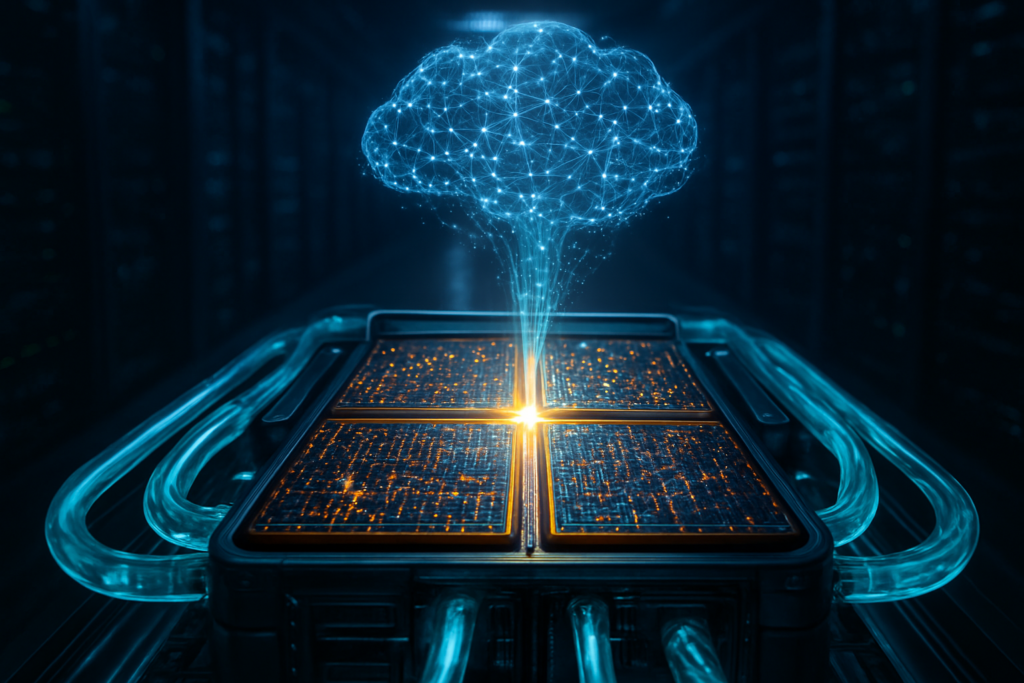
This architectural shift has also necessitated a radical approach to thermal management. The Blackwell Ultra (B300) variants, which are now being deployed in mass quantities, push the Thermal Design Power (TDP) to a massive 1,400W per GPU. This has rendered traditional air cooling obsolete for high-density AI clusters. The industry has been forced to adopt direct-to-chip (D2C) liquid cooling, where coolant is pumped directly over the silicon to dissipate the heat generated by its 208 billion transistors. This transition has turned data center plumbing into a high-stakes engineering feat, with coolants and distribution units (CDUs) now just as critical as the silicon itself.
Hyperscalers and the Rise of the AI Superfactory
The deployment of Blackwell has created a clear divide between "AI-rich" and "AI-poor" companies. Major cloud providers and AI labs, such as Amazon (NASDAQ: AMZN) and CoreWeave, have reorganized their capital expenditure strategies to build "AI Factories"—facilities designed from the ground up to support the power and cooling requirements of NVIDIA’s NVL72 racks. These racks, which house 72 Blackwell GPUs interconnected by the NVLink Switch System, act as a single 1.4 exaflop supercomputer. This level of integration has given tech giants a strategic advantage, allowing them to train models with 10 trillion parameters or more in weeks rather than months.
For startups and smaller AI labs, the Blackwell era has posed a strategic challenge. The high cost of entry for liquid-cooled infrastructure has pushed many toward specialized cloud providers that offer "Blackwell-as-a-Service." However, the competitive implications are clear: those with direct access to the Blackwell Ultra (B300) hardware are the first to market with "Agentic AI" services—models that don't just predict the next word but can reason, use external software tools, and execute multi-step plans. The Blackwell architecture is effectively the "gating factor" for the next generation of autonomous digital workers.
Furthermore, the market positioning of NVIDIA has never been stronger. By controlling the entire stack—from the NV-HBI chiplet interface to the liquid-cooled rack design and the InfiniBand/Ethernet networking (ConnectX-8)—NVIDIA has made it difficult for competitors like AMD (NASDAQ: AMD) or Intel (NASDAQ: INTC) to offer a comparable "system-level" solution. While competitors are still shipping individual GPUs, NVIDIA is shipping "AI Factories," a strategic move that has redefined the expectations of the enterprise data center market.
Scaling to Trillions: The Societal and Trends Impact
The transition to Blackwell marks a pivotal moment in the broader AI landscape, signaling the end of the "Generative" era and the beginning of the "Reasoning" era. Trillion-parameter models require a level of memory bandwidth and inter-gpu communication that only the NVLink 5 and NV-HBI interfaces can provide. As these models become the standard, we are seeing a trend toward "Physical AI," where these massive models are used to simulate complex physics for robotics and drug discovery, far surpassing the capabilities of the 80-billion transistor Hopper generation.
However, the massive 1,400W TDP of these chips has raised significant concerns regarding global energy consumption. While NVIDIA argues that Blackwell is 25x more efficient per watt than previous generations when running specific AI tasks, the sheer scale of the "Superfactories" being built—some consuming upwards of 100 megawatts per site—is straining local power grids. This has led to a surge in investment in modular nuclear reactors (SMRs) and dedicated renewable energy projects by the very same companies (MSFT, AMZN, GOOGL) that are deploying Blackwell clusters.
Comparatively, the leap from the H100 to the B200 and B300 is often cited by industry experts as being more significant than the jump from the A100 to the H100. The move to a multi-die chiplet strategy represents a "completion" of the vision for a unified AI computer. In early 2026, Blackwell is not just a component; it is the fundamental building block of a new industrial revolution where data is the raw material and intelligence is the finished product.
The Horizon: From Blackwell Ultra to the Rubin Architecture
Looking ahead, the roadmap for NVIDIA is already moving toward its next milestone. As Blackwell Ultra becomes the production standard throughout 2026, the industry is already bracing for the arrival of the "Rubin" (R100) architecture, expected to debut in the latter half of the year. Named after astronomer Vera Rubin, this successor is rumored to move to a 3nm process and incorporate the next generation of High Bandwidth Memory, HBM4. While Blackwell paved the way for trillion-parameter training, Rubin is expected to target "World Models" that require even more massive KV caches and data pre-processing capabilities.
The immediate challenges for the next 12 to 18 months involve the stabilization of the liquid cooling supply chain and the integration of the "Vera" CPU—the successor to the Grace CPU—which will sit alongside Rubin GPUs. Experts predict that the next frontier will be the optimization of the "System 2" thinking in AI models—deliberative reasoning that requires the GPU to work in a loop with itself to verify its own logic. This will require even tighter integration between the dies and even higher bandwidth than the 10 TB/s NV-HBI can currently offer.
Ultimately, the focus is shifting from "more parameters" to "better reasoning." Future developments will likely focus on how to use the Blackwell architecture to distill the knowledge of trillion-parameter giants into smaller, more efficient edge models. However, for the foreseeable future, the "frontier" of AI will continue to be defined by how many Blackwell chips one can fit into a single liquid-cooled room.
A Legacy of Silicon and Water
In summary, the Blackwell architecture represents the pinnacle of current semiconductor engineering. By successfully navigating the complexities of a 208-billion transistor dual-die design and implementing the high-speed NV-HBI interface, NVIDIA has provided the world with the necessary infrastructure for the "Trillion-Parameter Era." The transition to 1,400W liquid-cooled systems is a stark reminder of the physical demands of digital intelligence, and it marks a permanent change in how data centers are designed and operated.
As we look back at the development of AI, the Blackwell launch in 2024 and its mass-deployment in 2025-2026 will likely be viewed as the moment AI hardware moved from "accelerators" to "integrated systems." The long-term impact of this development will be felt in every industry, from healthcare to finance, as "Agentic AI" begins to perform tasks once thought to be the sole domain of human cognition.
In the coming weeks and months, all eyes will be on the first "Gigascale" clusters of Blackwell Ultra coming online. These massive arrays of silicon and water will be the testing grounds for the most advanced AI models ever created, and their performance will determine the pace of technological progress for the rest of the decade.
This content is intended for informational purposes only and represents analysis of current AI developments.
TokenRing AI delivers enterprise-grade solutions for multi-agent AI workflow orchestration, AI-powered development tools, and seamless remote collaboration platforms. For more information, visit https://www.tokenring.ai/.