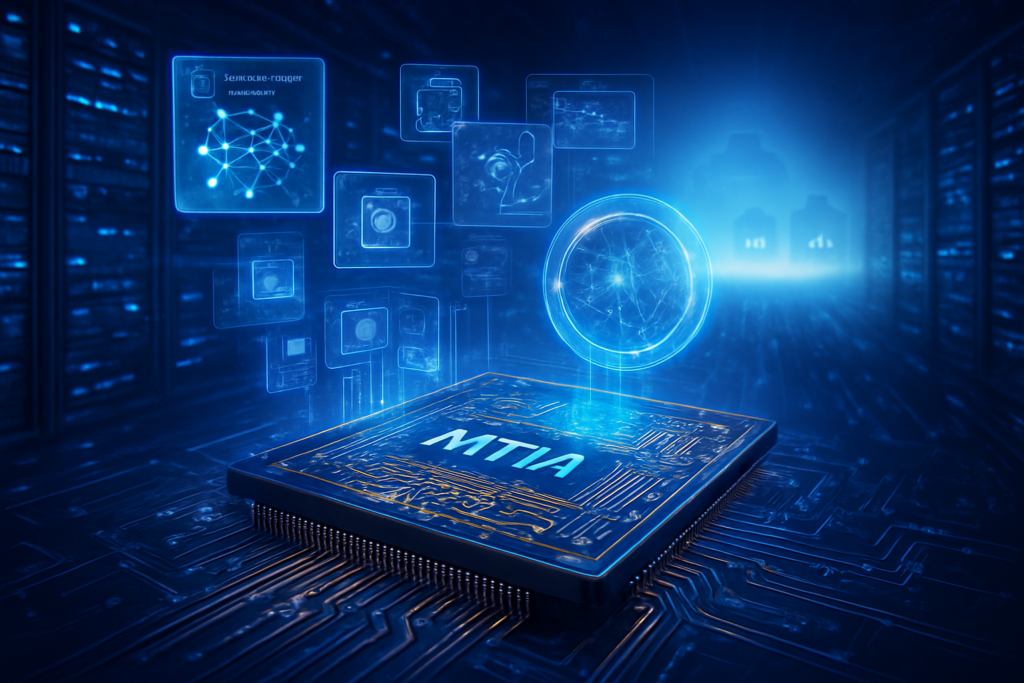
In a definitive move to secure its infrastructure against the volatile fluctuations of the global semiconductor market, Meta Platforms, Inc. (NASDAQ: META) has accelerated the deployment of its third-generation custom silicon, the Meta Training and Inference Accelerator (MTIA) v3, codenamed "Iris." As of February 2026, the Iris chips have moved into broad deployment across Meta’s massive data center fleet, signaling a pivotal shift from the company's historical reliance on general-purpose hardware. This rollout is not merely a hardware upgrade; it represents Meta’s full-scale transition into a vertically integrated AI powerhouse capable of designing, building, and optimizing the very atoms that power its algorithms.
The immediate significance of the Iris rollout lies in its specialized architecture, which is custom-tuned to manage the staggering scale of recommendation systems behind Facebook Reels and Instagram. By moving away from off-the-shelf solutions, Meta has reported a transformative 40% to 44% reduction in total cost of ownership (TCO) for its AI infrastructure. With an aggressive roadmap that includes the MTIA v4 "Santa Barbara," the v5 "Olympus," and the v6 "Universal Core" already slated for 2026 through 2028, Meta is effectively decoupling its future from the "GPU famine" of years past, positioning itself as a primary architect of the next decade's AI hardware standards.
Technical Deep Dive: The 'Iris' Architecture and the 2026 Roadmap
The MTIA v3 "Iris" represents a generational leap over its predecessors, Artemis (v2) and Freya (v1). Fabricated on the cutting-edge 3nm process from Taiwan Semiconductor Manufacturing Company (NYSE: TSM), Iris is designed to solve the "memory wall" that often bottlenecks AI performance. It integrates eight HBM3E 12-high memory stacks, delivering a bandwidth exceeding 3.5 TB/s. Unlike general-purpose GPUs from NVIDIA Corporation (NASDAQ: NVDA), which are designed for a broad array of mathematical tasks, Iris features a specialized 8×8 matrix computing architecture and a sparse computing pipeline. This is specifically optimized for Deep Learning Recommendation Models (DLRM), which spend the vast majority of their compute cycles on embedding table lookups and ranking funnels.
Meta has also introduced a specialized sub-variant of the Iris generation known as "Arke," an inference-only chip developed in collaboration with Marvell Technology, Inc. (NASDAQ: MRVL). While the flagship Iris was designed primarily with assistance from Broadcom Inc. (NASDAQ: AVGO), the Arke variant represents a strategic diversification of Meta’s supply chain. Looking ahead to the latter half of 2026, Meta is readying the MTIA v4 "Santa Barbara" for deployment. This upcoming generation is expected to move beyond air-cooled racks to advanced liquid-cooling systems, supporting high-density configurations that exceed 180kW per rack. The v4 chips will reportedly be the first to integrate HBM4 memory, further widening the throughput for the massive, multi-trillion parameter models currently in development.
Strategic Impact on the Semiconductor Industry and AI Titans
The aggressive scaling of the MTIA program has sent ripples through the semiconductor industry, specifically impacting the "Inference War." While Meta remains one of the largest buyers of NVIDIA’s Blackwell and Rubin GPUs for training its frontier Llama models, it is rapidly moving its inference workloads—which represent the bulk of its daily operational costs—to internal silicon. Analysts suggest that by the end of 2026, Meta aims to have over 35% of its total inference fleet running on MTIA hardware. This shift significantly reduces NVIDIA’s addressable market for high-volume, "standard" social media AI tasks, forcing the GPU giant to pivot toward more flexible, general-purpose software moats like the CUDA ecosystem.
Conversely, the MTIA program has become a massive revenue tailwind for Broadcom and Marvell. Broadcom, acting as Meta’s structural architect, has seen its AI-related revenue projections soar, driven by the custom ASIC (Application-Specific Integrated Circuit) trend. For Meta, the strategic advantage is two-fold: cost efficiency and hardware-software co-design. By controlling the entire stack—from the PyTorch framework to the silicon itself—Meta can implement optimizations that are physically impossible on closed-source hardware. This includes custom memory management that allows Instagram’s algorithms to process over 1,000 concurrent machine learning models per user session without the latency spikes that typically lead to user attrition.
Broader Significance: The Era of Domain-Specific AI Architectures
The rollout of Iris and the 2026 roadmap highlight a broader trend in the AI landscape: the transition from general-purpose "one-size-fits-all" hardware to domain-specific architectures (DSAs). Meta’s move mirrors similar efforts by Google and Amazon, but with a specific focus on the unique demands of social media. Recommendation engines require massive data movement and sparse matrix math rather than the raw FP64 precision needed for scientific simulations. By stripping away unnecessary components and focusing on integer and 16-bit operations, Meta is proving that efficiency—measured in performance-per-watt—is the ultimate currency in the race for AI supremacy.
However, this transition is not without concerns. The immense power requirements of the 2026 "Santa Barbara" clusters raise questions about the long-term sustainability of Meta’s data center growth. As chips become more specialized, the industry risks a fragmentation of software standards. Meta is countering this by ensuring MTIA is fully integrated with PyTorch, an open-source framework it pioneered, but the technical debt of maintaining a custom hardware-software stack is a hurdle few companies other than the "Magnificent Seven" can clear. This could potentially widen the gap between tech giants and smaller startups that lack the capital to build their own silicon.
Future Outlook: From Recommendation to Universal Intelligence
As we look toward the tail end of 2026 and into 2027, the MTIA program is expected to evolve from a specialized recommendation engine into a "Universal AI Core." The upcoming MTIA v5 "Olympus" is rumored to be Meta’s first attempt at a 2nm chiplet-based architecture. This generation is designed to handle both high-end training for future "Llama 5" and "Llama 6" models and real-time inference, potentially replacing NVIDIA’s role in Meta’s training clusters entirely. Industry insiders predict that v5 will feature Co-Packaged Optics (CPO), allowing for lightning-fast inter-chip communication that bypasses traditional copper bottlenecks.
The primary challenge moving forward will be the transition to these "Universal" cores. Training frontier models requires a level of flexibility and stability that custom ASICs have historically struggled to maintain. If Meta succeeds with v5 and v6, it will have achieved a level of vertical integration rivaled only by Apple in the consumer space. Experts predict that the next few years will see Meta focusing on "rack-scale" computing, where the entire data center rack is treated as a single, massive computer, orchestrated by custom networking silicon like the Marvell-powered FBNIC.
Conclusion: A New Milestone in AI Infrastructure
The rollout of the MTIA v3 Iris chips and the unveiling of the v4/v5/v6 roadmap mark a watershed moment in the history of artificial intelligence. Meta Platforms, Inc. has transitioned from a software company that consumes hardware to a hardware titan that defines the state of the art in silicon design. By successfully optimizing its hardware for the specific nuances of Reels and Instagram recommendations, Meta has secured a competitive advantage that is measured in billions of dollars of annual savings and unmatchable latency performance for its billions of users.
In the coming months, the industry will be watching closely as the Santa Barbara v4 clusters come online. Their performance will likely determine whether the trend of custom silicon remains a luxury for the top tier of Big Tech or if it begins to reshape the broader supply chain for the entire enterprise AI sector. For now, Meta’s "Iris" is a clear signal: the future of AI will not be bought off a shelf; it will be built in-house, custom-tuned, and scaled at a level the world has never seen.
This content is intended for informational purposes only and represents analysis of current AI developments.
TokenRing AI delivers enterprise-grade solutions for multi-agent AI workflow orchestration, AI-powered development tools, and seamless remote collaboration platforms.
For more information, visit https://www.tokenring.ai/.