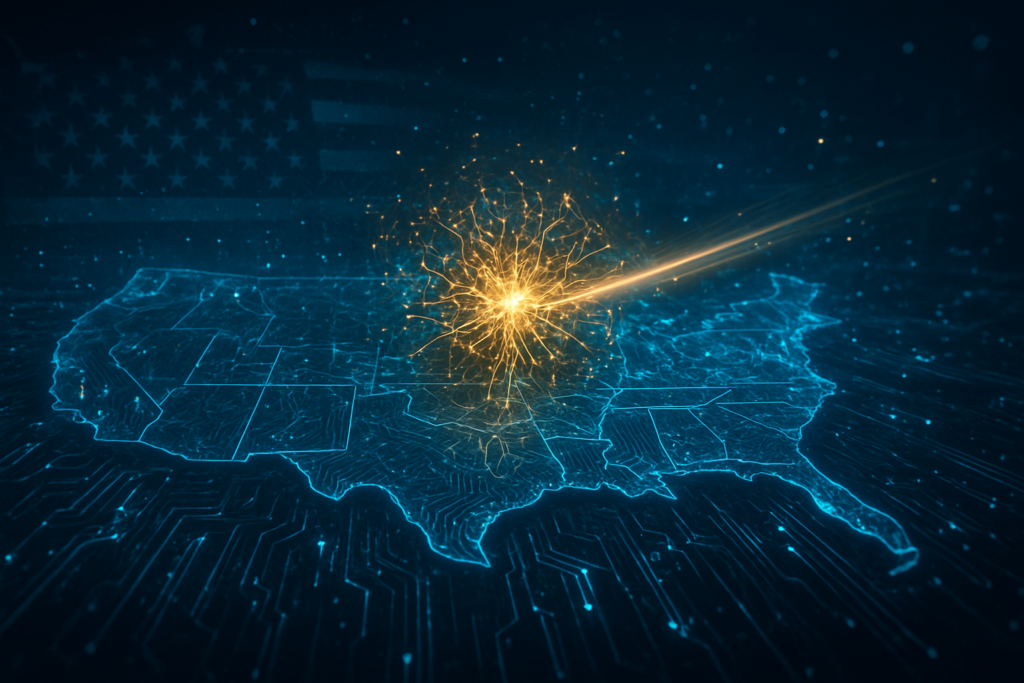
In a move that has sent shockwaves through both Silicon Valley and state capitals across the country, President Trump signed the "Executive Order on Ensuring a National Policy Framework for Artificial Intelligence" on December 11, 2025. Positioned as the cornerstone of the administration’s "America First AI" strategy, the order seeks to fundamentally reshape the regulatory landscape by establishing a single, deregulatory federal standard for artificial intelligence. By explicitly moving to supersede state-level safety and transparency laws, the White House aims to eliminate what it describes as a "burdensome patchwork" of regulations that threatens to hinder American technological dominance.
The immediate significance of this directive cannot be overstated. As of January 12, 2026, the order has effectively frozen the enforcement of several landmark state laws, most notably in California and Colorado. By asserting federal authority over "Frontier AI" models under the Dormant Commerce Clause, the administration is betting that a unified, "innovation-first" approach will provide the necessary velocity for U.S. companies to outpace global competitors, particularly China, in the race for Artificial General Intelligence (AGI).
A "One Federal Standard" Doctrine for the Frontier
The Executive Order introduces a "One Federal Standard" doctrine, which argues that because AI models are developed and deployed across state lines, they constitute "inherent instruments of interstate commerce." This legal framing is designed to strip states of their power to mandate independent safety testing, bias mitigation, or reporting requirements. Specifically, the order targets California’s stringent transparency laws and Colorado’s Consumer Protections in Interactions with AI Act, labeling them as "onerous barriers" to progress. In a sharp reversal of previous policy, the order also revokes the remaining reporting requirements of the Biden-era EO 14110, replacing prescriptive safety mandates with "minimally burdensome" voluntary partnerships.
Technically, the order shifts the focus from "safety-first" precautionary measures to "truth-seeking" and "ideological neutrality." A key provision requires federal agencies to ensure that AI models are not "engineered" to prioritize Diversity, Equity, and Inclusion (DEI) metrics over accuracy. This "anti-woke" mandate prohibits the government from procuring or requiring models that have been fine-tuned with specific ideological filters, which the administration claims distort the "objective reasoning" of large language models. Furthermore, the order streamlines federal permitting for AI data centers, bypassing certain environmental review hurdles for projects deemed critical to national security—a move intended to accelerate the deployment of massive compute clusters.
Initial reactions from the AI research community have been starkly divided. While "accelerationists" have praised the removal of bureaucratic red tape, safety-focused researchers at organizations like the Center for AI Safety warn of a "safety vacuum." They argue that removing state-level guardrails without a robust federal replacement could lead to the deployment of unvetted models with catastrophic potential. However, hardware researchers have largely welcomed the permitting reforms, noting that power and infrastructure constraints are currently the primary bottlenecks to advancing model scale.
Silicon Valley Divided: Winners and Losers in the New Regime
The deregulatory shift has found enthusiastic support among the industry’s biggest players. Nvidia (NASDAQ: NVDA), the primary provider of the hardware powering the AI revolution, has seen its strategic position bolstered by the order’s focus on rapid infrastructure expansion. Similarly, OpenAI (supported by Microsoft (NASDAQ: MSFT)) and xAI (led by Elon Musk) have voiced strong support for a unified federal standard. Sam Altman of OpenAI, who has transitioned into a frequent advisor for the administration, emphasized that a single regulatory framework is vital for the $500 billion AI infrastructure push currently underway.
Venture capital firms, most notably Andreessen Horowitz (a16z), have hailed the order as a "death blow" to the "decelerationist" movement. By preempting state laws, the order protects smaller startups from the prohibitive legal costs associated with complying with 50 different sets of state regulations. This creates a strategic advantage for U.S.-based labs, allowing them to iterate faster than their European counterparts, who remain bound by the comprehensive EU AI Act. However, tech giants like Alphabet (NASDAQ: GOOGL) and Meta Platforms (NASDAQ: META) now face a complex transition period as they navigate the "shadow period" of enforcement while state-level legal challenges play out in court.
The disruption to existing products is already visible. Companies that had spent the last year engineering models to comply with California’s specific safety and bias requirements are now forced to decide whether to maintain those filters or pivot to the new "ideological neutrality" standards to remain eligible for federal contracts. This shift in market positioning could favor labs that have historically leaned toward "open" or "unfiltered" models, potentially marginalizing those that have built their brands around safety-centric guardrails.
The Constitutional Clash and the "America First" Vision
The wider significance of the December 2025 EO lies in its aggressive use of federal power to dictate the cultural and technical direction of AI. By leveraging the Spending Clause, the administration has threatened to withhold billions in Broadband Equity Access and Deployment (BEAD) funds from states that refuse to suspend their own AI regulations. California, for instance, currently has approximately $1.8 billion in infrastructure grants at risk. This "carrot and stick" approach represents a significant escalation in the federal government’s attempt to centralize control over emerging technologies.
The battle is not just over safety, but over the First Amendment. The administration argues that state laws requiring "bias audits" or "safety filters" constitute "compelled speech" and "viewpoint discrimination" against developers. This legal theory, if upheld by the Supreme Court, could redefine the relationship between the government and software developers for decades. Critics, including California Governor Gavin Newsom and Attorney General Rob Bonta, have decried the order as "federal overreach" that sacrifices public safety for corporate profit, setting the stage for a landmark constitutional showdown.
Historically, this event marks a definitive pivot away from the global trend of increasing AI regulation. While the EU and several U.S. states were moving toward a "precautionary principle" model, the Trump administration has effectively doubled down on "technological exceptionalism." This move draws comparisons to the early days of the internet, where light-touch federal regulation allowed U.S. companies to dominate the global web, though opponents argue that the existential risks of AI make such a comparison dangerous.
The Horizon: Legal Limbo and the Compute Boom
In the near term, the AI industry is entering a period of significant legal uncertainty. While the Department of Justice’s new AI Litigation Task Force has already begun filing "Statements of Interest" in state cases, many companies are caught in a "legal limbo." They face the risk of losing federal funding if they comply with state laws, yet they remain liable under those same state laws until a definitive court ruling is issued. Legal experts predict that the case will likely reach the Supreme Court by late 2026, making this the most watched legal battle in the history of the tech industry.
Looking further ahead, the permitting reforms included in the EO are expected to trigger a massive boom in data center construction across the "Silicon Heartland." With environmental hurdles lowered, companies like Amazon (NASDAQ: AMZN) and Oracle (NYSE: ORCL) are expected to accelerate their multi-billion dollar investments in domestic compute clusters. This infrastructure surge is intended to ensure that the next generation of AGI is "Made in America," regardless of the environmental or local regulatory costs.
Final Thoughts: A New Era of AI Geopolitics
President Trump’s December 2025 Executive Order represents one of the most consequential shifts in technology policy in American history. By choosing to preempt state laws and prioritize innovation over precautionary safety, the administration has signaled that it views the AI race as a zero-sum geopolitical struggle. The key takeaway for the industry is clear: the federal government is now the primary arbiter of AI development, and its priority is speed and "ideological neutrality."
The significance of this development will be measured by its ability to withstand the coming wave of litigation. If the "One Federal Standard" holds, it will provide U.S. AI labs with a regulatory environment unlike any other in the world—one designed specifically to facilitate the rapid scaling of intelligence. In the coming weeks and months, the industry will be watching the courts and the first "neutrality audits" from the FTC to see how this new framework translates from executive decree into operational reality.
This content is intended for informational purposes only and represents analysis of current AI developments.
TokenRing AI delivers enterprise-grade solutions for multi-agent AI workflow orchestration, AI-powered development tools, and seamless remote collaboration platforms.
For more information, visit https://www.tokenring.ai/.