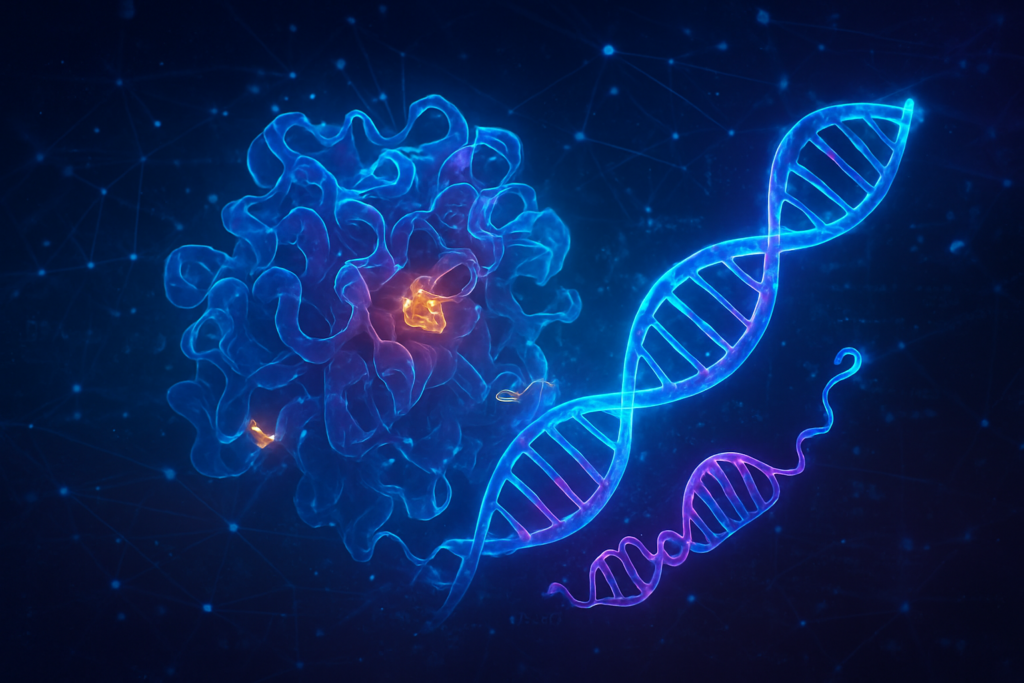
In the two years since its unveiling, AlphaFold 3 (AF3) has fundamentally transformed the landscape of biological research, moving the industry from simple protein folding to a comprehensive "all-atom" understanding of life. Developed by Google DeepMind and its commercial arm, Isomorphic Labs—both subsidiaries of Alphabet (NASDAQ: GOOGL)—the model has effectively bridged the gap between computational prediction and clinical reality. By accurately mapping the complex interactions between proteins, DNA, RNA, and small-molecule ligands, AF3 has provided scientists with a high-definition lens through which to view the molecular machinery of disease for the first time.
The immediate significance of AlphaFold 3 lies in its shift from a specialized tool to a universal biological engine. While its predecessor, AlphaFold 2, revolutionized biology by predicting the 3D structures of nearly all known proteins, it remained largely "blind" to how those proteins interacted with other vital molecules. AF3 solved this by integrating a multimodal architecture that treats every biological component—whether a strand of genetic code or a potential drug molecule—as part of a single, unified system. As of early 2026, this capability has compressed the "Hit-to-Lead" phase of drug discovery from years to mere months, signaling a paradigm shift in how we develop life-saving therapies.
The Diffusion Revolution: Mapping the Molecular Dance
Technically, AlphaFold 3 represents a radical departure from the architecture that powered previous iterations. While AlphaFold 2 relied on the "Evoformer" and a specialized Structure Module to predict geometric rotations, AF3 utilizes a sophisticated Diffusion Network. This is the same mathematical framework that powers modern AI image generators, but instead of refining pixels to create an image, the model begins with a "cloud of atoms" (random noise) and iteratively refines their spatial coordinates into a precise 3D structure. This approach allows the model to handle the immense complexity of "all-atom" interactions without the rigid constraints of previous geometric models.
A key component of this advancement is the "Pairformer" module, which replaces the sequence-heavy focus of earlier models with a streamlined analysis of the relationships between pairs of atoms. This allows AF3 to predict not just the shape of a protein, but how that protein binds to DNA, RNA, and critical ions like Zinc and Magnesium. Furthermore, the model’s ability to predict the binding of ligands—the small molecules that form the basis of most medicines—showed a 50% improvement over traditional "docking" methods. This breakthrough has allowed researchers to visualize "cryptic pockets" on proteins that were previously considered "undruggable," opening new doors for treating complex cancers and neurodegenerative diseases.
The research community's reaction has evolved from initial skepticism over its proprietary nature to widespread adoption following the release of its open-source weights in late 2024. Industry experts now view AF3 as the "ChatGPT moment" for structural biology. By accounting for post-translational modifications—chemical changes like phosphorylation that act as "on/off" switches for proteins—AF3 has moved beyond static snapshots to provide a dynamic view of biological function that matches the fidelity of expensive, time-consuming laboratory techniques like Cryo-Electron Microscopy.
The New Arms Race in Computational Medicine
The commercial impact of AlphaFold 3 has been felt most acutely through Isomorphic Labs, which has leveraged the technology to secure multi-billion dollar partnerships with pharmaceutical giants like Eli Lilly (NYSE: LLY) and Novartis (NYSE: NVS). These collaborations have already moved multiple oncology and immunology candidates into the Investigational New Drug (IND)-enabling phase, with the first AF3-designed drugs expected to enter human clinical trials by the end of 2026. For these companies, the strategic advantage lies in "rational design"—the ability to build a drug molecule specifically for a target, rather than screening millions of random compounds in a lab.
However, Alphabet is no longer the only player in this space. The release of AF3 sparked a competitive "arms race" among AI labs and tech giants. In 2025, the open-source community responded with OpenFold3, backed by a consortium including Amazon (NASDAQ: AMZN) and Novo Nordisk (NYSE: NVO), which provided a bitwise reproduction of AF3’s capabilities for the broader scientific public. Meanwhile, Recursion (NASDAQ: RXRX) and MIT released Boltz-2, a model that many experts believe surpasses AF3 in predicting "binding affinity"—the strength with which a drug sticks to its target—which is the ultimate metric for drug efficacy.
This competition is disrupting the traditional "Big Pharma" model. Smaller biotech startups can now access proprietary-grade structural data through open-source models or cloud-based platforms, democratizing a field that once required hundreds of millions of dollars in infrastructure. The market positioning has shifted: the value is no longer just in predicting a structure, but in the generative design of new molecules that don't exist in nature. Companies that fail to integrate these "all-atom" models into their pipelines are finding themselves at a significant disadvantage in both speed and cost.
A Milestone in the Broader AI Landscape
In the wider context of artificial intelligence, AlphaFold 3 marks a transition from "Generative AI for Content" to "Generative AI for Science." It fits into a broader trend where AI is used to solve fundamental physical problems rather than just mimicking human language or art. Like the Human Genome Project before it, AF3 is viewed as a foundational milestone that will define the next decade of biological inquiry. It has proved that the "black box" of AI can be constrained by the laws of physics and chemistry to produce reliable, actionable scientific data.
However, this power comes with significant concerns. The ability to predict how proteins interact with DNA and RNA has raised red flags regarding biosecurity. Experts have warned that the same technology used to design life-saving drugs could theoretically be used to design more potent toxins or pathogens. This led to a heated debate in 2025 regarding "closed" vs. "open" science, resulting in new international frameworks for the monitoring of high-performance biological models.
Compared to previous AI breakthroughs, such as the original AlphaGo, AlphaFold 3’s impact is far more tangible. While AlphaGo mastered a game, AF3 is mastering the "language of life." It represents the first time that a deep learning model has successfully integrated multiple branches of biology—genetics, proteomics, and biochemistry—into a single predictive framework. This holistic view is essential for tackling "systemic" diseases like aging and multi-organ failure, where a single protein target is rarely the whole story.
The Horizon: De Novo Design and Personalized Medicine
Looking ahead, the next frontier is the move from prediction to creation. While AlphaFold 3 is masterful at predicting how existing molecules interact, the research community is now focused on "De Novo" protein design—creating entirely new proteins that have never existed in nature to perform specific tasks, such as capturing carbon from the atmosphere or delivering medicine directly to a single cancer cell. Models like RFdiffusion3, developed by the Baker Lab, are already integrating with AF3-like architectures to turn this into a "push-button" reality.
In the near term, we expect to see AF3 integrated into "closed-loop" robotic laboratories. In these facilities, the AI designs a molecule, a robot synthesizes it, the results are tested automatically, and the data is fed back into the AI to refine the next design. This "self-driving lab" concept could reduce the cost of drug development by an order of magnitude. The long-term goal is a digital twin of a human cell—a simulation so accurate that we can test an entire drug regimen in a computer before a single patient is ever treated.
The challenges remain significant. While AF3 is highly accurate, it still struggles with "intrinsically disordered proteins"—parts of the proteome that don't have a fixed shape. Furthermore, predicting a structure is only the first step; understanding how that structure behaves in the messy, crowded environment of a living cell remains a hurdle. Experts predict that the next major breakthrough will involve "temporal modeling"—adding the dimension of time to see how these molecules move and vibrate over milliseconds.
A New Era of Biological Engineering
AlphaFold 3 has secured its place in history as the tool that finally made the molecular world "searchable" and "programmable." By moving beyond the protein and into the realm of DNA, RNA, and ligands, Google DeepMind has provided the foundational map for the next generation of medicine. The key takeaway from the last two years is that biology is no longer just a descriptive science; it has become an engineering discipline.
As we move through 2026, the industry's focus will shift from the models themselves to the clinical outcomes they produce. The significance of AF3 will ultimately be measured by the lives saved by the drugs it helped design and the diseases it helped decode. For now, the "all-atom" revolution is in full swing, and the biological world will never look the same again. Watch for the results of the first Isomorphic Labs clinical trials in the coming months—they will be the ultimate litmus test for the era of AI-driven medicine.
This content is intended for informational purposes only and represents analysis of current AI developments.
TokenRing AI delivers enterprise-grade solutions for multi-agent AI workflow orchestration, AI-powered development tools, and seamless remote collaboration platforms. For more information, visit https://www.tokenring.ai/.