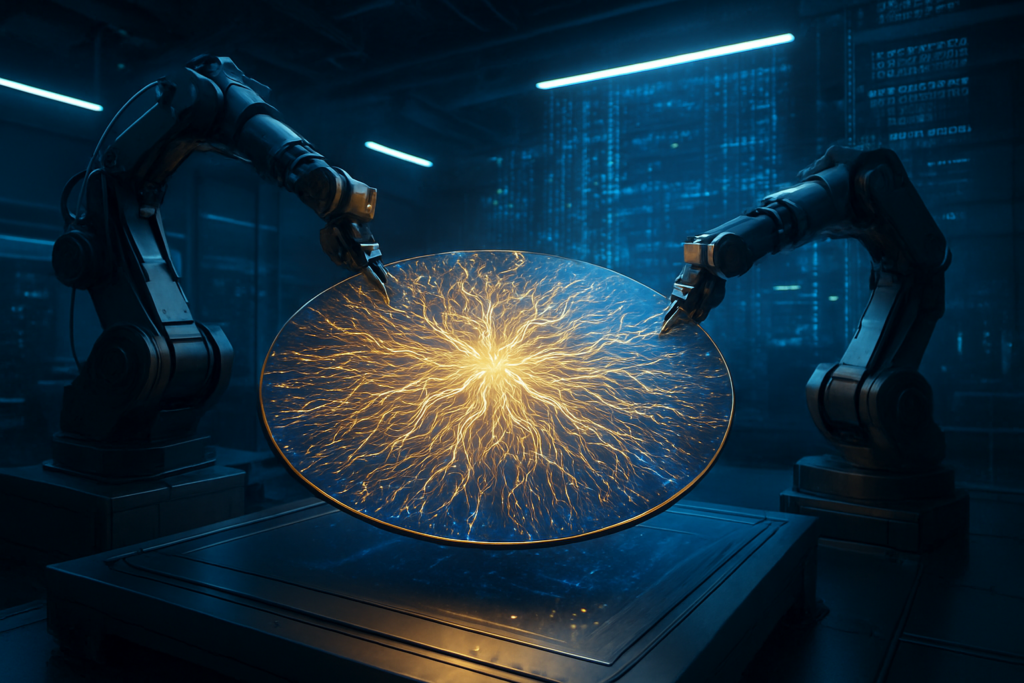
As the artificial intelligence industry grapples with the "memory wall" that has long constrained the performance of traditional graphics processing units (GPUs), Cerebras Systems has emerged as a formidable challenger to the status quo. On December 29, 2025, the company’s Wafer-Scale Engine 3 (WSE-3) and the accompanying CS-3 system have officially redefined the benchmarks for Large Language Model (LLM) inference, delivering speeds that were once considered theoretically impossible. By utilizing an entire 300mm silicon wafer as a single processor, Cerebras has bypassed the traditional bottlenecks of high-bandwidth memory (HBM), setting the stage for a highly anticipated initial public offering (IPO) targeted for the second quarter of 2026.
The significance of the CS-3 system lies not just in its raw power, but in its ability to provide instantaneous, real-time responses for the world’s most complex AI models. While industry leaders have focused on throughput for thousands of simultaneous users, Cerebras has prioritized the "per-user" experience, achieving inference speeds that enable AI agents to "think" and "reason" at a pace that mimics human cognitive speed. This development comes at a critical juncture for the company as it clears the final regulatory hurdles and prepares to transition from a venture-backed disruptor to a public powerhouse on the Nasdaq (CBRS).
Technical Dominance: Breaking the Memory Wall
The Cerebras WSE-3 is a marvel of semiconductor engineering, boasting a staggering 4 trillion transistors and 900,000 AI-optimized cores manufactured on a 5nm process by Taiwan Semiconductor Manufacturing Company (NYSE: TSM). Unlike traditional chips from NVIDIA (NASDAQ: NVDA) or Advanced Micro Devices (NASDAQ: AMD), which must shuttle data back and forth between the processor and external memory, the WSE-3 keeps the entire model—or significant portions of it—within 44GB of on-chip SRAM. This architecture provides a memory bandwidth of 21 petabytes per second (PB/s), which is approximately 2,600 times faster than NVIDIA’s flagship Blackwell B200.
In practical terms, this massive bandwidth translates into unprecedented LLM inference speeds. Recent benchmarks for the CS-3 system show the Llama 3.1 70B model running at a blistering 2,100 tokens per second per user—roughly eight times faster than NVIDIA’s H200 and double the speed of the Blackwell architecture for single-user latency. Even the massive Llama 3.1 405B model, which typically requires multiple networked GPUs to function, runs at 970 tokens per second on the CS-3. These speeds are not merely incremental improvements; they represent what Cerebras CEO Andrew Feldman calls the "broadband moment" for AI, where the latency of interaction finally drops below the threshold of human perception.
The AI research community has reacted with a mixture of awe and strategic recalibration. Experts from organizations like Artificial Analysis have noted that Cerebras is effectively solving the "latency problem" for agentic workflows, where a model must perform dozens of internal reasoning steps before providing an answer. By reducing the time per step from seconds to milliseconds, the CS-3 enables a new class of "thinking" AI that can navigate complex software environments and perform multi-step tasks in real-time without the lag that characterizes current GPU-based clouds.
Market Disruption and the Path to IPO
Cerebras' technical achievements are being mirrored by its aggressive financial maneuvers. After a period of regulatory uncertainty in 2024 and 2025 regarding its relationship with the Abu Dhabi-based AI firm G42, Cerebras has successfully cleared its path to the public markets. Reports indicate that G42 has fully divested its ownership stake to satisfy U.S. national security reviews, and Cerebras is now moving forward with a Q2 2026 IPO target. Following a massive $1.1 billion Series G funding round in late 2025 led by Fidelity and Atreides Management, the company's valuation has surged toward the tens of billions, with analysts predicting a listing valuation exceeding $15 billion.
The competitive implications for the tech industry are profound. While NVIDIA remains the undisputed king of training and high-throughput data centers, Cerebras is carving out a high-value niche in the inference market. Startups and enterprise giants alike—such as Meta (NASDAQ: META) and Microsoft (NASDAQ: MSFT)—stand to benefit from a diversified hardware ecosystem. Cerebras has already priced its inference API at a competitive $0.60 per 1 million tokens for Llama 3.1 70B, a move that directly challenges the margins of established cloud providers like Amazon (NASDAQ: AMZN) Web Services and Google (NASDAQ: GOOGL).
This disruption extends beyond pricing. By offering a "weight streaming" architecture that treats an entire cluster as a single logical processor, Cerebras simplifies the software stack for developers who are tired of the complexities of managing multi-GPU clusters and NVLink interconnects. For AI labs focused on low-latency applications—such as real-time translation, high-frequency trading, and autonomous robotics—the CS-3 offers a strategic advantage that traditional GPU clusters struggle to match.
The Global AI Landscape and Agentic Trends
The rise of wafer-scale computing fits into a broader shift in the AI landscape toward "Agentic AI"—systems that don't just generate text but actively solve problems. As models like Llama 4 (Maverick) and DeepSeek-R1 become more sophisticated, they require hardware that can support high-speed internal "Chain of Thought" processing. The WSE-3 is perfectly positioned for this trend, as its architecture excels at the sequential processing required for reasoning agents.
However, the shift to wafer-scale technology is not without its challenges and concerns. The CS-3 system is a high-power beast, drawing 23 kilowatts of electricity per unit. While Cerebras argues that a single CS-3 replaces dozens of traditional GPUs—thereby reducing the total power footprint for a given workload—the physical infrastructure required to support such high-density computing is a barrier to entry for smaller data centers. Furthermore, the reliance on a single, massive piece of silicon introduces manufacturing yield risks that smaller, chiplet-based designs like those from NVIDIA and AMD are better equipped to handle.
Comparisons to previous milestones, such as the transition from CPUs to GPUs for deep learning in the early 2010s, are becoming increasingly common. Just as the GPU unlocked the potential of neural networks, wafer-scale engines are unlocking the potential of real-time, high-reasoning agents. The move toward specialized inference hardware suggests that the "one-size-fits-all" era of the GPU may be evolving into a more fragmented and specialized hardware market.
Future Horizons: Llama 4 and Beyond
Looking ahead, the roadmap for Cerebras involves even deeper integration with the next generation of open-source and proprietary models. Early benchmarks for Llama 4 (Maverick) on the CS-3 have already reached 2,522 tokens per second, suggesting that as models become more efficient, the hardware's overhead remains minimal. The near-term focus for the company will be diversifying its customer base beyond G42, targeting U.S. government agencies (DoE, DoD) and large-scale enterprise cloud providers who are eager to reduce their dependence on the NVIDIA supply chain.
In the long term, the challenge for Cerebras will be maintaining its lead as competitors like Groq and SambaNova also target the low-latency inference market with their own specialized architectures. The "inference wars" of 2026 are expected to be fought on the battlegrounds of energy efficiency and software ease-of-use. Experts predict that if Cerebras can successfully execute its IPO and use the resulting capital to scale its manufacturing and software support, it could become the primary alternative to NVIDIA for the next decade of AI development.
A New Era for AI Infrastructure
The Cerebras WSE-3 and the CS-3 system represent more than just a faster chip; they represent a fundamental rethink of how computers should be built for the age of intelligence. By shattering the 1,000-token-per-second barrier for massive models, Cerebras has proved that the "memory wall" is not an insurmountable law of physics, but a limitation of traditional design. As the company prepares for its Q2 2026 IPO, it stands as a testament to the rapid pace of innovation in the semiconductor industry.
The key takeaways for investors and tech leaders are clear: the AI hardware market is no longer a one-horse race. While NVIDIA's ecosystem remains dominant, the demand for specialized, ultra-low-latency inference is creating a massive opening for wafer-scale technology. In the coming months, all eyes will be on the SEC filings and the performance of the first Llama 4 deployments on CS-3 hardware. If the current trajectory holds, the "Silicon Giant" from Sunnyvale may very well be the defining story of the 2026 tech market.
This content is intended for informational purposes only and represents analysis of current AI developments.
TokenRing AI delivers enterprise-grade solutions for multi-agent AI workflow orchestration, AI-powered development tools, and seamless remote collaboration platforms.
For more information, visit https://www.tokenring.ai/.