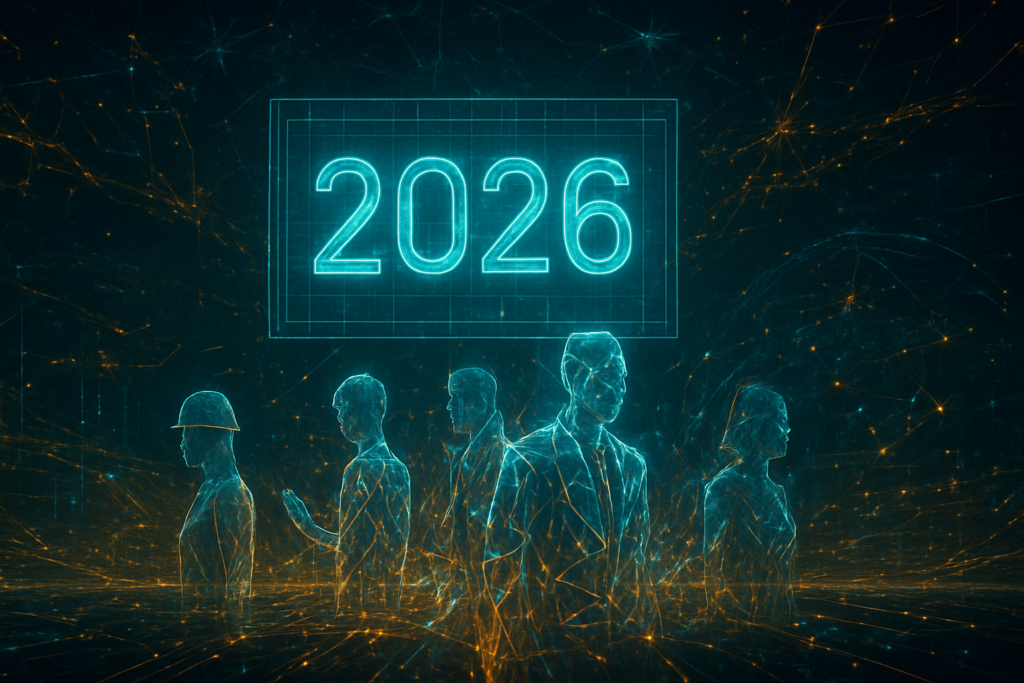
As the world prepares to ring in the new year, a chilling forecast from one of the most respected figures in technology has cast a shadow over the global labor market. Geoffrey Hinton, the Nobel Prize-winning "Godfather of AI," has issued a final warning for 2026, predicting it will be the year of mass job replacement as corporations move from AI experimentation to aggressive, cost-cutting implementation.
With the calendar turning to 2026 in just a matter of days, Hinton’s timeline suggests that the "pivotal" advancements of 2025 have laid the groundwork for a seismic shift in how business is conducted. In recent interviews, Hinton argued that the massive capital investments made by tech giants are now reaching a "tipping point" where the primary return on investment will be the systematic replacement of human workers with autonomous AI systems.
The Technical "Step Change": From Chatbots to Autonomous Agents
The technical foundation of Hinton’s 2026 prediction lies in what he describes as a "step change" in AI reasoning and task-completion capabilities. While 2023 and 2024 were defined by Large Language Models (LLMs) that could generate text and code with human assistance, Hinton points to the emergence of "Agentic AI" as the catalyst for 2026’s displacement. These systems do not merely respond to prompts; they execute multi-step projects over weeks or months with minimal human oversight. Hinton notes that the time required for AI to master complex reasoning tasks is effectively halving every seven months, a rate of improvement that far outstrips human adaptability.
This shift is exemplified by the transition from simple coding assistants to fully autonomous software engineering agents. According to Hinton, by 2026, AI will be capable of handling software projects that currently require entire teams of human developers. This is not just a marginal gain in productivity; it is a fundamental change in the architecture of work. The AI research community remains divided on this "zero-human" vision. While some agree that the "reasoning" capabilities of models like OpenAI’s o1 and its successors have crossed a critical threshold, others, including Meta Platforms, Inc. (NASDAQ: META) Chief AI Scientist Yann LeCun, argue that AI still lacks the "world model" necessary for total autonomy, suggesting that 2026 may see more "augmentation" than "replacement."
The Trillion-Dollar Bet: Corporate Strategy in 2026
The drive toward mass job replacement is being fueled by a "trillion-dollar bet" on AI infrastructure. Companies like NVIDIA Corporation (NASDAQ: NVDA), Microsoft Corporation (NASDAQ: MSFT), and Alphabet Inc. (NASDAQ: GOOGL) have spent the last two years pouring unprecedented capital into data centers and specialized chips. Hinton argues that to justify these astronomical expenditures to shareholders, corporations must now pivot toward radical labor cost reduction. "One of the main sources of money is going to be by selling people AI that will do the work of workers much cheaper," Hinton recently stated, highlighting that for many CEOs, AI is no longer a luxury—it is a survival mechanism for maintaining margins in a high-interest-rate environment.
This strategic shift is already reflected in the 2026 budget cycles of major enterprises. Market research firm Gartner, Inc. (NYSE: IT) has noted that approximately 20% of global organizations plan to use AI to "flatten" their corporate structures by the end of 2026, specifically targeting middle management and entry-level cognitive roles. This creates a competitive "arms race" where companies that fail to automate as aggressively as their rivals risk being priced out of the market. For startups, this environment offers a double-edged sword: the ability to scale to unicorn status with a fraction of the traditional headcount, but also the threat of being crushed by incumbents who have successfully integrated AI-driven cost efficiencies.
The "Jobless Boom" and the Erosion of Entry-Level Work
The broader significance of Hinton’s prediction points toward a phenomenon economists are calling the "Jobless Boom." This scenario describes a period of robust corporate profit growth and rising GDP, driven by AI efficiency, that fails to translate into wage growth or employment opportunities. The impact is expected to be most severe in "mundane intellectual labor"—roles in customer support, back-office administration, and basic data analysis. Hinton warns that for these sectors, the technology is "already there," and 2026 will simply be the year the contracts for human labor are not renewed.
Furthermore, the erosion of entry-level roles poses a long-term threat to the "talent pipeline." If AI can do the work of a junior analyst or a junior coder more efficiently and cheaply, the traditional path for young professionals to gain experience and move into senior leadership vanishes. This has led to growing calls for radical social policy changes, including Universal Basic Income (UBI). Hinton himself has become an advocate for such measures, comparing the current AI revolution to the Industrial Revolution, but with one critical difference: the speed of change is occurring in months rather than decades, leaving little time for societal safety nets to catch up.
The Road Ahead: Agentic Workflows and Regulatory Friction
Looking beyond the immediate horizon of 2026, the next phase of AI development is expected to focus on the integration of AI agents into physical robotics and specialized "vertical" industries like healthcare and law. While Hinton’s 2026 prediction focuses largely on digital and cognitive labor, the groundwork for physical labor replacement is being laid through advancements in computer vision and fine-motor control. Experts predict that the "success" or "failure" of the 2026 mass replacement wave will largely depend on the reliability of these agentic workflows—specifically, their ability to handle "edge cases" without human intervention.
However, this transition will not occur in a vacuum. The year 2026 is also expected to be a high-water mark for regulatory friction. As mass layoffs become a central theme of the corporate landscape, governments are likely to intervene with "AI labor taxes" or stricter reporting requirements for algorithmic displacement. The challenge for the tech industry will be navigating a world where their products are simultaneously the greatest drivers of wealth and the greatest sources of social instability. The coming months will likely see a surge in labor union activity, particularly in white-collar sectors that previously felt immune to automation.
Summary of the 2026 Outlook
Geoffrey Hinton’s forecast for 2026 serves as a stark reminder that the "future of work" is no longer a distant concept—it is a looming reality. The key takeaways from his recent warnings emphasize that the combination of exponential technical growth and the need to recoup massive infrastructure investments has created a perfect storm for labor displacement. While the debate between total replacement and human augmentation continues, the economic incentives for corporations to choose the former have never been stronger.
As we move into 2026, the tech industry and society at large must watch for the first signs of this "step change" in corporate earnings reports and employment data. Whether 2026 becomes a year of unprecedented prosperity or a year of profound social upheaval will depend on how quickly we can adapt our economic models to a world where human labor is no longer the primary driver of value. For now, Hinton’s message is clear: the era of "AI as a tool" is ending, and the era of "AI as a replacement" is about to begin.
This content is intended for informational purposes only and represents analysis of current AI developments.
TokenRing AI delivers enterprise-grade solutions for multi-agent AI workflow orchestration, AI-powered development tools, and seamless remote collaboration platforms.
For more information, visit https://www.tokenring.ai/.