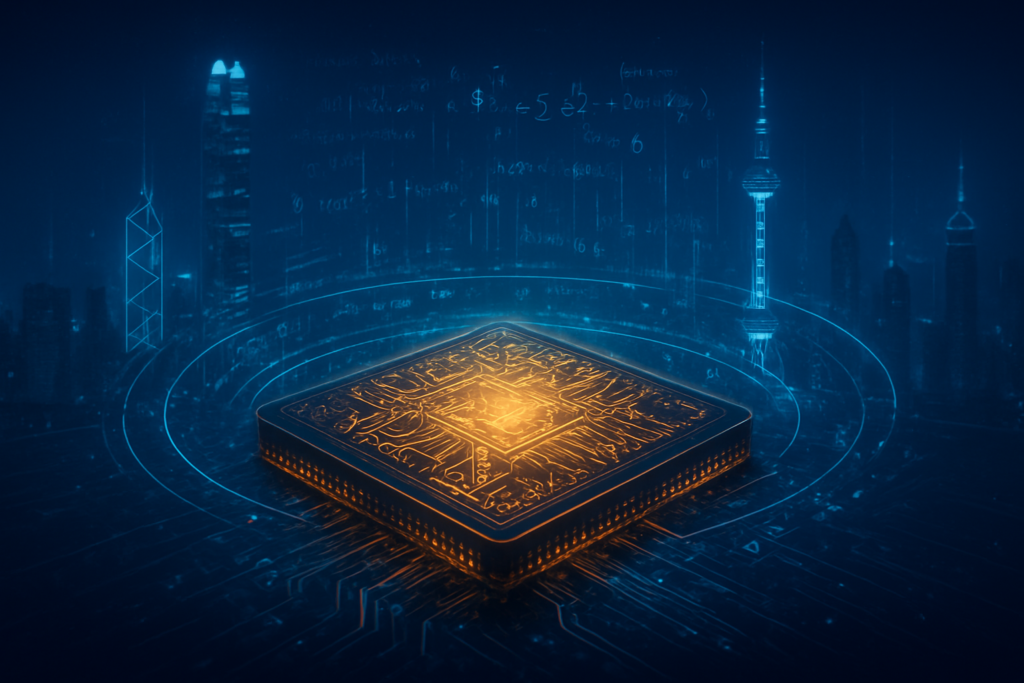
The landscape of global artificial intelligence hardware is undergoing a seismic shift as China’s domestic GPU champions reach major capital market milestones. In a move that signals the country’s deepening resolve to achieve semiconductor self-sufficiency, Biren Technology has cleared its final hurdles for a landmark Hong Kong IPO, while its rival, MetaX (also known as Muxi), saw its valuation skyrocket following a blockbuster debut on the Shanghai Stock Exchange. These developments mark a turning point in China’s multi-year effort to build a viable alternative to the high-end AI chips produced by Western giants like NVIDIA (NASDAQ: NVDA).
The immediate significance of these events cannot be overstated. For years, Chinese tech firms have been caught in the crossfire of tightening US export controls, which restricted access to the high-bandwidth memory (HBM) and processing power required for large language model (LLM) training. By successfully taking these companies public, Beijing is not only injecting billions of dollars into its domestic chip ecosystem but also validating the technical progress made by its lead architects. As of December 2025, the "Silicon Wall" is no longer just a defensive strategy; it has become a competitive reality that is beginning to challenge the dominance of the global incumbents.
Technical Milestones: Closing the Gap with the C600 and BR100
At the heart of this market boom are the technical breakthroughs achieved by Biren and MetaX over the past 18 months. MetaX recently launched its flagship C600 AI chip, which represents a significant leap forward for domestic hardware. The C600 is built on the proprietary MXMACA (Muxi Advanced Computing Architecture) and features 144GB of HBM3e memory—a specification that puts it in direct competition with NVIDIA’s H200. Crucially, MetaX has focused on "CUDA compatibility," allowing developers to migrate their existing AI workloads from NVIDIA’s ecosystem to MetaX’s software stack with minimal code changes, effectively lowering the barrier to entry for Chinese enterprises.
Biren Technology, meanwhile, continues to push the boundaries of chiplet architecture with its BR100 series. Despite being placed on the US Entity List, which limits its access to advanced manufacturing nodes, Biren has successfully optimized its BiLiren architecture to deliver over 1,000 TFLOPS of peak performance in BF16 precision. While still trailing NVIDIA’s latest Blackwell architecture in raw throughput, Biren’s BR100 and the scaled-down BR104 have become the workhorses for domestic Chinese cloud providers who require massive parallel processing for image recognition and natural language processing tasks without relying on volatile international supply chains.
The industry's reaction has been one of cautious optimism. AI researchers in Beijing and Shanghai have noted that while the raw hardware specs are nearing parity with Western 7nm and 5nm designs, the primary differentiator remains the software ecosystem. However, with the massive influx of capital from their respective IPOs, both Biren and MetaX are aggressively hiring software engineers to refine their compilers and libraries, aiming to replicate the seamless developer experience that has kept NVIDIA at the top of the food chain for a decade.
Market Dynamics: A 700% Surge and the Return of the King
The financial performance of these companies has been nothing short of explosive. MetaX (SHA: 688802) debuted on the Shanghai STAR Market on December 17, 2025, with its stock price surging nearly 700% on the first day of trading. This propelled the company's market capitalization to over RMB 332 billion (~$47 billion), providing a massive war chest for future R&D. Biren Technology (HKG: 06082) is following a similar trajectory, having cleared its listing hearing for a January 2, 2026, debut in Hong Kong. The IPO is expected to raise over $600 million, backed by a consortium of 23 cornerstone investors including state-linked funds and major private equity firms.
This surge in domestic valuation comes at a complex time for the global market. In a surprising policy shift in early December 2025, the US administration announced a "transactional" approach to chip exports, allowing NVIDIA to sell its H200 chips to "approved" Chinese customers, provided a 25% fee is paid to the US government. This move was intended to maintain US influence over the Chinese AI sector while taxing NVIDIA's dominance. However, the high cost of these "taxed" foreign chips, combined with the "Buy China" mandates issued to state-owned enterprises, has created a unique strategic advantage for Biren and MetaX.
Major Chinese tech giants like Alibaba (NYSE: BABA), Tencent (HKG: 0700), and Baidu (NASDAQ: BIDU) are the primary beneficiaries of this development. They are now dual-sourcing their hardware, using NVIDIA’s H200 for their most critical, cutting-edge research while deploying thousands of Biren and MetaX GPUs for internal cloud operations and inference tasks. This diversification reduces their geopolitical risk and exerts downward pricing pressure on international vendors who are desperate to maintain their footprint in the world’s second-largest AI market.
The Geopolitical Chessboard and AI Sovereignty
The rise of Biren and MetaX is a cornerstone of China's broader "AI Sovereignty" initiative. By fostering a domestic GPU market, China is attempting to insulate its digital economy from external shocks. This fits into the "dual circulation" economic strategy, where domestic innovation drives internal growth while still participating in global markets. The success of these IPOs suggests that the market believes China can eventually overcome the manufacturing bottlenecks imposed by sanctions, particularly through partnerships with domestic foundries like SMIC (SHA: 688981).
However, this transition is not without its concerns. Critics point out that both Biren and MetaX remain heavily loss-making, with Biren reporting a loss of nearly RMB 9 billion in the first half of 2025 due to astronomical R&D costs. There is also the risk of "technological fragmentation," where the global AI community splits into two distinct hardware and software ecosystems—one led by NVIDIA and the US, and another led by Huawei, Biren, and MetaX in China. Such a split could slow down global AI collaboration and lead to incompatible standards in model training and deployment.
Comparatively, this moment mirrors the early days of the smartphone industry, where domestic Chinese brands eventually rose to challenge established global leaders. The difference here is the sheer complexity of the underlying technology. While building a smartphone is a feat of integration, building a world-class GPU requires mastering the most advanced lithography and software stacks in existence. The fact that Biren and MetaX have reached the public markets suggests that the "Great Wall of Silicon" is being built brick by brick, with significant state and private backing.
Future Horizons: The 3nm Hurdle and Beyond
Looking ahead, the next 24 months will be critical for the long-term viability of China's GPU sector. The near-term focus will be on the mass production of the MetaX C600 and Biren’s next-generation "BR200" series. The primary challenge remains the "3nm hurdle." As NVIDIA and AMD (NASDAQ: AMD) move toward 3nm and 2nm processes, Chinese firms must find ways to achieve similar performance using older or multi-chiplet manufacturing techniques provided by domestic foundries.
Experts predict that we will see an increase in "application-specific" AI chips. Rather than trying to beat NVIDIA at every general-purpose task, Biren and MetaX may pivot toward specialized accelerators for autonomous driving, smart cities, and industrial automation—areas where China already has a massive data advantage. Furthermore, the integration of domestic HBM (High Bandwidth Memory) will be a key development to watch, as Chinese memory makers strive to match the speeds of global leaders like SK Hynix and Micron.
The success of these companies will also depend on their ability to attract and retain global talent. Despite the geopolitical tensions, the AI talent pool remains highly mobile. If Biren and MetaX can continue to offer competitive compensation and the chance to work on world-class problems, they may be able to siphon off expertise from Silicon Valley, further accelerating their technical roadmap.
Conclusion: A New Era of Competition
The IPOs of Biren Technology and MetaX represent a landmark achievement in China's quest for technological independence. While they still face significant hurdles in manufacturing and software maturity, their successful entry into the public markets provides them with the capital and legitimacy needed to compete on a global stage. The 700% surge in MetaX’s stock and the high-profile nature of Biren’s Hong Kong listing are clear signals that the domestic GPU market has moved past its experimental phase and into a period of aggressive commercialization.
As we look toward 2026, the key metric for success will not just be stock prices, but the actual displacement of foreign hardware in China’s largest data centers. The "25% fee" on NVIDIA’s H200s may provide the breathing room domestic makers need to refine their products and scale production. For the global AI industry, this marks the beginning of a truly multi-polar hardware landscape, where the dominance of a single player is no longer guaranteed.
In the coming weeks, investors and tech analysts will be closely watching Biren’s first days of trading on the HKEX. If the enthusiasm matches that of MetaX’s Shanghai debut, it will confirm that the market sees China’s GPU champions not just as a temporary fix for sanctions, but as the future of the nation’s AI infrastructure.
This content is intended for informational purposes only and represents analysis of current AI developments.
TokenRing AI delivers enterprise-grade solutions for multi-agent AI workflow orchestration, AI-powered development tools, and seamless remote collaboration platforms.
For more information, visit https://www.tokenring.ai/.