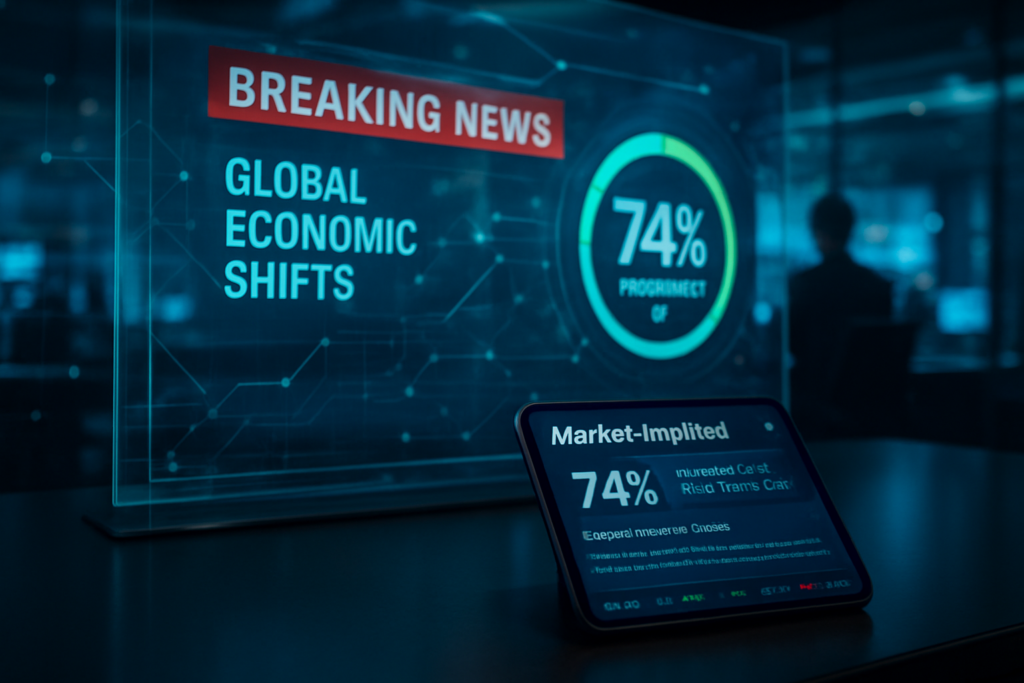
In the world of finance, information has always been the most valuable currency. But as of early 2026, how that information is gathered, verified, and broadcast has undergone a fundamental transformation. The 2024 U.S. Election was the "proof-of-concept" for prediction markets; today, they have become the "Oracle Layer" for the global economy.
Major media conglomerates, once skeptical of "election betting," have now fully integrated prediction market data into their core newsroom operations. Platforms like Polymarket and Kalshi are no longer just alternative data sources—they are the official scoreboards for reality. With probability data now appearing on the same ticker tapes as the S&P 500, the era of "Information Finance" (InfoFi) has officially arrived, turning every headline into a price and every event into a trade.
The Market: What's Being Predicted
Today, prediction markets cover nearly every measurable outcome in the modern world. While political markets remain a cornerstone, the scope has expanded drastically. Traders are now forecasting everything from the exact Federal Funds Rate target in the next FOMC meeting to the specific earnings-per-share (EPS) beats for tech giants like Nvidia (NASDAQ: NVDA) and Apple (NASDAQ: AAPL).
The two dominant players, Polymarket and Kalshi, have divided the landscape into global and domestic spheres. Polymarket, which saw its profile explode after the 2024 election cycle, now operates with a projected $1 trillion annual trading run-rate. Meanwhile, Kalshi has solidified its role as the premier CFTC-regulated venue for U.S. institutional and retail traders. The liquidity in these markets has reached a "critical mass," where even billion-dollar "whale" positions move the odds by only fractions of a percent, providing a level of stability and signal accuracy that traditional polling simply cannot match.
Why Traders Are Betting
The shift toward prediction markets as a primary news source is driven by the concept of "skin-in-the-game." Unlike traditional analysts or pollsters who face little professional consequence for being wrong, traders in these markets face immediate financial loss. This creates a powerful incentive for accuracy, known in the industry as the "Truth Premium."
In late 2025 and early 2026, we saw the emergence of massive hedging strategies where institutional investors used Kalshi contracts to protect against legislative changes. For example, during the debate over new AI regulations, the market-implied probability of a "strict regulatory flip" provided a more accurate signal for hedge funds than the public statements of lobbyists. Furthermore, retail participation has surged following the integration of event contracts into major brokerages like Robinhood (NASDAQ: HOOD), allowing everyday investors to trade on their personal knowledge of local trends or industry news.
Broader Context and Implications: The Rise of 'InfoFi'
The integration into mainstream media is perhaps the most significant milestone for the industry. In January 2026, News Corp (NASDAQ: NWSA), the parent company of The Wall Street Journal and Barron’s, announced an exclusive distribution partnership with Polymarket. Readers now see "Market-Implied Probability" widgets alongside every political and economic article. Similarly, Warner Bros. Discovery (NASDAQ: WBD), through CNN, has designated Kalshi as its "Official Prediction Market Partner," using their real-time odds to "fact-check" traditional polling data on-air.
This marks the definitive shift to "Information Finance." The narrative has changed from "gambling" to "price discovery for information." By treating odds as factual indicators, financial news outlets are acknowledging that a liquid market is the most efficient way to aggregate disparate pieces of information. This has profound implications for regulatory considerations; as these markets become vital public utilities for information, the push for clearer federal frameworks has intensified, leading to the institutionalization of the sector.
What to Watch Next
As we look toward the remainder of 2026, several key milestones will test the resilience of this new information ecosystem. The upcoming 2026 Midterm Elections will be the first major political test for the fully integrated "InfoFi" newsrooms. Analysts are already watching how "Market-Implied House Control" odds diverge from traditional surveys, which struggled to keep pace with the market’s predictive power in 2024.
Additionally, the expansion of "micro-markets" is a trend to monitor. We are seeing the rise of hyper-local prediction markets—such as the probability of a specific city council's zoning vote or the likelihood of a local weather event. These niche markets are becoming essential tools for local news outlets looking to provide their audiences with something more substantial than mere speculation.
Bottom Line
The integration of prediction market data into mainstream media represents the most significant change in financial journalism in a generation. By moving beyond the "expert opinion" model and toward a "market-driven truth" model, outlets like the WSJ and CNN are providing their audiences with a more objective, data-backed view of the world.
Prediction markets have evolved from a curiosity into a structural pillar of the financial world. They offer a real-time, high-stakes vibe check that traditional methods simply cannot replicate. While the risks of market manipulation or volatility remain, the sheer volume of liquidity and the diversity of participants have turned these platforms into the ultimate tools for navigating an increasingly uncertain global landscape. In 2026, the question is no longer "what do the experts think?" but rather, "what is the market price of the truth?"
This article is for informational purposes only and does not constitute financial or betting advice. Prediction market participation may be subject to legal restrictions in your jurisdiction.
PredictStreet focuses on covering the latest developments in prediction markets.
Visit the PredictStreet website at https://www.predictstreet.ai/.