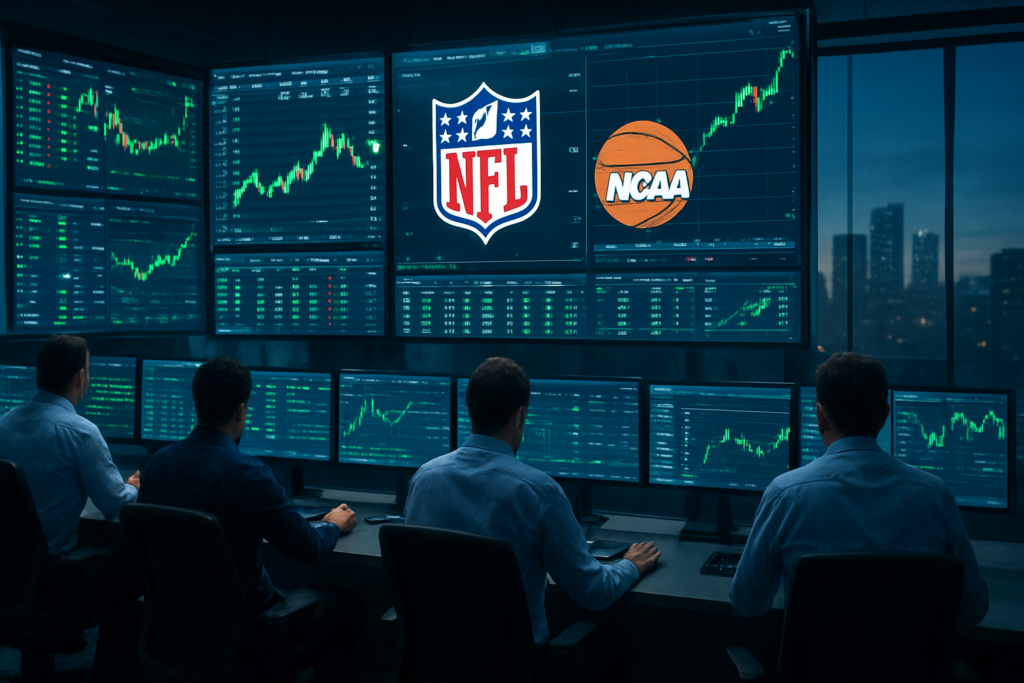
In the week following the NCAA Football Championship, the dust is settling on more than just the gridiron. On January 20, 2026, the championship game did more than crown a college football king; it solidified Kalshi as a financial juggernaut. The platform recorded a staggering $111 million in trading volume for the single event, a figure that signals a tectonic shift in how Americans—and increasingly, Wall Street—engage with sports.
Currently, the markets for the upcoming Super Bowl LX are already seeing nearly $150 million in open interest, with odds fluctuating as professional trading desks move multi-million dollar positions. This is no longer just "betting" in the traditional sense; it is the financialization of sports outcomes through federally regulated event contracts. Driven by a landmark regulatory victory and integration into major retail brokerages, Kalshi has transformed sports results into a legitimate asset class, attracting institutional-scale liquidity that was previously confined to offshore exchanges or private bookmakers.
The Market: What's Being Predicted
The core of Kalshi’s explosion lies in its "event contracts," which are binary options that pay out $1 if an event occurs and $0 if it does not. Unlike traditional sportsbooks where you "place a bet" against the house, Kalshi operates a peer-to-peer exchange where traders buy and sell contracts from one another. In the lead-up to the 2025-2026 NFL playoffs, this model allowed for unprecedented liquidity. For instance, the final day of the NFL regular season on January 4, 2026, saw a single-day volume record of $403 million.
While Polymarket continues to dominate the decentralized, crypto-native space, Kalshi has carved out a massive lead in the regulated U.S. domestic market. By the third week of January 2026, total trading volume for the NFL playoffs reached nearly $2 billion. The resolution criteria for these markets are strictly defined by official league data, ensuring that contracts settle instantly upon the final whistle. This transparency has allowed Kalshi to list complex derivatives, including point spreads and player performance metrics, all under the watchful eye of federal regulators.
Why Traders Are Betting
The migration of capital toward Kalshi is driven by one primary factor: regulatory certainty. Following the 2024 court victory in KalshiEX LLC v. CFTC, and the subsequent decision by the Commodity Futures Trading Commission (CFTC) to drop its appeal in May 2025, Kalshi’s status as a Designated Contract Market (DCM) became unassailable. This regulatory "seal of approval" has opened the floodgates for institutional participants.
Unlike traditional sportsbooks—which are notorious for limiting or banning "sharp" bettors who win too consistently—Kalshi’s exchange model welcomes winners. Large-scale proprietary trading firms and hedge funds now treat touchdowns and game wins as "Zero Days to Expiration" (0DTE) derivatives. They use these contracts to hedge macro risks or to capitalize on high-frequency data models that traditional books cannot accommodate. Furthermore, the integration of Kalshi markets into platforms like Robinhood (NASDAQ: HOOD) and Coinbase (NASDAQ: COIN) has brought institutional-level liquidity into the hands of over 24 million retail users, creating a deeper, more stable market than any sportsbook could offer.
Broader Context and Implications
The success of Kalshi represents a pivotal moment in the "Prediction Market vs. Gambling" debate. By framing sports outcomes as event contracts under the Commodity Exchange Act (CEA), Kalshi has managed a feat that traditional sports betting apps like DraftKings or FanDuel could not: federal preemption. Recent rulings in federal courts have suggested that the CEA preempts state-level gaming restrictions, allowing Kalshi to legally offer sports trading in all 50 U.S. states, including major markets like California and Texas where traditional online sports betting remains prohibited.
This shift reveals a growing public appetite for transparent, low-fee alternatives to the "vig-heavy" model of traditional gambling. It also highlights a change in public sentiment; sports are increasingly viewed through the lens of data and probability rather than just loyalty and luck. However, this growth has not come without friction. The NCAA has voiced significant concerns regarding the integrity of college sports, particularly around "player prop" markets. In response, Kalshi has had to balance its aggressive expansion with "market design" concessions, such as pulling controversial transfer portal markets in late 2025 to maintain its standing with federal regulators.
What to Watch Next
All eyes are now turned toward Super Bowl LX on February 8, 2026. Early trading suggests the championship winner market could surpass $300 million in volume before kickoff. This will be the ultimate test of Kalshi’s infrastructure and its ability to handle "Black Swan" events or massive late-game volatility without the "suspension of play" issues that often plague traditional sportsbooks during high-volume periods.
Beyond the Super Bowl, the next major milestone is March Madness 2026. Following the $350 million trading week in mid-January for NCAA basketball, analysts expect the tournament to break all previous records for prediction market engagement. Traders will be watching closely for any new regulatory guidance from the CFTC regarding "micro-trading" or live in-game contracts, which represent the next frontier for the platform.
Bottom Line
Kalshi’s rise marks the end of the era where sports betting was a sidelined, "sin-taxed" activity and the beginning of its life as a legitimate financial instrument. The $111 million NCAA Championship volume is not an outlier; it is the new baseline for a world where sports data is as tradable as oil or gold.
For the broader prediction market ecosystem, Kalshi’s success proves that regulation, rather than being a hindrance, can be a massive catalyst for liquidity when paired with a superior exchange model. As institutional capital continues to pour into these markets, the line between "trader" and "fan" will continue to blur, forever changing the landscape of both Wall Street and the stadium.
This article is for informational purposes only and does not constitute financial or betting advice. Prediction market participation may be subject to legal restrictions in your jurisdiction.
PredictStreet focuses on covering the latest developments in prediction markets.
Visit the PredictStreet website at https://www.predictstreet.ai/.