As of December 24, 2025, Caterpillar Inc. (NYSE: CAT) stands not only as the world’s leading manufacturer of construction and mining equipment but as a primary barometer for the health of the global economy. Often referred to as a "bellwether," Caterpillar’s performance signals shifts in infrastructure spending, commodity demand, and energy needs across six continents. In 2025, a year marking the company’s centennial anniversary, Caterpillar has defied the traditional "cyclical" label, evolving into a technology-driven powerhouse. With a surging stock price and a pivot toward autonomous mining and data center power solutions, the company has captured the attention of both value-oriented dividend investors and growth-focused tech analysts.
Historical Background
Caterpillar’s journey began in 1925 through the merger of the Holt Manufacturing Company and the C. L. Best Tractor Co. The union resolved a long-standing patent dispute over continuous-track tractors—machines that "crawled" like caterpillars. Throughout the 20th century, the company became synonymous with American industrial might. From the construction of the Hoover Dam and the Golden Gate Bridge to its critical role in World War II, "CAT" machines literally built the modern world.
Over the decades, the company transformed from a simple tractor maker into a global conglomerate. Key milestones included the 1980s restructuring to survive a severe recession, the acquisition of Perkins Engines (diesel) and Solar Turbines (gas), and the more recent push into digital services and autonomous hauling. Entering its 100th year in 2025, Caterpillar remains headquartered in Irving, Texas, having moved from its long-time home in Peoria, Illinois, in 2022 to better align with global logistics and talent pools.
Business Model
Caterpillar operates through a diversified model designed to mitigate the volatility of any single sector. Its revenue is generated through four primary segments:
- Construction Industries: The most visible segment, producing machinery for infrastructure, forestry, and building construction.
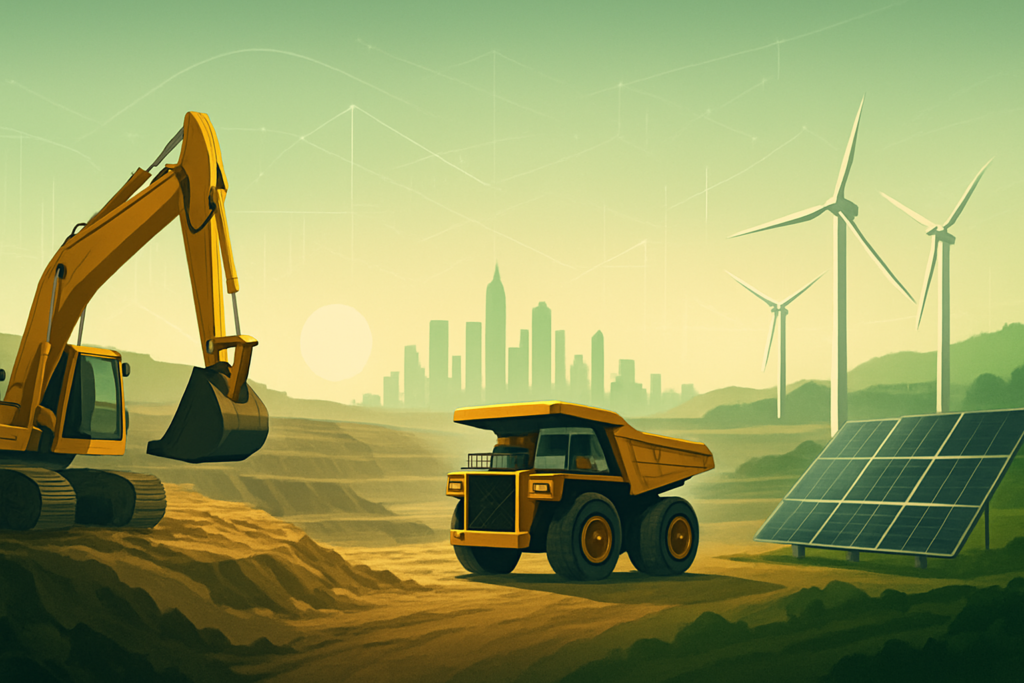
- Resource Industries: Focused on the mining and quarrying sectors. This segment is currently riding the wave of the "Critical Minerals" boom, providing equipment for lithium, copper, and nickel extraction.
- Energy & Transportation (E&T): Often the unsung hero of the portfolio, E&T provides reciprocating engines and turbines for oil and gas, marine, rail, and—most recently—massive backup power systems for hyperscale data centers.
- Financial Products: Through Caterpillar Financial Services, the company provides retail and wholesale financing, ensuring customers and dealers can acquire equipment regardless of credit cycles.
A central pillar of the modern business model is the "Services" initiative. Caterpillar has set a target to reach $28 billion in service-related revenue by 2026, focusing on parts, maintenance, and digital "connected" assets that provide higher margins than initial equipment sales.
Stock Performance Overview
Investors in Caterpillar have enjoyed a banner year in 2025. As of late December, CAT is trading near $582.41, representing a staggering 60% year-to-date gain. This outperformance far outstrips the broader S&P 500 and is driven by the realization that Caterpillar is a major secondary beneficiary of the Artificial Intelligence (AI) boom due to its power generation business.
- 1-Year Performance: +60%, fueled by robust U.S. infrastructure spending and the "AI-power" narrative.
- 5-Year Performance: The stock has more than tripled since late 2020, benefiting from the post-pandemic recovery and the passage of the U.S. Infrastructure Investment and Jobs Act (IIJA).
- 10-Year Performance: Caterpillar has evolved from a slow-growth industrial to a high-performer, consistently raising dividends and executing massive share buybacks, cementing its status as a "Dividend Aristocrat."
Financial Performance
The 2025 fiscal year has been one of record-breaking financials despite early-year concerns regarding manufacturing costs.
- Revenue: Projected to reach $66.06 billion for the full year 2025, a significant jump from previous years.
- Earnings: Q3 2025 saw an adjusted EPS of $4.95, with full-year expectations hovering around $18.42 per share.
- Margins: Operating profit margins in the Energy & Transportation segment have been particularly strong, often exceeding 20% due to high-value turbine sales.
- Backlog: The company enters 2026 with a massive $35 billion order backlog, providing a safety net against any potential macro slowdown in early 2026.
- Valuation: The stock currently trades at a Forward P/E of 31.28. While high by historical standards, bulls argue this reflects the company's shift toward high-margin services and tech-led solutions.
Leadership and Management
2025 was a pivotal year for Caterpillar’s C-suite. In May 2025, Joseph E. Creed took over as Chief Executive Officer. A 28-year veteran of the firm and former Chief Operating Officer, Creed’s appointment was seen as a "steady hand" transition. He succeeds D. James Umpleby III, who moved to the role of Executive Chairman.
Umpleby’s legacy is defined by the "Operating & Execution Model," which focused on high-margin growth and services. Creed is expected to double down on this, with a specific focus on "Mining 4.0" and the energy transition. The board remains highly regarded for its disciplined capital allocation, returning billions to shareholders annually through dividends and buybacks.
Products, Services, and Innovations
Caterpillar is no longer just "iron and steel." Its innovation pipeline is focused on three areas:
- Autonomy: The MineStar Command system is the industry gold standard. In 2025, CAT reached a milestone of over 700 autonomous trucks in operation globally and signed a landmark deal with Brazilian miner Vale to expand its autonomous fleet to 90 ultra-class trucks by 2028.
- Alternative Fuels: The new C13D engine platform is "hydrogen-ready." Furthermore, Caterpillar has made 100% of its current product line compatible with Hydrotreated Vegetable Oil (HVO), allowing customers to cut carbon emissions without replacing their fleets.
- Digital Twins: Caterpillar now has over 1.5 million "connected assets," using AI to predict when a component will fail, significantly reducing downtime for customers.
Competitive Landscape
Caterpillar maintains the largest market share in the global heavy equipment industry (approx. 16.3%). Its primary rivals include:
- Komatsu (Japan): The closest competitor, particularly strong in the Asia-Pacific region. Komatsu is a leader in electric excavators but trails CAT in the autonomous hauling space in the Americas.
- John Deere (NYSE: DE): While dominant in agriculture, Deere competes fiercely with CAT in medium-sized construction and road-building equipment.
- Sany (China): A low-cost competitor that has gained ground in emerging markets but lacks the global dealer network and service reputation that Caterpillar maintains.
Caterpillar’s "moat" is its Dealer Network. With over 150 independent dealers globally, CAT can provide parts and service in remote mining locations or busy urban centers faster than almost any competitor.
Industry and Market Trends
Several macro trends are currently working in Caterpillar’s favor:
- The AI Power Squeeze: Data centers require massive amounts of continuous and backup power. Caterpillar’s gas turbines and large-scale diesel generators are seeing unprecedented demand as the world builds out AI infrastructure.
- Infrastructure Supercycle: Aging infrastructure in the U.S. and Europe, combined with the U.S. IIJA, ensures a "floor" for construction equipment demand for several years.
- Energy Transition Mining: To build electric vehicles and renewable grids, the world needs copper, lithium, and cobalt. This requires the massive mining equipment that only Caterpillar and a few others can provide.
Risks and Challenges
Despite the current euphoria, several risks remain:
- Cyclicality: Historically, Caterpillar is highly sensitive to the global economic cycle. A global recession could lead to rapid cancellations of equipment orders.
- China Exposure: China’s real estate crisis has cooled demand for construction machinery in the region. While CAT is less reliant on China than in the past, it remains a headwind for the Construction segment.
- Valuation Risk: At a P/E of 31, there is little room for error. Any earnings miss or guidance downgrade could lead to a sharp correction.
- Geopolitics: Tariffs and trade wars could impact the cost of steel and the ability to export machines from U.S. plants.
Opportunities and Catalysts
- CES 2026: CEO Joe Creed is scheduled to deliver a keynote at the Consumer Electronics Show in January 2026, where the company is expected to showcase its first fully autonomous quarry site. This could further solidify the "CAT as a Tech Company" narrative.
- M&A Activity: With a strong balance sheet, Caterpillar is positioned to acquire smaller software or battery-tech firms to accelerate its electrification and autonomy goals.
- Dividend Growth: Caterpillar is expected to announce its 32nd consecutive year of dividend increases in 2026, attracting defensive income seekers.
Investor Sentiment and Analyst Coverage
Wall Street sentiment is overwhelmingly "Bullish." Analysts highlight that Caterpillar is no longer just selling machines; it is selling "uptime" and "productivity solutions." Major institutional holders like Vanguard and BlackRock have maintained or increased their positions, viewing CAT as a core industrial holding.
Retail sentiment is also positive, often discussed in the context of "re-industrialization" and "onshoring" trends in the United States. Analysts have a consensus price target of $616.00, with some ultra-bullish estimates reaching $730.00 if the energy transition mining boom accelerates.
Regulatory, Policy, and Geopolitical Factors
Caterpillar is heavily influenced by government policy:
- EPA Regulations: Stricter emissions standards for off-road engines (Tier 5) are on the horizon, forcing CAT to invest heavily in R&D, which also acts as a barrier to entry for smaller competitors.
- U.S. Foreign Policy: As a major exporter, Caterpillar benefits from stable trade relations. However, ongoing tensions between the U.S. and China create supply chain complexities, particularly regarding electronic components.
- Incentives for Green Tech: Governments in the EU and North America are providing subsidies for hydrogen and electric machinery, which CAT is well-positioned to capture.
Conclusion
As 2025 draws to a close, Caterpillar (NYSE: CAT) has proven that a century-old industrial giant can successfully reinvent itself for the modern era. By positioning itself at the intersection of three global megatrends—infrastructure renewal, the energy transition, and the digital/AI revolution—Caterpillar has transcended its roots as a simple "yellow iron" manufacturer.
While the current valuation requires a high degree of confidence in the company’s tech-led future, Caterpillar’s $35 billion backlog and dominant market position provide a substantial margin of safety. For investors, the "Caterpillar story" is no longer just about tractors; it is about the autonomous, electrified, and data-driven future of global industry. Watching the company's performance at CES 2026 and its ability to maintain margins in its Energy & Transportation segment will be the key tasks for observers in the coming year.
This content is intended for informational purposes only and is not financial advice.