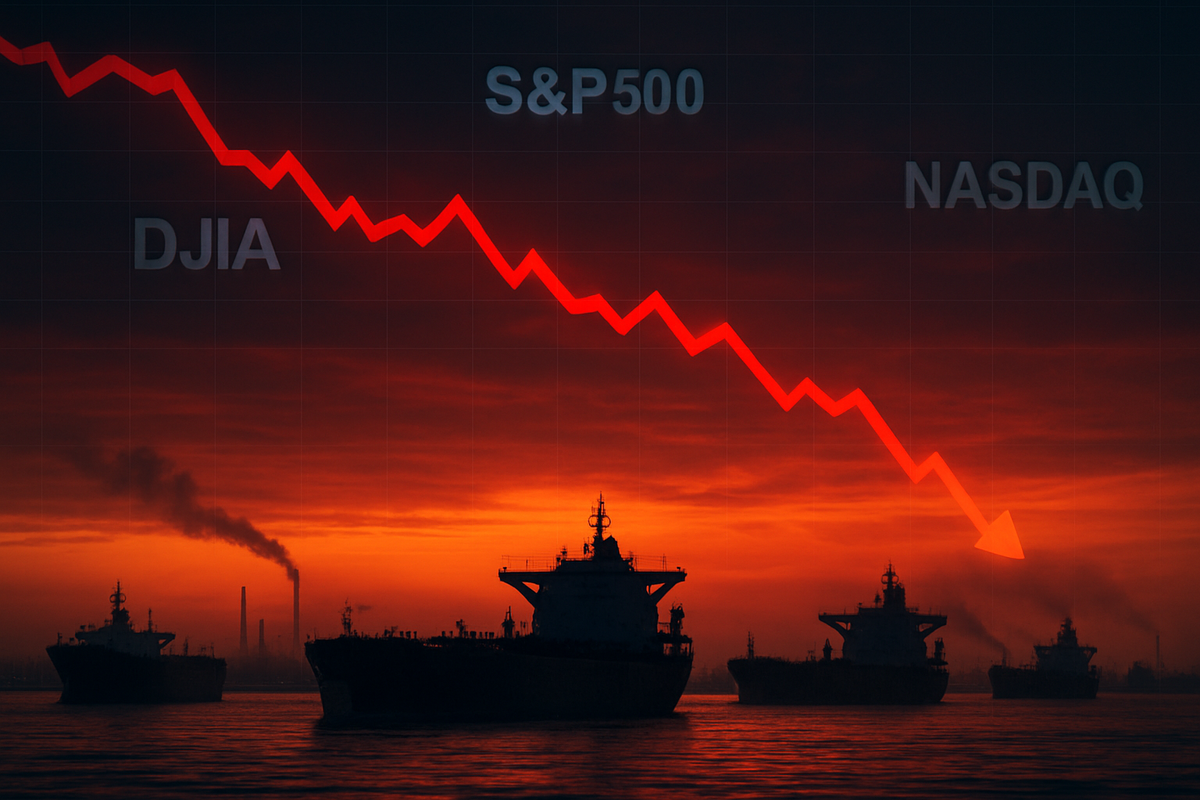
The global financial landscape was upended this week as escalating military conflict in the Middle East triggered a violent 7% surge in crude oil prices, forcing investors to recalibrate their expectations for inflation and monetary policy. As of March 5, 2026, the sudden volatility has shattered the relative calm of the first quarter, with both West Texas Intermediate (WTI) and Brent crude benchmarks gapping higher following a weekend of unprecedented regional instability.
The immediate implications for the U.S. stock market have been stark. Equity futures pointed toward a significant retreat for the S&P 500 and the Nasdaq as the prospect of "sticky" energy-driven inflation dampened hopes for the Federal Reserve’s anticipated spring rate cuts. With the energy sector decoupling from a broader market sell-off, the shockwaves are being felt from the gas pump to the bond market, raising fears that the central bank’s long-sought "soft landing" may be in jeopardy.
Escalation and the Closure of Hormuz
The current crisis traces its roots to the weekend of February 28, 2026, when coordinated strikes under "Operation Epic Fury" targeted key military infrastructure across Iran. The strikes, which reportedly resulted in the loss of senior Iranian leadership, triggered an immediate and aggressive retaliatory response. By March 2, Tehran’s forces had launched drone and missile barrages targeting U.S. installations and energy facilities across Kuwait, Qatar, and the United Arab Emirates. The most critical blow to global trade, however, was the effective closure of the Strait of Hormuz—the world’s most vital artery for oil transit—after marine insurers withdrew coverage amid the crossfire.
The reaction in the energy markets was instantaneous. As trading opened for the first week of March, Brent crude prices surged by nearly 13% at their peak, settling around $84.25 per barrel. Domestic WTI crude experienced a similar vertical climb, jumping over 7.25% to cross the $75 threshold. While OPEC+ attempted to soothe markets with a modest production increase of 206,000 barrels per day, the move was largely dismissed by analysts as "symbolic," given that the primary constraint is now the physical inability to transport existing supply through the Persian Gulf.
Initial market reactions reflected a classic flight to safety. Gold prices skyrocketed past $5,400 per ounce as investors sought shelter from the geopolitical storm. On the morning of March 3, U.S. stock futures plummeted, with the tech-heavy Nasdaq futures leading the decline with a 2% drop, as rising energy costs were viewed as a direct tax on consumer spending and a catalyst for higher corporate input costs.
Winners and Losers in a Volatile Tape
The energy shock has created a sharp divergence across various sectors of the U.S. market. Traditional energy giants have seen their valuations swell as the price of their primary commodity spikes. ExxonMobil (NYSE: XOM) and Chevron (NYSE: CVX) both saw their share prices climb in pre-market trading, benefiting from the immediate appreciation of global oil benchmarks. Defense contractors also emerged as notable winners in the current environment; Lockheed Martin (NYSE: LMT) and Northrop Grumman (NYSE: NOC) have seen increased investor interest as the potential for a prolonged regional conflict drives expectations for heightened military spending and replenishment of munitions.
Conversely, the travel and consumer discretionary sectors have been battered by the surge in input costs. Airlines, which are particularly sensitive to fluctuations in jet fuel prices, saw sharp sell-offs. Delta Air Lines (NYSE: DAL) and United Airlines (NASDAQ: UAL) faced significant pressure as analysts lowered earnings estimates to account for the overnight spike in operating expenses. Similarly, cruise operators like Carnival Corporation (NYSE: CCL) saw their stocks tumble as investors worried that higher gasoline prices—which jumped 13 cents per gallon nationally this week—would eat into the disposable income of vacationers.
Tech companies and other high-growth firms have also felt the heat. The prospect of the Federal Reserve maintaining higher interest rates to combat energy-led inflation has led to a valuation squeeze for companies that rely on future earnings. Small-cap stocks, often the most vulnerable to rising credit costs and economic uncertainty, have underperformed the broader indices, reflecting a growing caution among institutional traders.
A Policy Pivot: The Fed’s New Dilemma
The 7% surge in oil is more than just a commodity story; it is a fundamental threat to the Federal Reserve’s 2026 policy roadmap. Prior to this escalation, the consensus among economists was that the Fed would begin a cycle of rate cuts in March or May to normalize the economy. That narrative has now been replaced by a "hawkish tilt." Analysts from major financial institutions now project that the current oil spike could add 0.5 to 0.6 percentage points to headline PCE inflation, potentially pushing it back toward levels that would force the Fed’s hand.
This event fits into a broader historical pattern where energy shocks serve as "black swan" events that derail monetary easing cycles. Comparisons are already being drawn to the 1970s oil embargoes, though the U.S. is currently far more energy-independent than it was five decades ago. Nevertheless, the global nature of oil pricing means that U.S. consumers cannot escape the inflationary pressure. The Federal Reserve now faces a "no-win" scenario: cut rates to support a slowing economy and risk entrenched inflation, or hold rates high and potentially trigger a recession.
The ripple effects extend beyond the U.S. borders. The strengthening U.S. dollar, fueled by its status as a safe-haven currency, is putting immense pressure on emerging markets that carry dollar-denominated debt. Furthermore, the disruption in the Middle East is forcing a rapid re-evaluation of global supply chains, with many European partners looking to accelerate their pivot away from volatile energy corridors—a trend that may benefit U.S. liquefied natural gas (LNG) exporters in the long run.
The Path Forward: Scenarios and Strategic Pivots
In the short term, market participants should prepare for sustained volatility as the situation in the Strait of Hormuz remains fluid. If military tensions de-escalate and shipping lanes reopen, the "war premium" in oil prices could evaporate as quickly as it appeared. However, a prolonged blockade would likely push Brent crude toward the $100 mark, a level that historically triggers significant demand destruction and economic contraction.
Strategically, companies are already beginning to adapt. Logistics firms are re-routing cargo around the Cape of Good Hope, a move that increases shipping times and costs but ensures the safety of vessels. For investors, the focus is shifting toward "inflation hedges" and companies with high pricing power. We may see a renewed interest in renewable energy stocks and electric vehicle manufacturers as the vulnerability of the global fossil fuel supply chain is once again laid bare.
Looking further ahead, the 2026 outlook for the S&P 500 will likely be determined by the Fed’s upcoming March meeting. If the central bank signals a "hawkish hold"—maintaining rates while acknowledging the inflation risk—equity markets may find a floor, albeit at lower valuations. If the Fed hints at further rate hikes, the market could face a more protracted downturn as the cost of capital remains prohibitively high for many sectors.
Summary of the Market Landscape
The events of early March 2026 serve as a stark reminder of how quickly geopolitical events can dismantle economic forecasts. The 7% jump in oil prices has effectively reset the "inflation clock," putting the Federal Reserve on high alert and forcing a defensive posture across global equity markets. The transition from a focus on rate cuts to a focus on energy security has been swift and disruptive, leaving investors to navigate a landscape defined by uncertainty.
Moving forward, the primary metric to watch will be the status of the Strait of Hormuz and any further military retaliation in the Gulf. These factors will dictate the direction of oil prices, which in turn will drive the Fed's terminal rate projections. While the energy and defense sectors offer temporary sanctuary, the broader health of the market remains tethered to the stabilization of the Middle East.
Investors should remain vigilant, paying close attention to upcoming CPI and PCE data releases, which will provide the first statistical evidence of the conflict's impact on the domestic economy. For now, the "soft landing" narrative remains on ice as the world watches the unfolding drama in one of the globe's most critical energy hubs.
This content is intended for informational purposes only and is not financial advice.