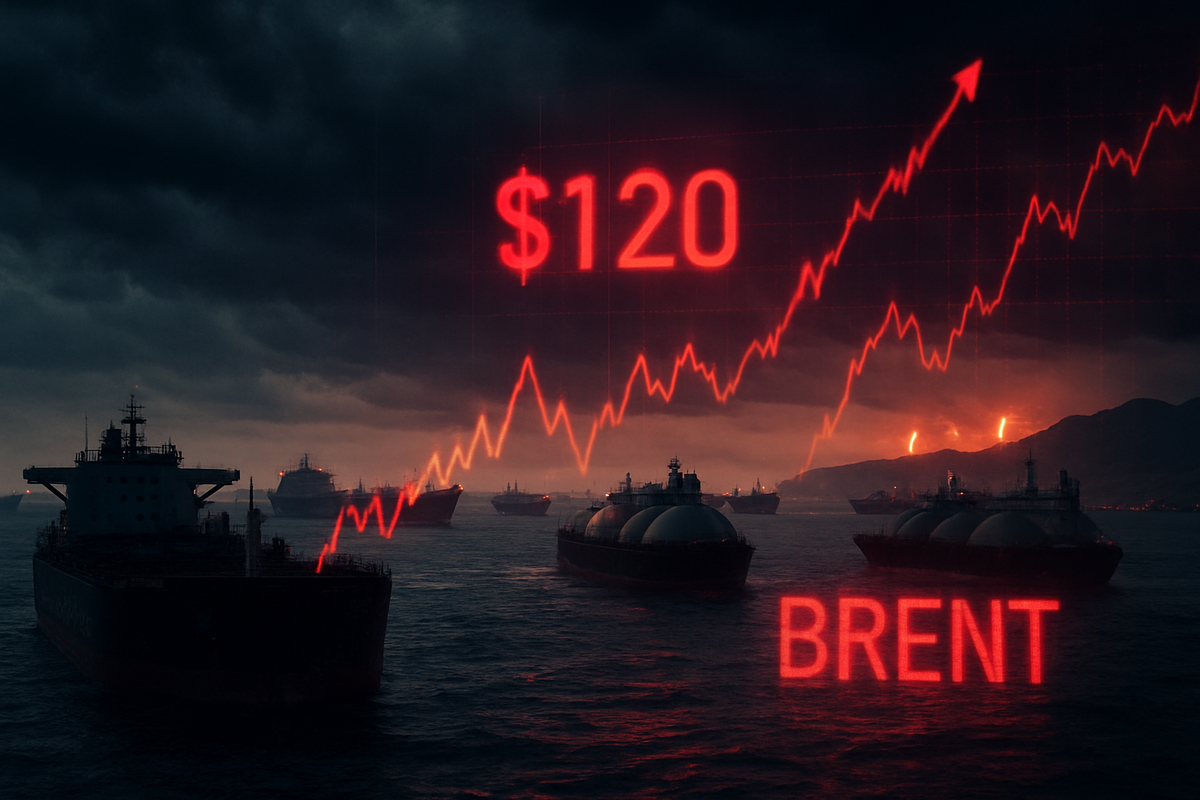
The global energy landscape has been thrust into a state of unprecedented chaos following the effective closure of the Strait of Hormuz, a critical maritime artery through which roughly 20% of the world’s oil and liquefied natural gas (LNG) flows. Following a sharp escalation in military hostilities between Iran and a U.S.-led coalition, the 21-mile-wide passage has been rendered impassable for commercial shipping, triggering a seismic shock to global supply chains and sending energy prices into a volatile upward spiral.
As of March 18, 2026, Brent Crude and West Texas Intermediate (WTI) have both breached the $115 mark, with Brent briefly touching $126 before stabilizing near $120. The shutdown of the Strait—long considered the world’s most vulnerable energy chokepoint—has removed over 20 million barrels of oil per day from the market, forcing major economies in Asia and Europe to scramble for dwindling alternatives. With no immediate resolution in sight, the crisis is threatening to derail global economic growth and ignite a new era of energy-driven inflation.
The Siege of the Strait: A Timeline of Escalation
The current crisis traces its roots to "Operation Epic Fury," a joint military campaign launched on February 28, 2026, by U.S. and Israeli forces targeting Iranian strategic infrastructure. In a swift and asymmetrical retaliation, Tehran deployed a sophisticated network of drone swarms, anti-ship missiles, and sea mines across the Strait of Hormuz. By March 2, the world’s largest shipping conglomerates, including Maersk and MSC, officially suspended all transits through the Persian Gulf, citing "unacceptable risks to crew and cargo."
The impact was instantaneous. The Strait is the sole exit for the petroleum exports of Iraq, Kuwait, Qatar, and Bahrain, and the primary outlet for Saudi Arabia and the UAE. While some regional producers have attempted to utilize bypass pipelines to the Red Sea and the Gulf of Oman, these routes can only handle a fraction of the displaced volume. Saudi Aramco (TADAWUL: 2222) has reportedly pushed its East-West Pipeline to a maximum capacity of 7 million barrels per day, yet even this heroic effort leaves a global shortfall of nearly 15 million barrels daily.
Key stakeholders, including the International Energy Agency (IEA), have authorized the release of strategic petroleum reserves, but the scale of the disruption dwarfs existing stockpiles. In Qatar, the world’s leading LNG exporter, production at the massive Ras Laffan complex has been curtailed after Iranian strikes targeted coastal loading facilities, effectively severing 20% of the global LNG trade at a time when Europe is still transitioning away from Russian gas.
Market Winners and Losers: The Great Energy Realignment
The closure has bifurcated the energy sector into clear winners and losers. Companies with production bases far from the Persian Gulf have seen their valuations soar. ExxonMobil (NYSE: XOM) and Chevron (NYSE: CVX) have emerged as the primary beneficiaries of the "safe barrel" premium. With significant assets in the U.S. Permian Basin, Guyana, and Brazil, these giants are providing much-needed supply to Western markets while their stock prices hit multi-year highs. Similarly, U.S.-focused upstream players like ConocoPhillips (NYSE: COP) and Occidental Petroleum (NYSE: OXY) have seen double-digit gains as WTI prices hover near record levels.
Conversely, the crisis has been devastating for companies with deep operational exposure in the Middle East. BP (NYSE: BP) was recently forced to evacuate non-essential personnel from its Iraqi operations following regional drone activity, and Shell (NYSE: SHEL) has faced significant earnings volatility due to its heavy reliance on Qatari LNG. Outside of the energy sector, the "losers" are led by the airline and logistics industries. American Airlines (NASDAQ: AAL), Delta Air Lines (NYSE: DAL), and United Airlines (NASDAQ: UAL) have all seen their shares plummet as jet fuel costs surge toward 40% of their operating expenses, forcing a new wave of fuel surcharges and flight cancellations.
The maritime sector has also seen a dramatic split. While tanker traffic inside the Strait has halted, firms operating on "safe" global routes are reaping a windfall. Frontline (NYSE: FRO) and Teekay Tankers (NYSE: TNK) have seen charter rates for Suezmax vessels skyrocket as the market bids up any available ship capable of hauling crude from West Africa or the Americas to energy-starved Asian hubs. Defense contractors, including Lockheed Martin (NYSE: LMT) and RTX (NYSE: RTX), have also seen increased demand as regional allies rush to bolster their missile defense systems.
A Geopolitical Pivot: The Wider Significance
This event represents a fundamental shift in the concept of global energy security. For decades, the "Hormuz Dilemma" was largely a theoretical risk, but its realization in 2026 has exposed the fragility of the "just-in-time" energy model. Asia is bearing the brunt of the crisis, as 80% of the oil transiting the Strait is destined for markets in China, India, Japan, and South Korea. India, in particular, is facing an acute energy shortage, with millions of tons of crude currently "stuck" in vessels idling outside the conflict zone.
The crisis also serves as a stark historical parallel to the "Tanker War" of the 1980s, though the current technological sophistication of Iranian naval assets makes the blockade far more effective and difficult to clear. Regulatory and policy implications are already emerging; G7 nations are discussing a "Maritime Security Corridor" that would require a massive naval escort program, effectively militarizing the world's most profitable trade routes. Furthermore, the total loss of Qatari LNG is likely to accelerate Europe’s pivot toward North American LNG and renewable energy infrastructure, potentially permanently altering trade patterns.
The Path Ahead: Strategic Pivots and Scenarios
In the short term, the market remains on a knife-edge. If the Strait remains closed for more than 30 days, analysts at major financial institutions warn that Brent crude could spike toward $150 per barrel, a level that would almost certainly trigger a global recession. The immediate focus for the U.S. and its allies will be a de-escalation effort or a coordinated military "mine-clearing" operation, though both carry the risk of further widening the conflict.
Longer-term, the world is likely to see a massive investment in bypass infrastructure. Saudi Arabia’s success in utilizing its East-West Pipeline will likely lead to calls for doubling its capacity, while the UAE may look to expand the ADCOP pipeline to the port of Fujairah. For the energy giants, the "safe-haven" status of the Permian Basin and South American offshore projects will only strengthen, likely leading to a wave of mergers and acquisitions as companies seek to insulate their portfolios from Middle Eastern volatility.
Closing the Loop: What to Watch
The effective shutdown of the Strait of Hormuz is the single most significant energy event of the decade. It has demonstrated that despite the global transition toward greener energy, the world remains precariously dependent on a handful of maritime chokepoints. For investors and market participants, the coming months will be defined by the resilience of the U.S. shale sector and the ability of Asian economies to navigate a period of prolonged energy scarcity.
The key metrics to watch include the weekly inventory draws from the U.S. Strategic Petroleum Reserve, the success rate of the Saudi East-West Pipeline bypass, and any signs of diplomatic thawing that could reopen the Strait. While the current $120 price point is painful, the "fear premium" could rise even further if military tensions expand to include attacks on production facilities in the Saudi Eastern Province or the UAE's offshore rigs. For now, the global energy market is in survival mode, waiting for a resolution to a crisis that has rewritten the rules of the game overnight.
This content is intended for informational purposes only and is not financial advice.