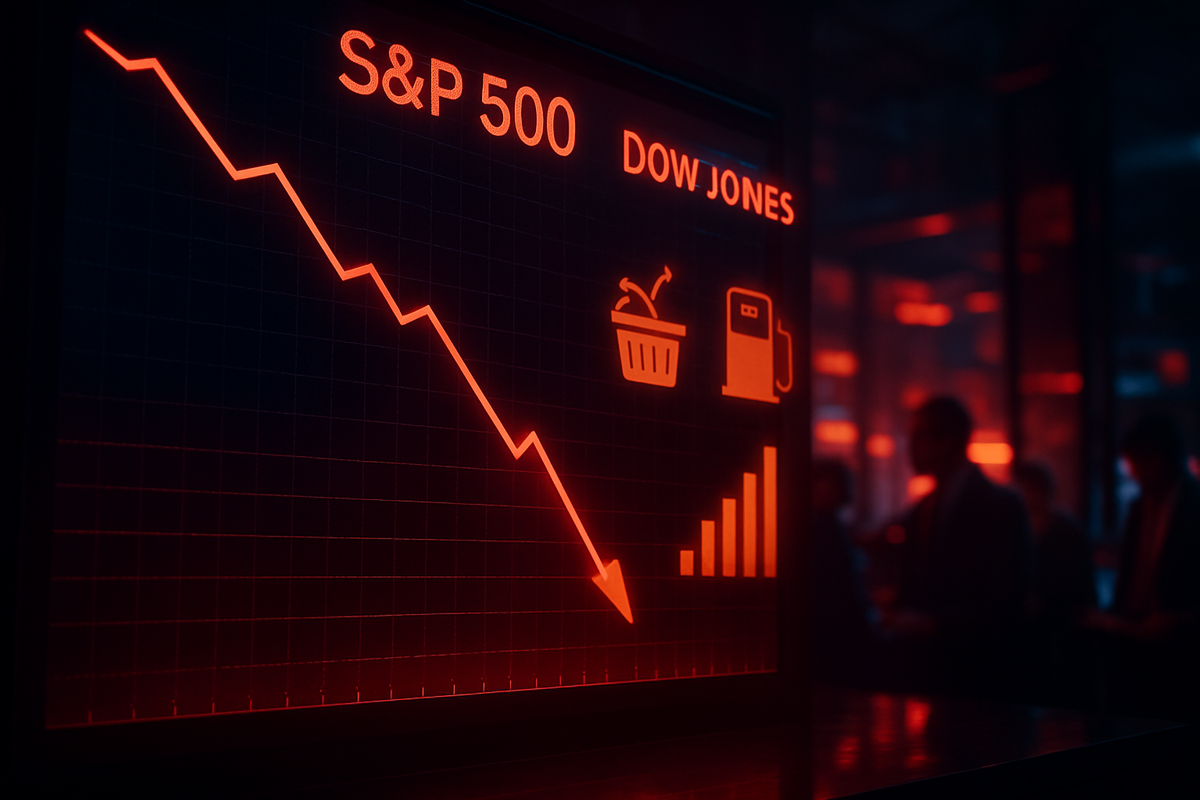
The optimism that defined the start of 2026 evaporated on Friday as the S&P 500 and the Dow Jones Industrial Average suffered their steepest single-day declines in months. A surprise surge in the January Personal Consumption Expenditures (PCE) price index—the Federal Reserve’s preferred inflation gauge—shattered the prevailing narrative that price pressures were on a permanent "glide path" toward the 2% target. The data, released on the morning of February 27, 2026, sparked a massive sell-off as traders recalibrated their expectations for the path of interest rates.
The immediate fallout was visible across all sectors, but high-growth technology and consumer discretionary stocks bore the brunt of the damage. With the 10-year Treasury yield spiking in response to the data, the market's hope for a series of interest rate cuts throughout the remainder of 2026 has been thrown into serious doubt. Investors, who had priced in a "neutral" monetary policy by mid-year, are now confronting the reality of a Federal Reserve that may be forced to keep the federal funds rate at its current 3.50%–3.75% range for much longer than anticipated.
Red Friday: A Morning of Market Turmoil
The turmoil began at 8:30 AM ET when the Bureau of Economic Analysis reported that the Core PCE Price Index rose 0.5% in January, significantly higher than the 0.2% consensus estimate. On an annual basis, core inflation accelerated to 3.1%, up from 2.8% in December. This unexpected "heat" in the data follows a string of January reports that suggested a cooling labor market, leading many analysts to believe that the "last mile" of the inflation fight was already won. Instead, the February 27 report suggested that service-sector inflation and housing costs remain stubbornly entrenched.
The market reaction was instantaneous. The S&P 500 (INDEXSP:.INX) dropped over 2.4% within the first hour of trading, while the Dow Jones Industrial Average (INDEXDJX:.DJI) shed more than 800 points. The volatility was exacerbated by the timing of the release, occurring just as the market was testing record highs near the 7,700 level for the S&P 500. Automated trading systems and institutional de-risking added fuel to the fire, as the "higher-for-longer" fear—a ghost from the 2023-2024 era—returned to haunt Wall Street.
Key stakeholders, including Federal Reserve officials who had recently hinted at a potential rate cut in May, were caught in a difficult position. Fed Governor Christopher Waller, who spoke earlier this month about the possibility of a pause, may now find the committee leaning toward a more hawkish stance. The shift in sentiment was reflected in the fed funds futures market, which saw the probability of a May rate cut plummet from 65% to less than 15% in a matter of hours.
Winners and Losers in a Rising Rate Environment
The most significant casualties of the day were the "Magnificent" tech giants that have led the market’s AI-driven rally. Nvidia (NASDAQ: NVDA) and Microsoft (NASDAQ: MSFT), which carry heavy weightings in both the S&P 500 and the Nasdaq, saw their share prices tumble by 4.2% and 3.5%, respectively. These companies, while fundamentally strong, are highly sensitive to the discount rates used to value future cash flows; as yields rise, their present valuations become harder to justify for risk-averse investors. Similarly, Tesla (NASDAQ: TSLA) faced pressure as concerns mounted that higher borrowing costs would further dampen consumer demand for big-ticket electric vehicles.
On the other side of the ledger, a few sectors managed to hedge against the broader downturn. Large-cap financial institutions like JPMorgan Chase & Co. (NYSE: JPM) and Goldman Sachs (NYSE: GS) initially showed resilience, as higher interest rates can bolster net interest margins. However, even these gains were capped by fears that a prolonged period of high rates could eventually trigger a hard landing for the economy. The insurance sector also saw modest interest, as higher yields improve the returns on their massive fixed-income portfolios.
Energy and industrial stocks were a mixed bag. While Caterpillar Inc. (NYSE: CAT) fell on fears of slowing global construction activity, companies tied to the physical infrastructure of the AI boom—such as utilities and specialized data center REITs—fared slightly better. Investors are beginning to differentiate between "growth at any price" and "essential infrastructure," a trend that may accelerate if inflation remains sticky throughout the first half of 2026.
Analyzing the Significance: A Return to 2023 Parallels?
This event marks a pivot point in the 2026 market narrative. For the past six months, the consensus was that the U.S. economy had achieved a "soft landing," with inflation receding and growth remaining robust due to AI productivity gains. The February 27 data challenges this "Goldilocks" scenario. It suggests that the transition to a 2% inflation target is not linear and that the secondary effects of 2025 tariff implementations and rising energy costs may be filtering through the economy faster than expected.
The ripple effects extend beyond the stock market to the global stage. A stronger-than-expected dollar, fueled by rising U.S. yields, is putting pressure on emerging markets and European equities. Historically, when the Fed is forced to pivot back to a hawkish stance, it creates a "liquidity vacuum" that sucks capital out of riskier assets and back into the safety of U.S. Treasuries. Today’s market action is a stark reminder of the 2022-2023 period, when similar inflation surprises led to prolonged bear market conditions.
From a policy perspective, the January PCE print complicates the upcoming transition at the Federal Reserve. With Chair Jerome Powell’s term set to expire in May 2026, the prospect of a leadership change during an inflation flare-up introduces an additional layer of political and economic uncertainty. Candidates rumored for the position may now be judged on their perceived "inflation-fighting" credentials, potentially leading to a more aggressive policy path than the market had previously anticipated.
The Road Ahead: Scenarios for Spring 2026
In the short term, investors should prepare for heightened volatility as the market searches for a new floor. The S&P 500 is likely to test its 50-day moving average, and any further signs of economic overheating in next month’s jobs report could lead to a deeper correction. Strategic pivots are already underway at major hedge funds, which are shifting toward "defensive value" and "quality" stocks that offer reliable dividends and low debt-to-equity ratios.
The long-term outlook depends entirely on whether this PCE print is a "one-off" anomaly or the start of a new inflationary trend. If subsequent data in March and April shows a cooling, the February 27 "Red Friday" may be remembered as a healthy correction in a broader bull market. However, if inflation remains above 3%, the Federal Reserve may be forced to consider a "terminal rate" higher than 4%, a move that would fundamentally re-rate the entire equity market and potentially end the post-2024 expansion.
Market opportunities may emerge for those with a long time horizon. While the headline indices are sinking, the underlying "productivity boom" driven by agentic AI remains intact. Companies that can demonstrate real-world cost savings and efficiency gains through technology will likely decouple from the macro-driven sell-off once the initial panic subsides. Investors will be looking for "earnings over hype" as the primary criteria for portfolio selection in this new, more disciplined environment.
Wrap-Up and Investor Outlook
The events of February 27, 2026, serve as a potent reminder that the battle against inflation is rarely won in a straight line. The sinking of the S&P 500 and the Dow Jones Industrial Average has effectively reset market expectations, wiping out billions in market value and forcing a re-evaluation of the Federal Reserve’s timeline. The key takeaway for investors is that the "soft landing" is not a guaranteed destination, but a fragile state that requires constant vigilance.
Moving forward, the market is likely to remain in a defensive posture. The coming months will be dominated by "Fed-speak" and high-frequency economic data as participants look for any sign that the January inflation spike was transitory. The focus will shift from "when will the Fed cut?" to "will the Fed have to hike?"—a question few expected to be asking in 2026.
For now, the advice for the average investor is to watch the bond market closely. The 10-year Treasury yield is currently the most important indicator of market health; until it stabilizes, equities will likely remain under pressure. While the AI revolution continues to provide a long-term tailwind, the short-term reality is that "Cash is King" once again, at least until the inflation fog begins to clear.
This content is intended for informational purposes only and is not financial advice.