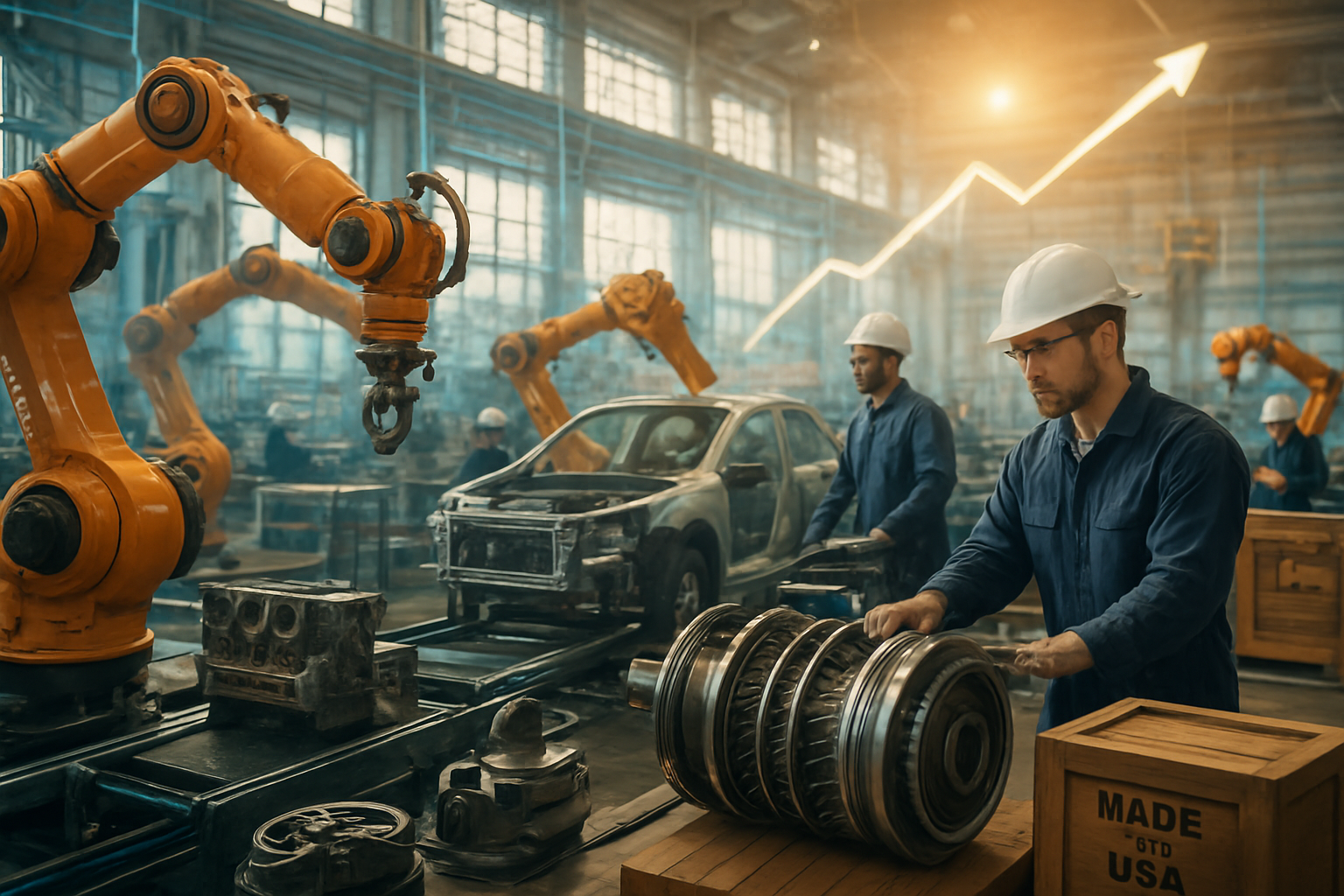
The United States manufacturing sector, long written off by skeptics as a casualty of high interest rates and global trade volatility, has roared back to life in early 2026. Fresh data released this week shows that manufacturing output rose by a surprising 0.7% in January, more than doubling consensus estimates of 0.3%. This surge in production was further validated by the Philadelphia Fed Manufacturing Index, which leaped to 16.3 in February—a five-month high that suggests the industrial heartland is entering a "second gear" of expansion.
These figures have sent a jolt through financial markets, effectively recalibrating the narrative for the broader US economy. Instead of the "soft landing" many economists predicted for 2026, the data points toward a "no-landing" scenario: a situation where the economy continues to accelerate despite the Federal Reserve’s benchmark interest rates remaining between 3.50% and 3.75%. The resilience of the factory floor is now the primary driver of a revised economic outlook that prioritizes domestic production over globalized supply chains.
A High-Tech Rebirth on the Factory Floor
The 0.7% rise in January manufacturing output was spearheaded by a 0.8% increase in durable goods production, marking the strongest monthly performance for the sector in nearly a year. This growth was not evenly distributed but was concentrated in high-tech machinery and electronics, fueled by a massive infrastructure build-out for artificial intelligence. Domestic factories are now operating at a capacity utilization rate of 76.2%, as companies scramble to meet a sudden influx of new orders for data center hardware and advanced electronics.
This manufacturing renaissance is largely being credited to the "One Big Beautiful Bill Act" (OBBBA) of 2025, which introduced 100% bonus depreciation and aggressive incentives for domestic modernization. The timeline of this recovery began in late 2025, when supply chains finally stabilized following years of post-pandemic fluctuations. By the time January 2026 arrived, the combination of policy incentives and a surge in AI-related demand created a perfect storm for industrial growth.
The Philadelphia Fed’s February reading of 16.3 provided the psychological "all-clear" for the sector. While the headline number was robust, sub-indices revealed a complex internal dynamic: the future activity index spiked to 42.8, indicating extreme optimism for the coming six months. However, the employment index dipped slightly to -1.3, suggesting that manufacturers are increasingly leaning on automation and "low-hire" strategies to boost output rather than traditional labor expansion.
Winners and Losers in the New Industrial Era
Industrial giants like Caterpillar Inc. (NYSE: CAT) have emerged as clear winners in this environment. Caterpillar reported a record $51 billion backlog in early 2026, driven primarily by its Power and Energy segment. The company’s large-scale generators are in high demand for AI data centers, offsetting a projected $2.6 billion headwind from current trade tariffs. Similarly, GE Aerospace (NYSE: GE) has capitalized on the trend, forecasting double-digit revenue growth for 2026 as it pivots toward high-margin aftermarket services for an aging global airline fleet.
The automotive sector is also seeing a dramatic reshuffling. Ford Motor Co. (NYSE: F) recently announced plans to boost its F-Series production by 50,000 units in 2026, pivoting away from pure electric vehicles (EVs) to focus on more profitable hybrid and gas-powered trucks. Meanwhile, General Motors (NYSE: GM) is aggressively moving production of its popular SUV models from Mexico to plants in Tennessee and Kansas. This move is designed to mitigate the impact of the 2025 tariff regime and align with the "Made in America" incentives that are currently driving the 0.7% output rise.
However, not all players are faring equally. Smaller manufacturers that lack the capital to automate are struggling with a "Prices Paid" index that hit 38.9 in February, signaling persistent inflationary pressure on raw materials. While Deere & Company (NYSE: DE) has seen its stock rally 27% year-to-date due to a recovery in construction demand, it must still navigate over $1.2 billion in annual tariff costs. The "winners" in 2026 are those with the scale to reshore production and the technology to maintain margins in a high-cost environment.
The Macro Significance: "Higher for Longer" Returns
The resilience of US manufacturing has profound implications for the Federal Reserve’s policy trajectory. Entering 2026, many traders were betting on a series of rate cuts beginning in March. Those expectations have now evaporated. With manufacturing output surging and the "no-landing" scenario gaining traction, the Fed is likely to maintain its current interest rate levels well into the third quarter of 2026. The "Prices Paid" component of the Philly Fed report suggests that inflation remains stickier than the central bank's 2% target, particularly as the 2025 tariff regime raises the cost of imported components.
Historically, such a sharp rise in the Philly Fed Index has been a precursor to sustained economic heat. Comparing this to the mid-1990s expansion, economists note that the current cycle is unique because it is being driven by a structural shift—reshoring—rather than just a cyclical rebound. This trend has ripple effects on competitors in Europe and Asia, who are seeing a "capital flight" toward the US as manufacturers seek to benefit from the OBBBA incentives and proximity to the world’s largest consumer market.
Furthermore, the policy shift toward protectionism and domestic subsidies represents a departure from decades of globalized trade. This "new normal" means that manufacturing is no longer the "swing" sector of the economy that suffers first during rate hikes; instead, it has become a resilient pillar bolstered by national security interests and the race for AI supremacy.
What Lies Ahead: Strategic Pivots and Market Risks
In the short term, investors should prepare for a period of market volatility as the reality of "higher for longer" interest rates sinks in. While the manufacturing data is positive for growth, it complicates the valuation of growth stocks that depend on cheap capital. Companies will likely continue their strategic pivots toward automation; we can expect to see increased capital expenditures (CAPEX) in robotics and AI-integrated assembly lines as firms seek to bypass the stagnant labor market reflected in the Philly Fed’s employment sub-index.
The long-term outlook remains bullish for the "re-industrialization" of America, but challenges remain. If the Fed is forced to keep rates at 3.75% or higher through 2027 to combat "tariff-flation," the cost of servicing industrial debt could begin to eat into the very CAPEX that is driving current growth. A potential scenario involves a "bifurcated recovery," where tech-enabled industrial leaders thrive while traditional, debt-laden manufacturers are squeezed out.
Summary and Investor Outlook
The January and February data for 2026 has confirmed that US manufacturing is undergoing a structural transformation. The 0.7% rise in output and the 16.3 Philly Fed reading are not just statistical anomalies; they are the results of a concerted policy shift toward reshoring and a technological revolution in the form of AI infrastructure.
Key Takeaways for Investors:
- The "No-Landing" is Real: Strong industrial data suggests the US economy is not cooling as fast as expected, which will delay Federal Reserve rate cuts.
- Reshoring is the Driver: Watch companies like General Motors (NYSE: GM) and Caterpillar Inc. (NYSE: CAT) as they move production back to the US to capture tax incentives and avoid tariffs.
- Watch the Margin: With the "Prices Paid" index rising, focus on companies with high pricing power and advanced automation capabilities.
Moving forward, the market will be hyper-focused on the March industrial production report and the Fed’s July meeting. For now, the factory floor is once again the engine of American economic exceptionalism, proving that even in a high-interest-rate environment, the "Made in the USA" label is staging a formidable comeback.
This content is intended for informational purposes only and is not financial advice.