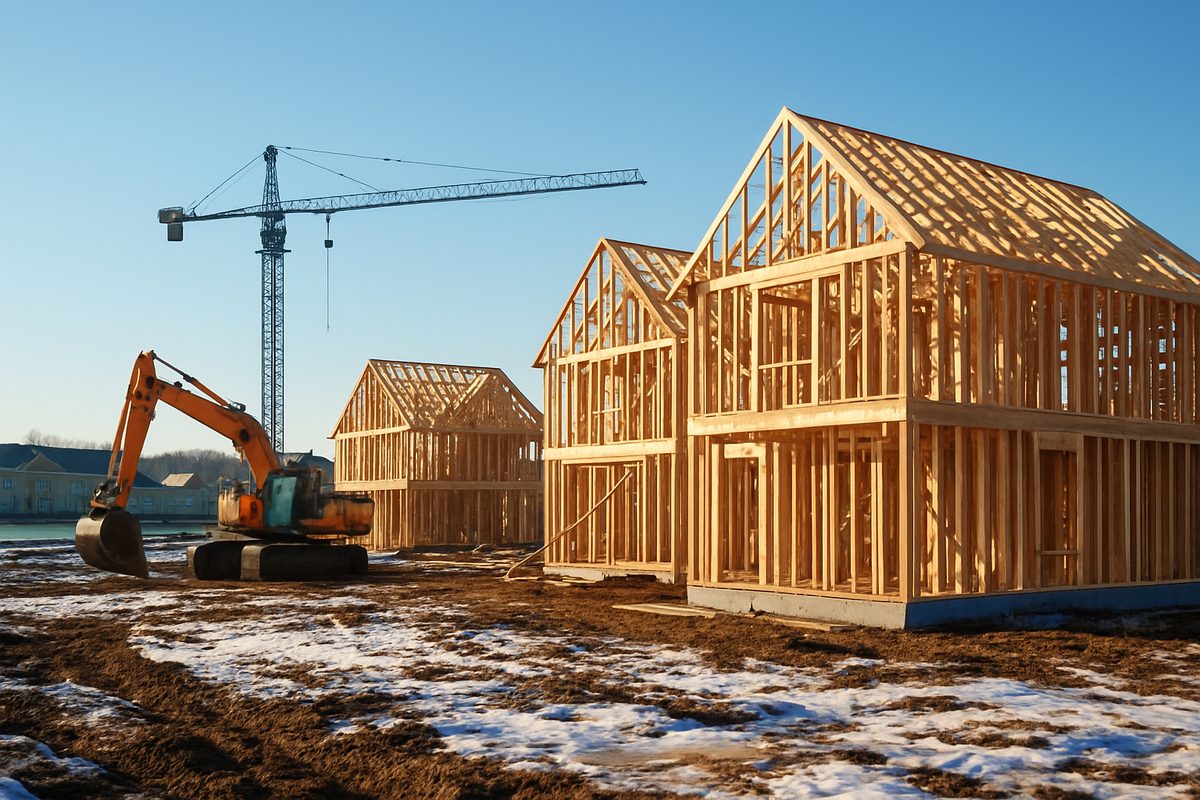
The American housing market, long shackled by the "lock-in effect" and a multi-year inventory drought, showed unexpected signs of a robust thaw this week. In a report released by the U.S. Census Bureau on February 18, 2026, housing starts for the previous period jumped a staggering 6.2%, signaling that homebuilders are finally finding their footing in a "higher-for-longer" interest rate environment. This surge suggests that despite elevated borrowing costs, the underlying demand for shelter remains a potent force in the U.S. economy.
The immediate implications of this data are far-reaching. While many economists predicted a seasonal winter slowdown, the jump to a seasonally adjusted annual rate (SAAR) of 1.404 million units in December—followed by an even more aggressive surge to 1.48 million units in January 2026—indicates a structural pivot. This suggests that the market has reached an equilibrium where buyers are no longer waiting for the return of 3% mortgage rates, but are instead adapting to a new normal of approximately 6%, supported by steady wage growth and a normalizing inventory of existing homes.
The Numbers Behind the Surge: A Winter Thaw for Construction
The recent data release was particularly noteworthy for its timing and scope. Due to a brief federal government shutdown earlier in the year, the Census Bureau provided a "double-barreled" update covering both December 2025 and January 2026. The 6.2% jump in December starts brought the pace to 1.404 million units, the highest level since mid-2025. However, it was the January 2026 figure of 1.48 million units that truly caught Wall Street off guard, representing a nearly 4% month-over-month increase from an already strong baseline.
The rebound was led by the single-family sector, which saw starts climb to an annualized rate of 981,000 units—the strongest pace in ten months. Multifamily construction, often more sensitive to financing costs, also saw a resurgence, with units in buildings of five or more jumping 10.1% to reach a three-month high. Regionally, the construction boom was most pronounced in the Northeast and the West, where building permits—a leading indicator of future activity—surged by 44.1% and 37.4% respectively.
This momentum has been building since late 2025, as the 10-year Treasury yield retreated to approximately 4.08%. This move in the bond market allowed the average 30-year fixed mortgage rate to settle at 6.01% by mid-February 2026, its lowest level since September 2022. The drop in rates triggered a 183% year-over-year spike in refinance applications and gave builders the confidence to break ground on new projects intended for the 2026 spring selling season.
Key stakeholders, including the Federal Housing Finance Agency (FHFA), led by Director Bill Pulte, have been closely monitoring this activity. The sudden burst in starts is seen as a crucial pressure valve for a market that has suffered from a decade-long supply deficit. Market reactions were immediate; on the day of the release, major homebuilder indices saw modest gains as investors recalibrated their expectations for 2026 earnings, though gains were tempered by concerns over potential regulatory "sticks" regarding corporate capital allocation.
Winners, Losers, and the Regulatory Crosshairs
The primary beneficiaries of this construction surge are the nation’s largest homebuilders, who have used their scale to navigate the high-interest-rate environment. D.R. Horton, Inc. (NYSE: DHI), often referred to as the "Horton Machine," saw its stock rise 0.81% following the report. The company has announced a 12% expansion in community counts for 2026, positioning itself to capture the lion's share of entry-level demand. Similarly, Lennar Corporation (NYSE: LEN) gained 0.70%, benefiting from its "land-light" strategy which allows it to ramp up production without the heavy carrying costs of owned land.
PulteGroup, Inc. (NYSE: PHM) also stands to win as its focus on "move-up" buyers aligns with the current demographic shift of aging Millennials seeking more space. However, these "Big Three" builders are facing a new kind of scrutiny. FHFA Director Bill Pulte has recently targeted these firms over their aggressive stock buyback programs. In late 2025 and early 2026, the industry collectively spent over $7 billion on share repurchases, a move Pulte criticized as being at odds with the national need for affordable housing. The FHFA has signaled that future access to secondary market liquidity could be tied to a builder’s commitment to lower-priced inventory.
On the losing end of this trend are the small, local "mom-and-pop" builders who lack the capital to offer the mortgage rate buydowns that have become essential to closing sales. While D.R. Horton can subsidize a buyer’s rate down to 5.5%, smaller firms are forced to compete on price alone in a market where land and labor costs remain stubbornly high. Furthermore, some regional markets in Florida and Texas are seeing an "inventory overhang," where a surplus of completed new homes is beginning to weigh on prices, potentially hurting builders with heavy exposure to those specific geographies.
The building materials sector, represented by giants like The Home Depot, Inc. (NYSE: HD) and Lowe's Companies, Inc. (NYSE: LOW), is also seeing a mixed impact. While new construction boosts bulk sales, the stagnation in existing home sales—down from their 2021 peaks—means the "renovate-to-sell" market remains soft. However, if the 6.2% jump in starts translates into a sustained trend, these retailers could see a significant lift in professional contractor sales throughout the second half of 2026.
A Structural Shift in the American Housing Narrative
The January surge in housing starts is more than just a statistical outlier; it represents the "Great Housing Reset" of 2026. This period marks a definitive shift away from the gridlock of 2023–2025, where high rates effectively froze the market. For the first time since the 2008 financial crisis, wage growth in early 2026 is outpacing home price growth, which is projected to stall at a 0–1% increase this year. This "cooling of the fever" is allowing the market to return to its long-term historical average of approximately 1.43 million starts.
Historically, 2026 was feared by some as the potential end of an "18-year property cycle" that began with the 2008 crash. However, the current data paints a different picture. Unlike the subprime era, today’s homeowners sit on record levels of equity, with nearly 46% of owners holding 50% or more equity in their homes. The current "bust" is not one of foreclosures and systemic collapse, but rather one of volume and price calibration. The 6.2% jump in starts is a signal that the "new normal" of 6% mortgage rates is a viable environment for growth, provided that supply continues to expand.
From a policy perspective, the shift under the current administration toward a "risk-based supervisory framework" at the FHFA is significant. By proposing an increased role for Private Label Securities (PLS), the agency is signaling a move toward the eventual re-privatization of Fannie Mae and Freddie Mac. This regulatory environment favors transparency and market-driven pricing over the federal interventions seen in the early 2020s. The surge in starts provides the political cover necessary to pursue these reforms, as it proves the private sector can still deliver housing without zero-interest-rate subsidies.
The ripple effects are also being felt in the rental market. The 10.1% jump in multifamily starts indicates that developers are betting on a continued demand for high-quality rental units as homeownership remains out of reach for many. This could lead to a stabilization of rent inflation in late 2026 and 2027, providing a crucial tailwind for the Federal Reserve as it attempts to bring overall inflation back to its 2% target.
Forecast 2026: Stability Amidst Scrutiny
Looking ahead, the short-term outlook for the housing market is one of "cautious optimism." Most economists expect mortgage rates to hover near 6% for the remainder of 2026, with a possible dip toward 5.75% if the Federal Reserve implements its projected 25-basis-point cuts later this year. For homebuilders, the strategic pivot will involve balancing volume with affordability. We should expect to see more "missing middle" housing—townhomes and smaller single-family units—as builders attempt to appease both the FHFA and a price-sensitive consumer.
Market opportunities are emerging in the "Private Label" space. As the FHFA pushes for less reliance on government-sponsored enterprises (GSEs), new financial products and niche lenders may step in to fill the gap. Additionally, the increase in housing starts will likely lead to a "catch-up" period for infrastructure and utility companies, as new communities require significant investment in local services. This could provide a secondary boost to the industrial and utilities sectors of the stock market.
The primary challenge moving forward will be the "affordability gap." Even with a 6.2% jump in production, the U.S. remains millions of units short of meeting long-term demand. Any sudden spike in inflation or a reversal in the 10-year Treasury yield could quickly stifle this nascent recovery. Investors should also watch for the results of an ongoing antitrust probe into the "Leading Builders of America" trade group, which could disrupt the pricing power currently enjoyed by the industry’s largest players.
Final Outlook: Building Through the Noise
The 6.2% surge in U.S. housing starts is a testament to the resilience of the American consumer and the strategic agility of the nation's largest homebuilders. It confirms that the housing market has survived the most aggressive interest rate hiking cycle in decades and has emerged with a clearer, more sustainable trajectory. For investors, the takeaway is clear: the "Horton Machine" and its peers are well-capitalized and ready to build, but they must now navigate a more complex regulatory landscape that prioritizes affordability over shareholder returns.
Moving forward, the market should be watched for three key indicators: the persistence of the 6% mortgage rate floor, the impact of FHFA’s "buyback-to-building" pressure, and the rate of inventory normalization in the existing home market. If these factors remain balanced, 2026 could be remembered as the year the U.S. housing market finally found its "new normal" and began the long process of building its way out of a decade-long crisis.
While the "Great Housing Reset" may lack the explosive growth of the pandemic era, it offers something arguably more valuable: stability. For a market that has spent years oscillating between extremes, a return to historical averages and predictable demand is a welcome development for builders, buyers, and investors alike.
This content is intended for informational purposes only and is not financial advice