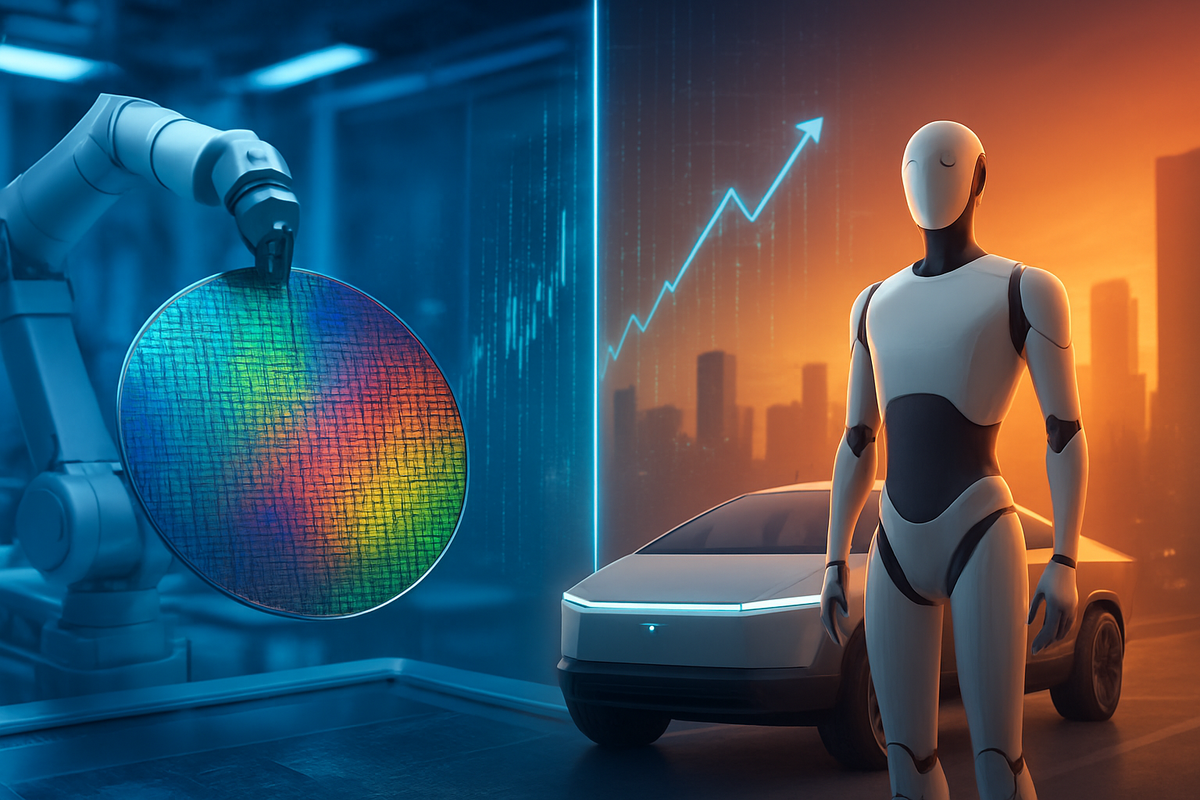
As the opening bell of 2026 rings across a landscape of shifting interest rates and evolving industrial policy, two of the market’s most watched titans—Intel and Tesla—are providing a masterclass in corporate reinvention. In a mixed market environment characterized by a Nasdaq Composite flirting with all-time highs and a Federal Reserve weighing its next move, these two companies have become the primary barometers for investor sentiment. While one is clawing its way back to manufacturing dominance, the other is aggressively trading its identity as an automaker for a future in robotics and artificial intelligence.
The divergence in their paths has created a complex puzzle for investors. Intel is finally reaping the rewards of a multi-year turnaround strategy centered on its domestic manufacturing capabilities, while Tesla is navigating a cooling electric vehicle (EV) market by doubling down on a high-stakes bet that its software and humanoid robots will justify a valuation that its car sales no longer can. As of January 8, 2026, the market is split between those rewarding tangible industrial progress and those betting on the long-term promise of autonomous systems.
The Manufacturing Milestone and the Delivery Dilemma
The first week of 2026 has been dominated by news from the Consumer Electronics Show (CES), where Intel (NASDAQ: INTC) officially declared victory in its quest to regain process leadership. The company announced that its 18A process node has reached high-volume manufacturing, a milestone that many analysts doubted was possible just two years ago. The launch of the Panther Lake processors, branded as Core Ultra Series 3, marks the first time Intel has utilized its proprietary RibbonFET and PowerVia technologies in consumer chips. This technological leap has helped push Intel’s stock to approximately $42.63, a significant recovery from its 2024 lows. The success of 18A has also solidified Intel Foundry as a powerhouse, with a reported $15 billion backlog and a surprising $5 billion private placement stake from Nvidia (NASDAQ: NVDA) to secure future capacity.
In stark contrast, Tesla (NASDAQ: TSLA) entered the new year facing a sobering reality in its core business. The company reported Q4 2025 deliveries of 418,227 vehicles, representing a 16% year-over-year decline. For the first time, Tesla has officially yielded its title as the world’s largest battery electric vehicle (BEV) manufacturer to BYD (OTC: BYDDY), which delivered over 2.26 million vehicles in 2025. However, Tesla’s stock has remained resilient, buoyed not by car sales, but by a series of AI breakthroughs. On January 2, Tesla’s AI team confirmed the first successful fully autonomous coast-to-coast drive across the U.S. using FSD V14, signaling that the company’s pivot toward a "Cybercab" future is accelerating despite the headwinds in the retail EV market.
Winners and Losers in the New Industrial Order
The primary winner in this current environment appears to be the broader U.S. semiconductor ecosystem. Intel’s resurgence, backed by a 10% non-voting equity stake from the U.S. Treasury Department as part of the 2025 CHIPS Act milestones, has provided a "national resilience" floor for the stock. This government-backed stability has made Intel a preferred partner for domestic tech giants. Apple (NASDAQ: AAPL) and AMD (NASDAQ: AMD) are reportedly in talks to evaluate Intel’s upcoming 14A node for production in 2027, a move that would have been unthinkable during Intel’s "stagnant" years. This shift suggests that the reliance on overseas foundries is beginning to crack, benefiting companies that can leverage domestic manufacturing.
Conversely, traditional EV-focused investors are finding themselves in a difficult position. Tesla’s transition away from high-volume growth has left a vacuum in the "affordable EV" space that is currently being filled by Chinese competitors like BYD and Xiaomi. While Tesla’s Energy segment remains a bright spot—deploying a record 14.2 GWh of storage in Q4 2025—the company’s traditional automotive rivals are struggling to match its software-first approach. Companies that bet heavily on a slow transition to EVs are now caught between a dominant BYD in the low-end market and a technologically superior (if volume-constrained) Tesla at the high end.
Broad Trends: Sovereign Silicon and the Autonomous Pivot
The performance of Intel and Tesla reflects two of the most significant trends of the mid-2020s: the rise of "Sovereign Silicon" and the "Autonomous Pivot." Intel’s success is a direct result of a global trend toward regionalizing high-tech supply chains. The "Big Beautiful Bill" (OBBBA), a major fiscal stimulus package passed in 2025, has provided a massive tailwind for industrial capex through permanent immediate expensing provisions. This has incentivized a wave of domestic investment that has fundamentally changed the risk profile of American manufacturing.
Tesla’s trajectory, meanwhile, represents the final decoupling of AI valuations from traditional industrial metrics. The market is no longer pricing Tesla as a car company; it is pricing it as a robotics conglomerate. This mirrors the historical precedent of Amazon’s transition from a bookstore to a cloud computing giant. The potential ripple effects are enormous—if Tesla successfully launches its "Cybercab" in April 2026 and its "Optimus V3" humanoid robot in March, it could redefine the labor market and urban transportation entirely. This shift is forcing competitors to decide whether they are in the business of moving people or the business of selling intelligence.
The Road Ahead: Catalysts and Challenges
The short-term outlook for the market remains "cautiously optimistic" as the Federal Reserve is expected to pause its rate-cutting cycle at the January 27–28 meeting, holding rates in the 3.50%–3.75% range. For Intel, the next six months will be about execution. The company must prove that its 18A yields can remain stable as it scales to meet the demands of its new foundry customers. Any slip in manufacturing consistency could quickly erase the gains made over the last year.
For Tesla, the spring of 2026 will be a "make-or-break" period. The scheduled debut of the $30,000 "Model 2" in May 2026 is critical to stemming the loss of market share to BYD. Simultaneously, the mass production of the Cybercab in April will serve as the ultimate test of Tesla’s FSD V14 software. If these launches are successful, Tesla could reclaim its narrative as a growth engine; if they falter, the "valuation reality check" that many analysts fear could lead to a significant correction in the tech-heavy Nasdaq.
Summary and Investor Outlook
As we move deeper into 2026, the key takeaway is that the "Magnificent Seven" era of uniform growth has been replaced by a more nuanced, execution-driven market. Intel has proven that a legacy giant can reinvent itself through sheer industrial will and strategic government partnership. Tesla has shown that a visionary company can maintain a premium valuation by successfully pivoting its core mission, even as its original product line matures and faces fierce competition.
Investors should watch the 18A yield reports from Intel and the regulatory approval of FSD in China and Europe for Tesla in the coming months. The market is currently rewarding companies that can demonstrate a clear path to AI monetization and manufacturing self-sufficiency. In this mixed environment, the winners will be those who can bridge the gap between high-concept technology and high-volume reality.
This content is intended for informational purposes only and is not financial advice.