The 2026 Consumer Electronics Show (CES) has officially marked the end of the "chatbot era," ushering in what industry leaders are calling the "Physical AI" pivot. As the Las Vegas convention halls hum with the whir of servo motors and the quiet glide of autonomous systems, the narrative has shifted from large language models that merely talk to "agentic" systems that can walk, grasp, and execute complex tasks in the real world. This transition represents a fundamental leap in artificial intelligence, moving the technology from digital screens into the three-dimensional reality of homes, factories, and city streets.
However, while the technological breakthroughs are undeniable, a palpable tension hangs over the desert air. Despite the spectacle of humanoids folding laundry and cars navigating with human-like logic, Wall Street has adopted a notably cautious stance. Investors, once intoxicated by the promise of generative AI, are now entering what analysts call the "Audit Year." In early 2026, the market is no longer satisfied with flashy demos; it is demanding a clear path to monetization and a rigorous accounting of the hundreds of billions spent on infrastructure.
From Chatbots to Kinetic Agents: The CES 2026 Landscape
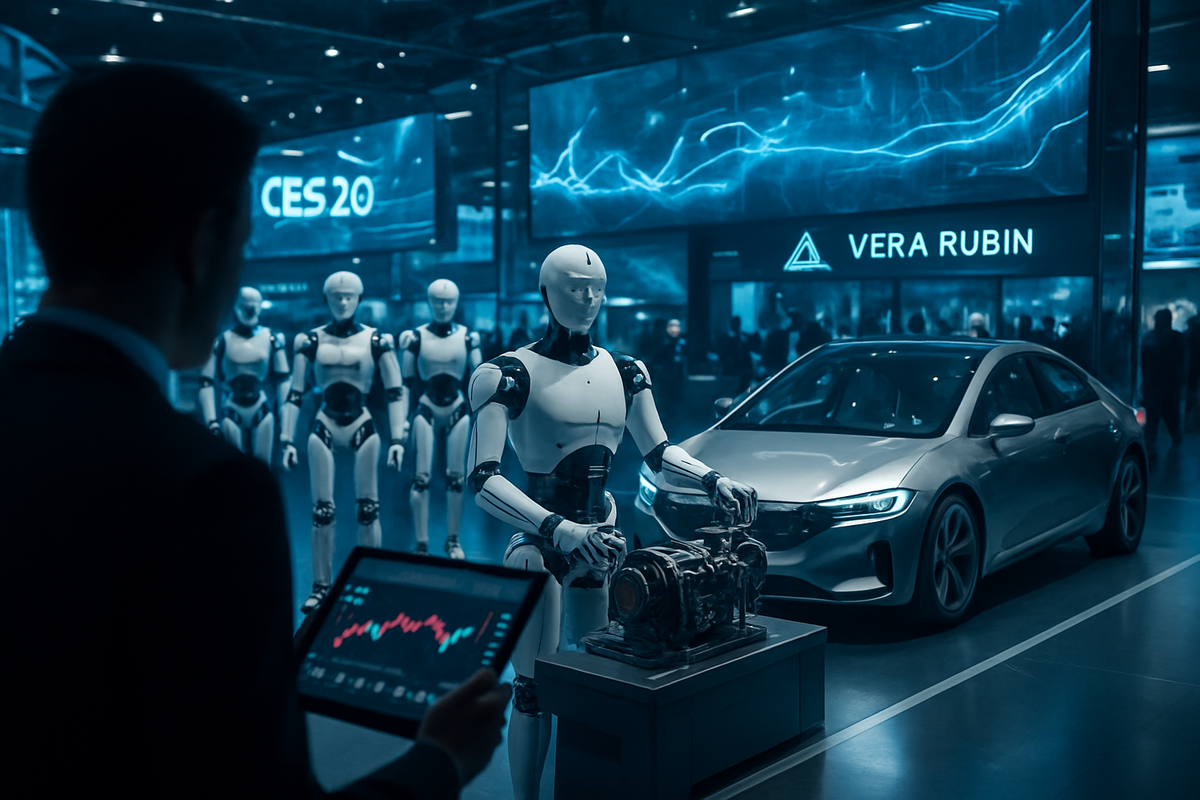
The centerpiece of the event was the keynote by Nvidia (NASDAQ: NVDA) CEO Jensen Huang, who unveiled the "Vera Rubin" architecture. This 3nm successor to the Blackwell line is specifically engineered for Physical AI, boasting five times the inference power required for the massive context memory of agentic systems. Nvidia also launched "Cosmos," a foundation model designed to teach robots the laws of physics—such as gravity and friction—within a simulated environment before they ever step onto a factory floor. This "simulation-to-reality" pipeline is seen as the critical bridge for the mass deployment of autonomous hardware.
The humanoid robotics sector saw its most significant commercial milestone yet. Boston Dynamics, backed by Hyundai (KRX: 005380), showcased the fully electric version of its Atlas robot, now ready for public commercial use in "software-defined factories." Not to be outdone, LG Electronics (KRX: 066570) debuted "CLOiD," a dual-arm humanoid assistant designed for "zero-labor homes," capable of autonomously managing household chores like loading dishwashers. Meanwhile, though not officially at CES, the shadow of Tesla (NASDAQ: TSLA) loomed large as rumors swirled regarding the impending launch of the Optimus Gen 3, which is expected to feature "V3 hands" with human-level dexterity for factory deployment later this year.
Initial market reactions have been mixed. While the hardware engineering on display is lightyears ahead of where the industry stood in 2024, the "Agentic AI" software—capable of booking flights, managing supply chains, and paying for parking without human oversight—has raised questions about reliability. SoundHound AI (NASDAQ: SOUN) introduced its "Amelia 7" voice ecosystem, which aims to handle autonomous consumer commerce, yet the stock saw only modest gains as traders weighed the potential for "hallucinated" transactions against the convenience of the service.
Winners, Losers, and the "Software Slog"
Nvidia remains the undisputed king of the hardware hill, but the 2026 landscape is becoming more crowded. Qualcomm (NASDAQ: QCOM) has emerged as a formidable challenger with its "Snapdragon X2 Plus" and "Dragonwing" chips, specifically designed for "Edge AI"—the ability for robots to process information locally without relying on a distant cloud server. This shift toward local processing is a win for Qualcomm and potentially a headwind for pure-play cloud providers who have benefited from centralized AI workloads.
On the losing side of the current sentiment are the software firms caught in the "Software Slog." Companies like Microsoft (NASDAQ: MSFT) and various enterprise SaaS providers are facing intense scrutiny from Wall Street. Analysts at Morgan Stanley (NYSE: MS) and Citi (NYSE: C) have noted that while these companies are spending record amounts on AI infrastructure, the productivity gains for their end-users have yet to translate into significant top-line growth. The market is increasingly rotating out of companies that "promise" AI and into those that can demonstrate "Physical AI" utility, such as Lenovo (HKG: 0992), which introduced "Agentic AI Services" to manage logistics for global supply chains.
The automotive sector is also seeing a divide. Mercedes-Benz (ETR: MBG) won accolades at the show for integrating Nvidia’s "Alpamayo" reasoning model into its CLA class, allowing for a level of autonomous navigation that relies on logic rather than simple pattern recognition. Conversely, legacy automakers who have been slow to pivot to "AI-first" architectures are finding themselves relegated to the status of mere hardware assemblers, losing the high-margin software battle to tech-integrated competitors.
The "Audit Year" and the Power Wall
The wider significance of CES 2026 lies in the industry's confrontation with physical reality. For the past two years, AI growth was limited only by code and data; now, it is limited by power and physics. The "Power Wall"—the massive energy demand of the next generation of data centers—has become a primary concern for regulators and investors alike. This has sparked a secondary boom in energy-efficient computing and localized "Edge AI" solutions, as the cost of sending every robotic movement through a centralized cloud becomes economically and environmentally unsustainable.
Historically, this moment mirrors the transition from the "dot-com" hype of the late 90s to the "build-out" phase of the early 2000s. Just as the market eventually demanded to see how the internet would actually sell books or groceries, the 2026 market is demanding to see how AI will actually move boxes or manufacture cars. Regulatory bodies are also catching up, with the first drafts of "Agentic Liability" frameworks being discussed in the EU and the US, seeking to determine who is responsible when an autonomous agent makes a financial or physical error.
Furthermore, the "Physical AI" pivot is creating a ripple effect across the global supply chain. The demand for High Bandwidth Memory (HBM4) and specialized sensors has led to a "sold-out" status for many components through the end of 2026. This scarcity is forcing a strategic pivot among smaller robotics startups, who must now decide whether to build their own hardware or become "agentic software" layers on top of platforms provided by giants like Tesla or Boston Dynamics.
The Road to 2027: Scaling and Adaptation
In the short term, the market will likely remain volatile as the "Audit Year" plays out. We expect to see a "great shakeout" of AI startups that lack a physical or agentic component. Strategic pivots are already underway; companies that once focused on generative art or text are now frantically rebranding as "Agentic Process Managers." The real market opportunity lies in the "scaling laws" for physical data. Just as LLMs were trained on the internet, the next generation of Physical AI is being trained on video data and robotic simulations, a frontier that is still largely up for grabs.
Long-term, the successful integration of humanoids into the workforce could address chronic labor shortages in manufacturing and eldercare. However, the "scenarios and outcomes" for 2027 and beyond depend heavily on whether these machines can move from "controlled demos" to "unstructured environments." If Tesla successfully deploys thousands of Optimus units in its own factories by mid-2026 as planned, it will serve as a "Sputnik moment" for the rest of the industrial world, likely triggering a massive wave of capital expenditure in robotics.
Summary and Investor Outlook
CES 2026 has proven that the "Physical AI" era is no longer a futuristic dream but a present-day industrial reality. The pivot from digital assistants to kinetic agents is the defining trend of the year, led by hardware giants like Nvidia and Qualcomm and pushed into the physical world by pioneers like Boston Dynamics and Tesla. However, the "Audit Year" sentiment means that the market is no longer grading on a curve. Investors should be prepared for a period of "fundamental scrutiny" where the winners will be those who can prove Return on Investment through tangible productivity gains.
Moving forward, watch for the "Power Wall" to dictate the pace of growth and for "Edge AI" to become the dominant architecture for autonomous systems. The key takeaways for investors are clear: prioritize companies with a foothold in the physical world, watch the progress of humanoid deployment in factories as a lead indicator for the broader economy, and remain wary of software providers who cannot demonstrate a clear path out of the "Software Slog." The era of AI that talks is over; the era of AI that does has begun.
This content is intended for informational purposes only and is not financial advice.