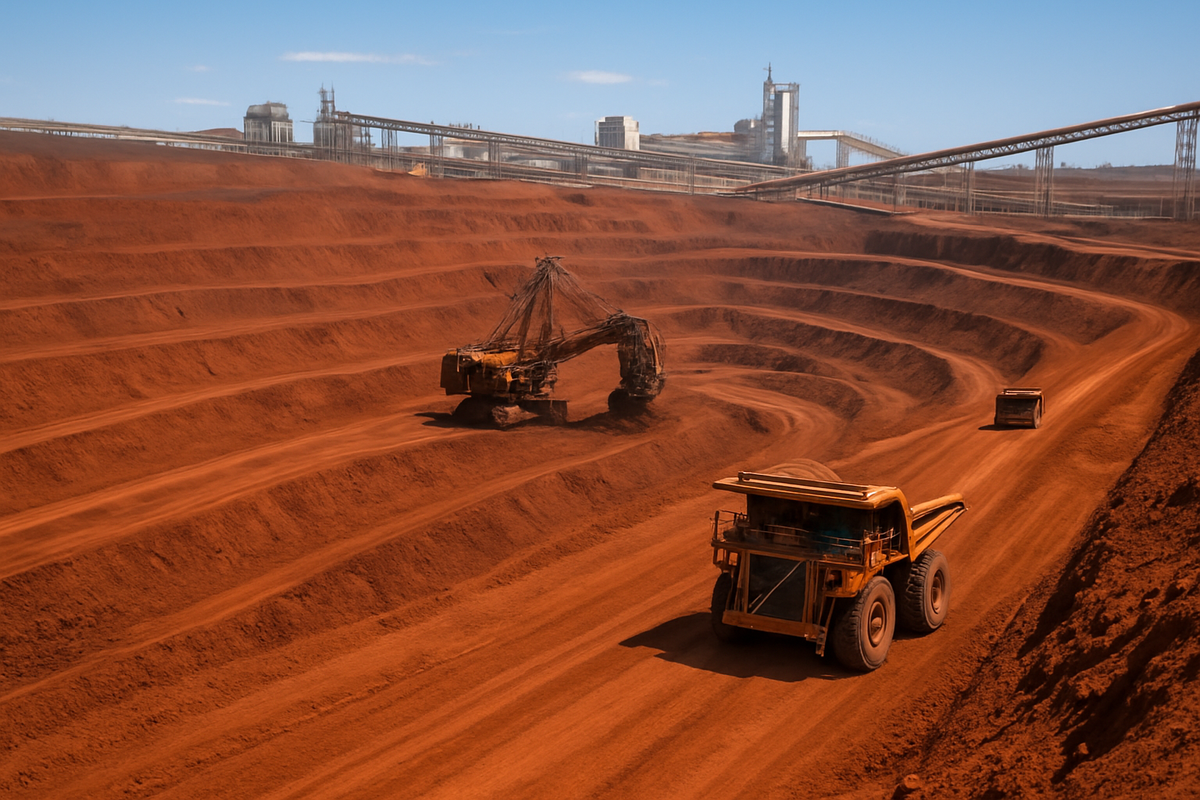
In a definitive signal of its operational recovery, Vale S.A. (NYSE: VALE) has announced that its 2025 iron ore production exceeded the upper limit of its annual guidance, effectively reclaiming its title as the world’s largest iron ore producer. The Brazilian mining giant reported a total output of 336.1 million tonnes (Mt) for the full year, surpassing its projected range of 325–335 Mt. This milestone marks the first time since the 2019 Brumadinho dam disaster that Vale has outpaced its primary Australian rival, Rio Tinto (NYSE: RIO), in total annual volume.
The surge in supply from Brazil comes at a delicate time for the global commodities market. While Vale’s operational efficiency and the successful debottlenecking of its S11D and Southeastern mining systems have bolstered the company’s balance sheet, the influx of high-grade ore has contributed to a loosening of the global supply-demand balance. As the market enters 2026, the implications of this supply-side strength are reverberating through the steel industry, placing downward pressure on benchmark iron ore prices and challenging the margins of higher-cost competitors.
A Multi-Year Turnaround Reaches Its Zenith
Vale’s 2025 performance is the culmination of a rigorous multi-year "value over volume" strategy that was paradoxically validated by record volumes. After bottoming out at 300.4 Mt in 2020 following the suspension of several mining hubs for safety upgrades, the company spent the last five years reinvesting in tailings filtration technology and logistics. The 336.1 Mt achieved in 2025 represents a 2.5% increase over 2024’s already strong 328.0 Mt, driven largely by the Northern System's reliability and the full ramp-up of the Itabira complex.
The timeline of this recovery was punctuated by several key operational milestones. In late 2024, Vale completed the expansion of its "Mega Hubs" in the Middle East and Brazil, which allowed for the increased production of high-grade iron ore briquettes and pellets. These products, which command a premium over the standard 62% Fe benchmark, were essential in allowing Vale to beat its guidance even as weather-related challenges briefly hampered operations in the Minas Gerais region during the fourth quarter. The market’s initial reaction has been a mix of admiration for Vale’s operational discipline and caution regarding the resulting oversupply in the Atlantic basin.
Winners and Losers in a Saturated Market
The return of Vale as the global volume leader has created a shifting landscape for the "Big Four" miners. While Vale (NYSE: VALE) stands as the clear winner in terms of market share and operational momentum, its success poses a direct threat to the price realization of its peers. Rio Tinto (NYSE: RIO), which had held the top spot for several years, now faces increased pressure to accelerate its Simandou project in Guinea to maintain its competitive edge in the high-grade ore segment.
BHP Group (NYSE: BHP) remains relatively insulated due to its industry-leading cost curve and diversified portfolio, which includes significant copper and potash interests. However, the most significant "loser" in this scenario may be Fortescue Ltd (OTCPK: FSUMF). As a producer of primarily lower-grade (57-58% Fe) ore, Fortescue is highly sensitive to widening price discounts that occur when high-grade supply—like that from Vale—becomes more abundant. Analysts note that Fortescue's 2025 cost-reduction programs were a necessary defensive move to protect margins as benchmark prices dipped toward the $90/t mark.
Broader Industry Trends and the "Green Steel" Pivot
The implications of Vale’s production beat extend far beyond simple volume metrics; they signal a broader shift toward the decarbonization of the global steel industry. Vale’s focus on high-grade products aligns with the increasing demand from steelmakers in Europe and East Asia for ores that can be used in Electric Arc Furnaces (EAF) and Direct Reduced Iron (DRI) processes. This transition is essential for the industry to meet 2030 carbon reduction targets.
Historically, a production surge from a major player would lead to a straightforward price collapse. However, the 2025-2026 period is characterized by a "two-tier" market. While the benchmark 62% Fe price averaged approximately $95/t in 2025 and is forecast to drift toward $88/t in 2026, the premiums for Vale’s low-impurity briquettes have remained resilient. This divergence suggests that the market is no longer viewing iron ore as a monolithic commodity, but rather as a bifurcated market where quality and environmental footprint dictate value.
The Road Ahead: 2026 and Beyond
Looking forward, Vale has reaffirmed its 2026 production guidance of 335–345 Mt, suggesting that the company does not intend to pull back on its production throttle. Short-term challenges remain, including the seasonal rains in Brazil and the structural slowdown of the Chinese property sector, which traditionally accounts for the lion's share of iron ore demand. To mitigate these risks, Vale is expected to lean further into its "Mega Hub" strategy, seeking to secure long-term offtake agreements with "green steel" projects in India and Southeast Asia—regions that are currently the primary growth engines for global steel demand.
Strategic pivots may be required if benchmark prices fall faster than anticipated. While Vale has successfully reclaimed its volume crown, the challenge for 2026 will be maintaining profitability in a potentially sub-$90/t environment. Investors are closely watching for potential capital expenditure adjustments, particularly regarding the development of new high-grade capacity, as the company balances its growth ambitions with the need for shareholder returns through dividends and buybacks.
Market Outlook and Investor Takeaways
Vale’s triumphant 2025 performance marks a new chapter in the global iron ore wars. By exceeding guidance and reclaiming the #1 spot, the company has proven its operational resilience and solidified its role as a price-setter for the high-grade market. However, for the broader market, this supply-side strength acts as a ceiling for iron ore prices, suggesting a period of range-bound trading as the industry digests the additional tonnage.
For investors, the impact is most visible in sector-specific ETFs. The iShares MSCI Global Metals & Mining Producers ETF (BATS: PICK), which holds significant positions in Vale, Rio Tinto, and BHP, remains the most direct way to play this global supply dynamic. Conversely, the SPDR S&P Metals & Mining ETF (NYSEARCA: XME) has remained largely decoupled from these events, as its focus on U.S.-listed steel producers makes it more sensitive to domestic infrastructure spending than to Brazilian mining cycles. In the coming months, the key indicator to watch will be the "high-grade premium" spread; if it remains wide, Vale will likely continue to outperform its peers regardless of where the benchmark price settles.
This content is intended for informational purposes only and is not financial advice