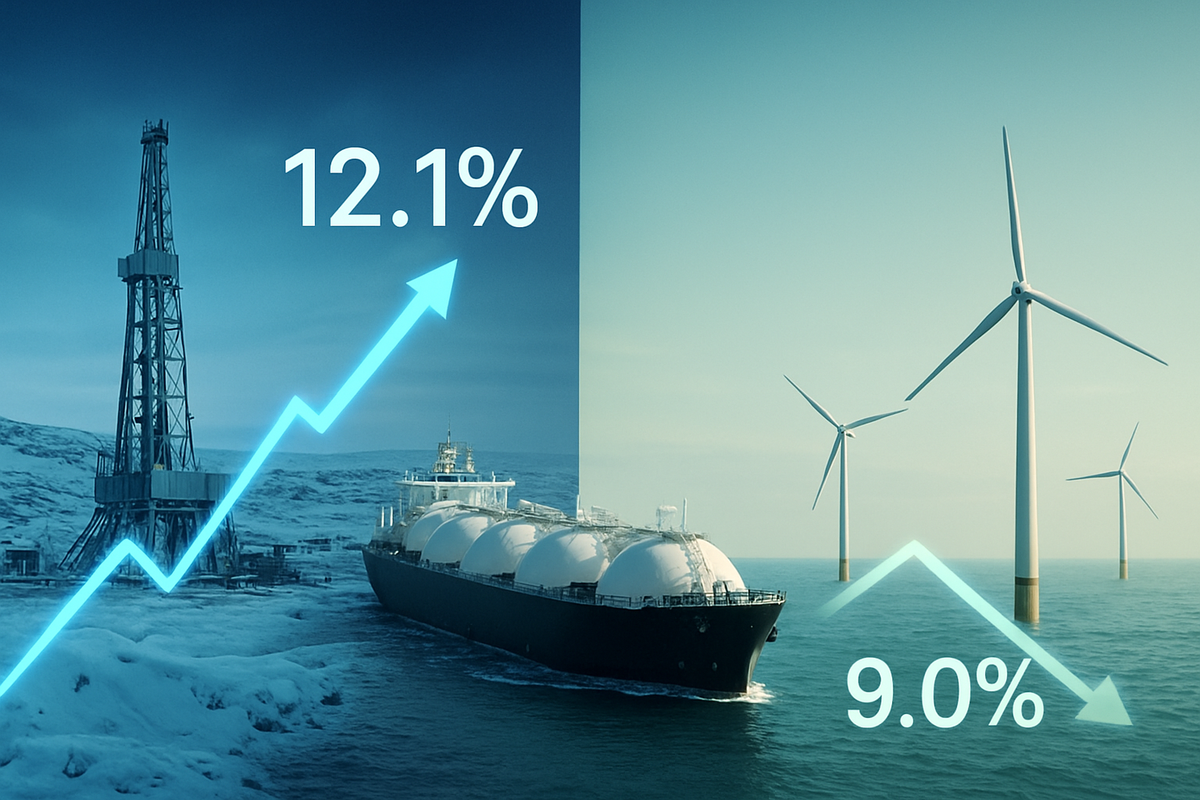
The global natural gas market witnessed an extraordinary "great divergence" in December 2025, as a brutal cold snap in North America sent domestic prices soaring while a mild, windy winter in Europe allowed the continent’s energy crisis fears to cool. U.S. natural gas futures surged by 12.1% during the month, driven by a combination of record-breaking export activity and localized production freezes. This rally pushed the Henry Hub benchmark to its highest level in three years, catching many market participants off guard during what was expected to be a well-supplied season.
In sharp contrast, European benchmarks saw a significant 9.0% decline over the same period. The Title Transfer Facility (TTF) price in the Netherlands dropped as record-high wind power generation and unseasonably warm temperatures across Northwest Europe dampened heating demand. This decoupling of the two most critical gas markets has reshaped the global arbitrage landscape, narrowing the price spread between the U.S. and Europe to its tightest margin in years and forcing a re-evaluation of energy sector valuations as 2026 begins.
Market Dynamics: A Tale of Two Winters
The surge in U.S. natural gas prices was precipitated by a "perfect storm" of climatic and structural factors. In early December, a powerful Arctic blast—often referred to as a Polar Vortex event—swept across the lower 48 states, triggering a massive spike in residential and commercial heating demand. The intensity of the cold led to "freeze-offs" in key production basins like the Permian and Appalachia, where liquids in the wellheads froze and blocked the flow of gas. This resulted in a temporary production dip to a two-year low, tightening the market exactly when demand was peaking.
Simultaneously, the U.S. solidified its status as the world’s leading liquefied natural gas (LNG) exporter. The commencement of operations at new facilities, including Phase 1 of Plaquemines LNG and Stage 3 of Corpus Christi LNG, allowed the U.S. to export more than 10 million tonnes of LNG in a single month for the first time in history. This structural "pull" from international markets ensured that even as domestic demand rose, supply remained constrained, leading the Energy Information Administration (EIA) to report a massive weekly withdrawal of 167 billion cubic feet (Bcf) in mid-December.
While the U.S. grappled with supply-side constraints, Europe enjoyed a reprieve. The continent entered December with storage levels at a comfortable 75.4% capacity, bolstered by a steady stream of imports from Norway and a flurry of LNG cargoes diverted from Asian markets. The primary downward pressure on European prices, however, came from the weather. Not only were temperatures milder than average, but record wind speeds across the North Sea allowed wind turbines to provide a higher-than-expected share of the electricity grid's load, drastically reducing the "call on gas" for power plants.
By the end of December, the price gap between the U.S. Henry Hub and the European TTF had collapsed to approximately $4 per million British thermal units (MMBtu). For much of the previous two years, this spread had often exceeded $10 or $20, reflecting Europe’s desperate need for gas following the loss of Russian pipeline supplies. This sudden narrowing represents a significant shift in the global energy trade, signaling that the U.S. market is no longer isolated from the pressures of its own export success.
Winners, Losers, and the Corporate Landscape
The primary winners of the December price surge were pure-play natural gas producers who were able to maintain production through the cold snap. EQT Corporation (NYSE: EQT), the largest producer in the United States, saw its stock price hit an all-time high in early December as it capitalized on the rising Henry Hub benchmark. Similarly, Expand Energy (NASDAQ: EXE)—the entity formed from the high-profile merger of Chesapeake Energy and Southwestern Energy—reached record valuations, trading as high as $122.89 per share. These companies benefited from a combination of higher realized prices and a strategic focus on the Appalachian Basin, where infrastructure is better equipped to handle winter volatility.
Investors in specialized exchange-traded funds also saw dramatic moves. The United States Natural Gas Fund (NYSEARCA: UNG) tracked the 12.1% jump in front-month futures closely, providing a windfall for tactical traders who had positioned for a colder winter. The S&P Oil & Gas Exploration & Production ETF (NYSEARCA: XOP) also outperformed the broader market, as the "beta" of rising gas prices lifted the tide for mid-cap drillers like Coterra Energy (NYSE: CTRA), which saw its stock trade near the top of its 52-week range during the peak of the December rally.
Conversely, the drop in European prices and the narrowing arbitrage spread posed challenges for global energy giants with heavy LNG trading arms. Firms like Shell (NYSE: SHEL) and TotalEnergies (NYSE: TTE), which have historically profited from buying cheap U.S. gas and selling it at a premium in Europe, saw their profit margins on "spot" cargoes squeezed. While these companies remain highly profitable, the reduced spread suggests that the era of "easy" arbitrage profits between the Atlantic basins may be drawing to a close as U.S. domestic prices become more sensitive to global demand.
For diversified majors like ExxonMobil (NYSE: XOM) and Chevron (NYSE: CVX), the impact was mixed. While their upstream gas production in the U.S. gained value, their global refining and trading operations had to navigate the volatile price environment. These firms are increasingly looking toward long-term contracts to hedge against this type of regional divergence, a strategy that is becoming more critical as the U.S. becomes the "swing producer" for the global gas market.
Global Significance: The End of Isolation
The December divergence is more than a seasonal anomaly; it marks a turning point in the integration of global energy markets. Historically, U.S. natural gas was a stranded resource, with prices dictated solely by local supply and demand. However, the massive expansion of LNG export capacity has effectively "tethered" Henry Hub to the rest of the world. The 12.1% surge in the U.S. highlights a new reality: the U.S. consumer is now competing directly with European and Asian buyers for the same molecule of gas, particularly during periods of peak demand.
This event also highlights the fragility of the energy transition’s "bridge fuel" narrative. As Europe leans more heavily on intermittent renewables like wind and solar, its gas demand becomes increasingly sensitive to weather patterns. The 9.0% drop in TTF prices was a direct result of the wind blowing at the right time. This volatility creates a complex environment for policymakers who must balance the need for reliable backup power (gas) with the goal of decarbonization. In the U.S., the price spike has already reignited debates over whether the pace of LNG export approvals should be tempered to protect domestic industrial consumers from global price shocks.
Historically, this divergence mirrors the 2022 energy crisis following the invasion of Ukraine, but in reverse. In 2022, European prices skyrocketed while U.S. prices remained relatively subdued due to an export bottleneck (the Freeport LNG outage). Today, with export bottlenecks largely removed, the markets are moving toward a "globalized" price, where a cold snap in Texas can lower the temperature of the trading floor in London. This interconnectedness means that volatility is likely to remain a permanent fixture of the natural gas market moving forward.
Future Outlook: Navigating a Tightened Market
Looking ahead to the remainder of 2026, the market will be laser-focused on the rate of storage replenishment. In the U.S., the heavy withdrawals in December have left inventories leaner than they have been in years, meaning that any late-winter cold snaps in February or March could trigger another round of price spikes. Producers are expected to ramp up drilling activity in the Haynesville and Permian basins to meet this renewed demand, but supply-chain lags and a disciplined approach to capital expenditure among the "Big Gas" players may slow the response.
In the long term, the opening of more LNG terminals along the Gulf Coast—such as the Golden Pass LNG project—will further tighten the link between domestic and international prices. Strategic pivots are already underway, with major industrial consumers in the U.S. seeking more fixed-price, long-term supply agreements to insulate themselves from the growing influence of global markets. We may also see an increase in "dual-fuel" capabilities among power generators, allowing them to switch away from gas if prices remain elevated.
The primary challenge for investors will be navigating this new era of "globalized volatility." Market opportunities will likely emerge in the midstream sector, as the need for additional pipeline capacity to move gas from production hubs to LNG export terminals becomes even more acute. Companies that control the infrastructure connecting the wellhead to the water will be in a prime position to capture the "toll-booth" revenue generated by this high-volume trade.
Conclusion: Watching the Flow
The divergence of December 2025 serves as a stark reminder that the natural gas market has fundamentally changed. The 12.1% rise in U.S. prices and the 9.0% fall in European prices are two sides of the same coin: a globalized energy system where local weather and international trade are inextricably linked. For the U.S., the era of permanently cheap gas appears to be over, replaced by a more dynamic, export-driven price regime. For Europe, the reliance on LNG has provided security but introduced a new form of price uncertainty tied to the vagaries of the Atlantic weather.
As we move through the first quarter of 2026, investors should keep a close watch on weekly EIA storage reports and the operational status of key LNG export facilities. Any disruption to the flow of gas from the U.S. Gulf Coast will now have immediate and profound ripple effects on both sides of the ocean. The "great divergence" may have narrowed the price gap for now, but the underlying forces of global demand and regional supply will continue to drive significant swings in the months to come.
Ultimately, the events of last month underscore the importance of a diversified energy strategy. Whether it is a producer like EQT or a broad energy ETF like XLE, the ability to navigate a market that is increasingly sensitive to both a Texas freeze and a North Sea breeze will be the hallmark of successful energy investing in the late 2020s.
This content is intended for informational purposes only and is not financial advice.