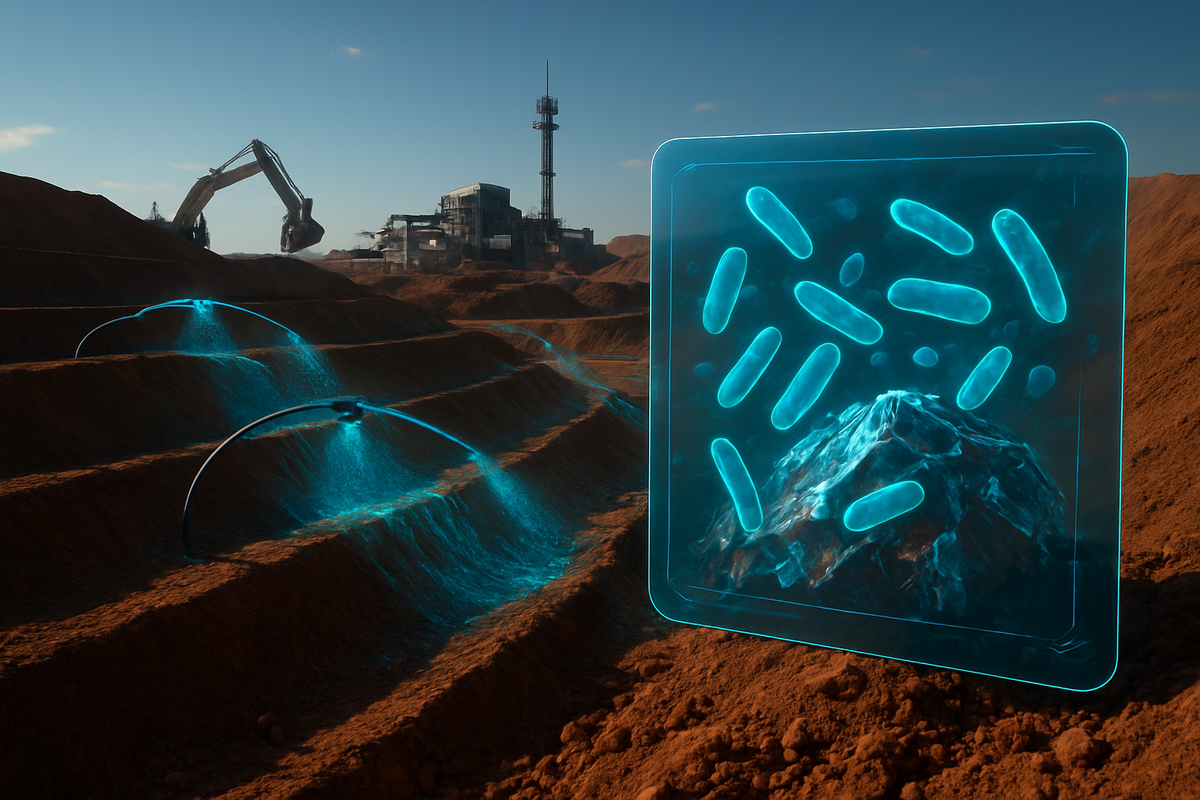
The global copper market has entered a transformative era, driven by a "perfect storm" of surging demand from artificial intelligence (AI) data centers and a series of catastrophic supply shocks at major traditional mines. As of late January 2026, copper prices have stabilized near a historic $5.91 per pound, a level that has forced the world's largest mining conglomerates to pivot from traditional smelting toward a once-niche biological solution: biomining. By deploying specialized bacteria to "eat" the copper out of low-grade waste rock, the industry is attempting to bridge a massive structural deficit that threatens the global energy transition.
The immediate implications are profound. Traditional copper mining—reliant on high-grade ores and energy-intensive smelting—is failing to keep pace with the electrification of the global economy. The shift to bacterial extraction, or bioleaching, represents a fundamental move toward "circular mining," where decades-old waste piles are being re-mined for their remaining metal content. With refined copper deficits projected at 330,000 tonnes for 2026, these microscopic organisms are no longer just a scientific curiosity; they have become a critical pillar of global supply chain security.
The Microbial Revolution: From Waste to Wealth
The surge in bioleaching technology reached a fever pitch in late 2025, following a "black swan" event at Freeport-McMoRan (NYSE: FCX)’s Grasberg mine in Indonesia. A massive landslide in November 2025 halted roughly 4% of the world’s copper output, sending prices toward the $6.00 mark and leaving manufacturers scrambling. In response, the industry accelerated the deployment of proprietary bacterial technologies. A pivotal moment occurred in December 2025 when Rio Tinto (NYSE: RIO) achieved its first industrial-scale deployment of its Nuton™ bioleaching technology at the Johnson Camp Mine in Arizona. Unlike traditional methods, Nuton uses proprietary microorganisms to extract copper from primary sulfide ores (chalcopyrite) that were previously considered "unrecoverable" waste.
The timeline of this bacterial boom is closely tied to the massive infrastructure needs of 2026. In early January, a landmark partnership was announced between Rio Tinto and Amazon Web Services (AWS), where AWS provided the cloud-based AI to monitor microbial health in real-time. This partnership underscored the reality that modern mining is now as much a data science as it is a geology. Meanwhile, BHP (NYSE: BHP) has successfully integrated its BioLeach system at its Escondida mine in Chile, the world's largest copper operation. By utilizing "microbial biomarkers"—essentially genetic fingerprints of the bacteria—BHP has been able to increase recovery rates of low-grade ore to a record 85%, up from 70% just two years ago.
The Winners and Losers of the Bio-Extractive Age
The primary winners in this technological shift are the diversified miners who invested early in proprietary "leach to the last drop" initiatives. Rio Tinto (NYSE: RIO) stands at the forefront, with its Nuton technology now being licensed to smaller junior miners, creating a new high-margin software-and-services revenue stream for the mining giant. Similarly, BHP (NYSE: BHP) has secured a significant competitive advantage by optimizing its existing Chilean assets without the multi-billion-dollar price tag of building new smelters. These companies are effectively "manufacturing" new copper supply from their existing land footprints, bypassing the decade-long permitting processes required for new "greenfield" mines.
Conversely, traditional smelting operations and mid-tier miners without access to bio-technology may find themselves at a disadvantage. Smelters, particularly those in East Asia, are facing a "concentrate crunch" as more copper is extracted and refined at the mine site via bacteria, bypassing the need for traditional heat-based processing. Furthermore, companies heavily reliant on high-grade but depleting deposits, which lack the massive waste stockpiles necessary for large-scale bioleaching, could see their margins squeezed as the cost of conventional underground mining rises alongside labor and energy inflation.
A Wider Significance: AI, ESG, and the New Supply Chain
The bioleaching trend fits into a broader industry narrative of "greening" the supply chain. Bacterial extraction is significantly more environmentally friendly than traditional smelting, using roughly 80% less water and producing 60% fewer carbon emissions. This has allowed companies like Freeport-McMoRan (NYSE: FCX) to market their copper as "low-carbon," fetching a premium price from climate-conscious buyers in the EV and tech sectors. This "green premium" is becoming a standard feature of the 2026 market, as tech giants like Apple (NASDAQ: AAPL) and Microsoft (NASDAQ: MSFT) seek to decarbonize their massive hardware supply chains.
The regulatory environment is also shifting to favor these biological methods. In the United States, the Department of Energy recently awarded an $80 million grant to Freeport-McMoRan to pilot geothermal heating for its bioleaching piles. By using the Earth's natural heat to keep "bugs" active during winter months, the project aims to stabilize domestic copper production. This reflects a growing realization among policymakers that mineral independence cannot be achieved through new mines alone, but must involve the technological optimization of existing resources. The historical precedent for this is the "shale revolution" in the oil industry, where technology unlocked vast reserves from previously unproductive rock.
The Horizon: Synthetic Biology and Geothermal Piles
Looking ahead to the remainder of 2026 and into 2027, the industry is eyeing the next frontier: synthetic biology. Startups are already testing "designer microbes" engineered to withstand extreme temperatures and toxic concentrations of heavy metals. If successful, these "super-bugs" could potentially cut the time required for copper extraction from years to months. We may also see the rise of "microbial prebiotics"—chemical cocktails injected into waste heaps to stimulate native bacteria, a process that Transition Metal Solutions is currently piloting with major industry partners.
The short-term market challenge will be the "lag time" of biological systems. Unlike a smelter, which can be turned up or down, a bacterial leach heap is a living ecosystem that takes time to reach peak productivity. If the AI-driven demand for copper continues to accelerate at its current pace, even the bugs might not be fast enough to prevent a further price spike toward $6.50/lb. Strategic pivots will likely include miners acquiring more "waste-rich" assets specifically to apply these bio-technological layers to them.
Final Assessment for the 2026 Market
The 2026 copper market is being defined by a move toward efficiency and biological innovation. The age of "easy copper" is over, replaced by an era where the most valuable asset a mining company possesses may be its library of microbial DNA. With copper holding steady at $5.91/lb, the economic incentive to perfect these biological methods has never been higher. For the public, this shift means a more resilient supply chain for the technologies that define modern life, from smartphones to the power grids that charge them.
Investors should closely watch the quarterly production reports of Rio Tinto (NYSE: RIO) and Freeport-McMoRan (NYSE: FCX) for updates on their leaching recovery rates. Any breakthrough in "chalcopyrite leaching"—the ability to efficiently process the world's most common but stubborn copper ore—could be a major market catalyst. While the "microbial gold rush" is still in its early stages, it is clear that the future of mining is small, biological, and incredibly lucrative.
This content is intended for informational purposes only and is not financial advice.