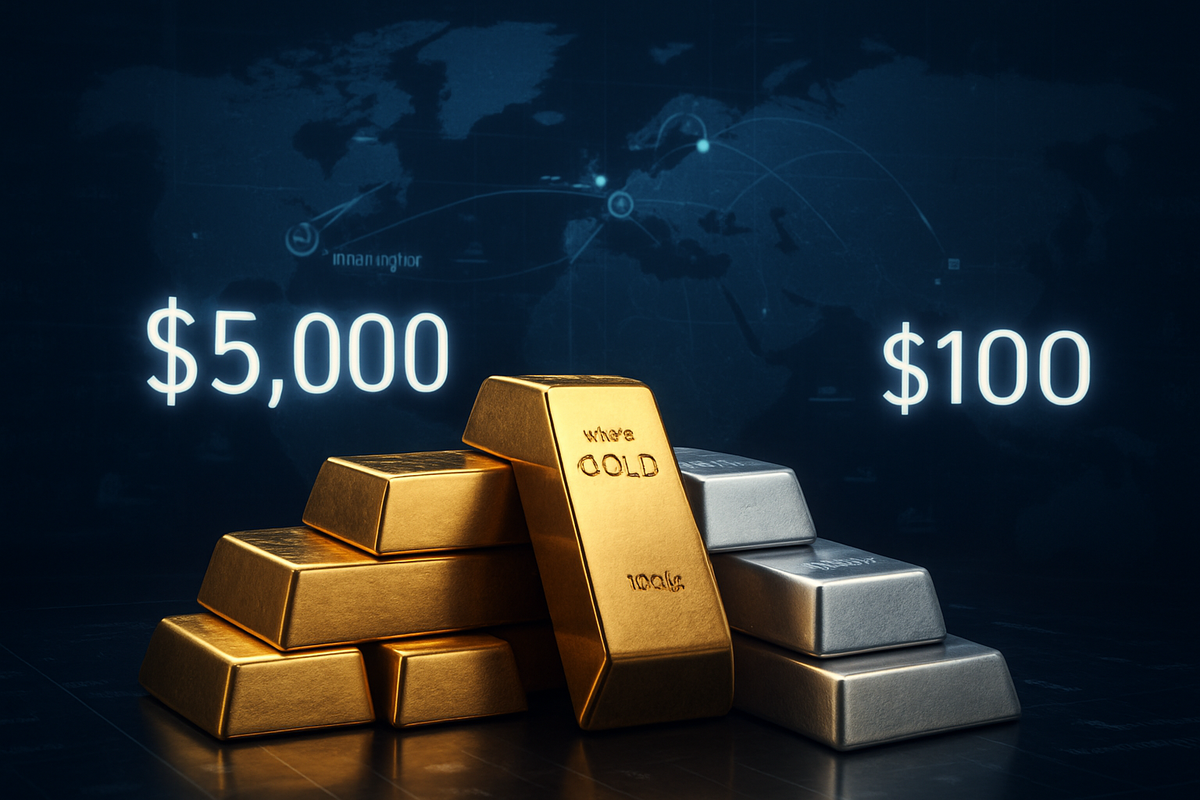
In a seismic shift for global financial markets, the safe-haven rally of the decade has reached a fever pitch. As of January 26, 2026, gold has shattered psychological barriers to trade at a record-setting $4,908.80 per ounce, with analysts eyeing a sustained hold above the $5,000 mark. Simultaneously, silver has completed a breathtaking ascent, surging through the $100 barrier to trade in a volatile range between $95.97 and $103.00. This dual-metal breakout represents a fundamental realignment of investor priorities as the traditional "Bretton Woods" era of trade stability gives way to a more fragmented and confrontational global order.
The immediate implications of this surge are being felt across every asset class. A softer U.S. dollar, currently struggling under the weight of "Sell America" sentiment, has provided the necessary tailwind for this historic run. However, the true engine of the rally is a "perfect storm" of geopolitical friction. Threats of aggressive new tariffs against European allies and an unprecedented diplomatic standoff regarding the status of Greenland have sent institutional capital fleeing toward the perceived safety of hard assets. As traditional hedges falter, the markets are witnessing a generational migration into precious metals that shows few signs of abating.
The Greenland Gambit and the Collapse of Trade Stability
The current surge can be traced back to a series of escalating geopolitical maneuvers that began in mid-January 2026. On January 17, the U.S. administration stunned the international community by threatening a cumulative 25% tariff against eight key European nations—including France, Germany, and Denmark—unless negotiations regarding the strategic acquisition of Greenland were reopened. This move effectively fractured the "Turnberry Agreement" of 2025, a framework that many had hoped would bring a 15% ceiling to trans-Atlantic trade friction. The resulting "Greenland Crisis" has since morphed into a broader standoff between the U.S. and its NATO allies, forcing investors to price in a permanent state of trade volatility.
The timeline leading to today’s record prices was punctuated by a brief moment of hope during the World Economic Forum in Davos on January 21. President Trump met with NATO Secretary-General Mark Rutte to discuss a "framework of a future deal" that would focus on a shared Arctic missile defense system, dubbed the "Golden Dome," rather than a forced land sale. While this led to a temporary withdrawal of the immediate 10% tariff threat, the damage to market confidence was already done. The uncertainty surrounding the "concept of a deal" has created a floor for precious metals, as traders remain skeptical of long-term diplomatic stability.
Key players in this drama extend beyond the political arena. Central banks in the Global South have accelerated their gold purchases, viewing the U.S. dollar’s weaponization through tariffs as a signal to further diversify their reserves. On the floor of the COMEX, the reaction was instantaneous: a "global short squeeze" on physical silver took hold as the metal’s dual role as an industrial necessity for the AI-driven energy transition and a monetary hedge collided. By the time the market opened this morning, the gold-to-silver ratio had plunged to levels not seen in over a decade, signaling a fundamental rerating of silver’s value.
Market Beneficiaries: The ETF Boom and Mining Giants
The primary beneficiaries of this historic run have been the major exchange-traded funds, which have seen record-breaking inflows from both retail and institutional desks. The SPDR Gold Shares (NYSE Arca: GLD) has become the de facto destination for capital looking to exit the cooling equities market, with its holdings reaching heights that challenge sovereign reserves. Similarly, the iShares Silver Trust (NYSE Arca: SLV) has experienced a "high-octane" rally, with the fund often trading at a significant premium to its Net Asset Value (NAV) as investors scramble for exposure to silver’s triple-digit price tag.
The mining sector has also seen a dramatic re-valuation. Industry leaders such as Newmont Corporation (NYSE: NEM) and Barrick Gold (NYSE: GOLD) have seen their margins expand exponentially, as the cost of production remains anchored while the price of their primary output has nearly doubled in eighteen months. Silver-focused producers and streamers like Wheaton Precious Metals (NYSE: WPM) and Pan American Silver (NASDAQ: PAAS) are perhaps the biggest winners, benefiting from a silver price that has outperformed gold on a percentage basis throughout January. For these companies, the current price environment represents a "goldilocks" scenario of high prices and sustained global demand.
However, the rally is not without its casualties. Industrial consumers of silver, particularly in the solar energy and high-end electronics sectors, are facing a mounting supply-chain crisis. Companies that failed to hedge their silver requirements at lower prices are now seeing their profit margins evaporated by the $100+ price tag. Furthermore, the volatility has created "premium risk" for ETF investors; any hint of a diplomatic breakthrough in the "Greenland Crisis" has triggered sharp, double-digit corrections in GLD and SLV, as "TACO trade" (Trump Always Chickens Out) participants—those betting on a reversal of aggressive policy threats—quickly book profits.
A New Monetary Paradigm: Beyond the Bretton Woods Era
This event is not merely a temporary price spike; it represents a significant shift in the global financial architecture. The rise of the "Turnberry System," characterized by bilateral, interest-based trade deals rather than multilateral WTO stability, has weakened the U.S. dollar's role as the undisputed global anchor. In January 2026, the U.S. Dollar Index (DXY) hovered near multi-month lows between 97 and 98. This weakness is paradoxical given the strong U.S. GDP growth projections of 5.4%, yet it reflects a deep-seated concern over the potential loss of Federal Reserve independence and the unpredictability of "reciprocal tariffs."
Historically, such surges in precious metals have preceded major shifts in the international monetary order. The current milestone of $5,000 gold is being compared to the inflationary era of the 1970s, but with the added complexity of modern digital finance and de-dollarization. The "Greenland Crisis" serves as a historical precedent for the use of territorial and national security claims to reset trade terms, a tactic that hasn't been seen at this scale in the modern era. The ripple effects are spreading to competitors and partners alike, as nations like China and Russia observe the fracturing of the Western alliance with an eye toward their own commodity-backed currency ambitions.
Regulatory and policy implications are also coming to the forefront. The massive inflows into SLV and GLD have caught the attention of the Commodity Futures Trading Commission (CFTC), with discussions beginning regarding position limits to prevent a total decoupling of paper and physical prices. Meanwhile, the Federal Reserve finds itself in a precarious position: raising rates to defend the dollar could stifle the robust growth that is the administration’s hallmark, while doing nothing risks further fueling the flight into "hard money."
The Road Ahead: Volatility as the New Constant
In the short term, the market is bracing for further "policy whiplash." If the Davos framework for a "Golden Dome" missile shield fails to materialize into a signed treaty, gold could easily test the $5,200 level as the threat of 25% European tariffs becomes a reality. Conversely, a sudden de-escalation could see a "crash" back to the $4,500 level as the geopolitical risk premium evaporates. For silver, the path forward is even more volatile; with a critical shortage of physical metal reported in London and Zurich vaults, any sustained price above $100 could lead to further industrial rationing.
Long-term, strategic pivots will be required from both investors and nations. We may see a "Golden Dome" economy emerge, where trade is partitioned into secure blocs, and precious metals serve as the bridge between these disparate systems. For public companies, the challenge will be managing the "concept of a deal" environment—a world where a single social media post or diplomatic threat can move market caps by billions in a matter of minutes. Market opportunities will likely emerge in the exploration sector, as the $5,000 gold price makes previously uneconomical deposits highly attractive.
Potential scenarios range from a "Grand Bargain" that stabilizes the dollar and cools the metals rally, to a "Hard Break" where the U.S. pursues an isolationist trade policy, potentially pushing gold toward $6,000 and silver toward $150. Investors must remain agile, as the current market is driven more by headlines and geopolitical theater than by traditional fundamental metrics like interest rates or inflation data.
Conclusion: A Milestone with Lasting Consequences
The achievement of $4,908.80 gold and $100 silver is more than a headline; it is a signal that the era of predictable trade and currency stability has ended. The confluence of the Greenland diplomatic crisis, aggressive tariff threats against the EU, and a weakening U.S. dollar has created an environment where "safe haven" is no longer just a defensive posture, but a primary investment strategy. The massive growth of vehicles like GLD and SLV underscores a fundamental shift in how both individuals and institutions view wealth preservation in a fragmented world.
Moving forward, the market will be defined by its sensitivity to geopolitical maneuvering. The "Turnberry System" has introduced a level of unpredictability that rewards those holding tangible assets while penalizing those reliant on the old rules of global cooperation. The lasting impact of this January rally will likely be a permanent increase in the baseline allocation of precious metals in global portfolios, as the "Greenland Gambit" has shown that no alliance or trade agreement is set in stone.
For investors, the coming months will require a focus on "geopolitical literacy" as much as financial literacy. Watching the progress of the "Golden Dome" negotiations and the implementation of the proposed EU tariffs will be critical. In this new era, the value of gold and silver is no longer just about inflation—it is a barometer of global trust, and currently, that barometer is pointing toward a long, cold winter for traditional diplomacy.
This content is intended for informational purposes only and is not financial advice