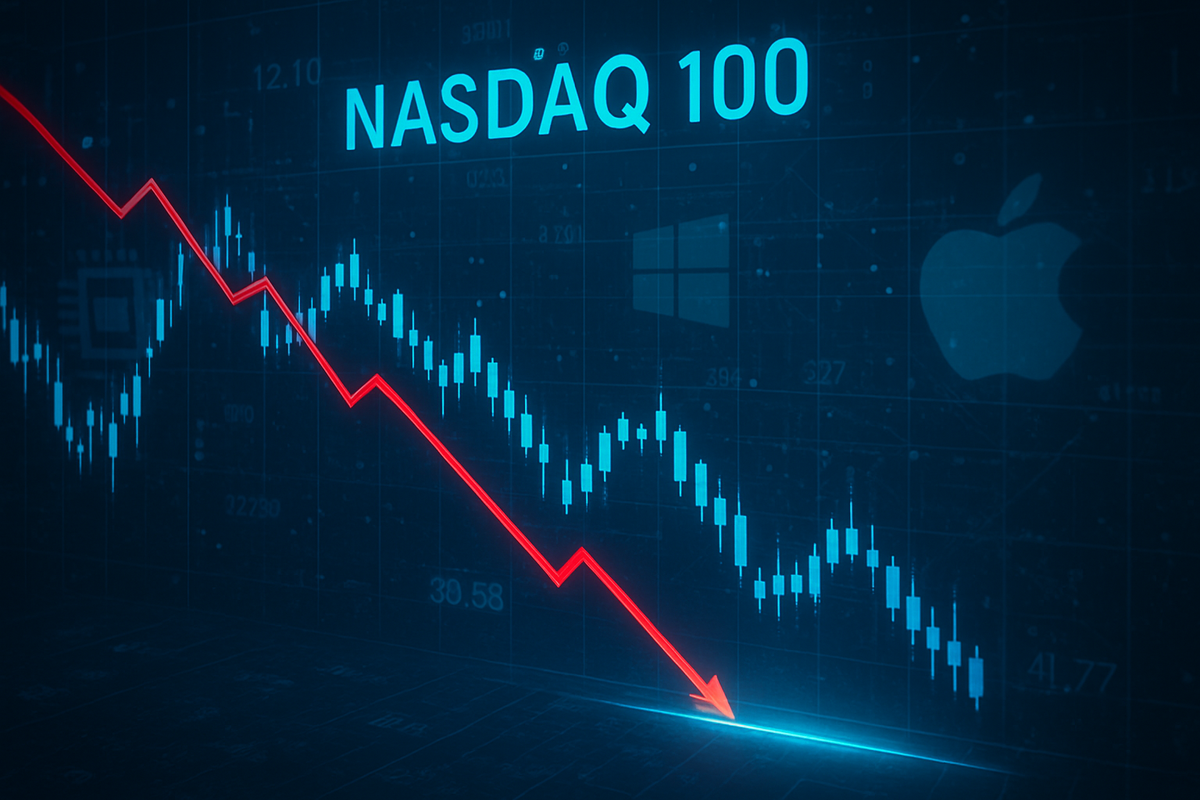
The Nasdaq 100 (NASDAQ: QQQ) has entered the new year on a tenuous footing, following a volatile final quarter of 2025 that saw the tech-heavy index retreat from its record highs. As investors return from the holiday break, the focus has shifted from the unbridled optimism of the early AI era to a more sober assessment of technical support levels and earnings sustainability. The recent 4.5% pullback in late December has left the index hovering just above critical psychological and technical floors, raising questions about whether the multi-year bull market is finally catching its breath or preparing for a deeper correction.
This retreat has been particularly pronounced in Nasdaq futures (CME:NQ), which saw a surge in volume as traders hedged against a "hawkish tilt" from the Federal Reserve and a "show me the money" sentiment regarding artificial intelligence investments. With the index closing 2025 near the 25,100 mark—down from its December peak of nearly 26,400—the technical landscape for January 2026 is defined by a battle between long-term momentum and short-term exhaustion.
The December Descent: A Collision of Valuations and Policy
The downturn that defined the closing weeks of 2025 was not triggered by a single catastrophic event, but rather a confluence of technical exhaustion and shifting macroeconomic signals. After a stellar performance throughout much of 2025, which saw the Nasdaq 100 gain over 20%, the index hit a wall in mid-December. The primary catalyst was the Federal Reserve’s final meeting of the year, where officials signaled that interest rates would remain "higher for longer" to combat a persistent 2.8% inflation rate, effectively dashing hopes for an aggressive rate-cut cycle in early 2026.
Technically, the index formed a "double top" pattern near the 26,400 level before breaking below its 50-day Simple Moving Average (SMA), which currently sits at approximately 25,350. This breach triggered systematic selling from trend-following algorithms, accelerating the slide toward the 25,150 pivot zone. The timeline of this descent saw the most aggressive selling during the week of December 15th, as institutional rebalancing and tax-loss harvesting in non-AI sectors further strained liquidity in the broader tech market.
Market participants are now closely monitoring the Relative Strength Index (RSI), which dipped into the high 30s during the final days of December—the lowest level seen since the "carry trade" volatility of late 2024. While a low RSI often suggests an oversold condition ripe for a bounce, the Moving Average Convergence Divergence (MACD) remains in a bearish crossover state, indicating that downward momentum has not yet fully dissipated as the 2026 trading year commences.
Winners and Losers: The Great AI Divergence
The recent drop has highlighted a growing divergence within the "Magnificent Seven," as investors become increasingly selective about where they park their capital. Nvidia (NASDAQ: NVDA), the undisputed champion of the 2023-2024 rally, has faced significant pressure as it struggles to maintain its astronomical growth rates. While still a strategic leader, NVDA has seen its stock price stabilize in a wide range between $180 and $200, acting more like a mature industrial giant than a hyper-growth startup.
Conversely, Alphabet (NASDAQ: GOOGL) and Amazon (NASDAQ: AMZN) have emerged as relative safe havens during the recent volatility. Alphabet’s aggressive integration of Gemini AI into its search and cloud ecosystems, coupled with a more attractive valuation relative to its peers, has kept it afloat. Amazon, meanwhile, is reaping the rewards of its massive 2025 capital expenditures, with AWS showing accelerated growth as "Agentic AI"—autonomous systems capable of executing complex business tasks—reaches mass adoption.
On the losing end of the recent technical breakdown are Microsoft (NASDAQ: MSFT) and Tesla (NASDAQ: TSLA). Microsoft’s stock has been weighed down by the sheer scale of its AI infrastructure spending, with investors demanding more immediate "Copilot" revenue to justify its premium multiple. Tesla continues to be the most volatile of the group, with its stock price tethered to the high-stakes rollout of its Robotaxi fleet. As the index tests support, these high-beta names are often the first to be trimmed by risk-averse fund managers.
Broader Significance: From Hype to Execution
The current technical crossroads for the Nasdaq 100 mirrors a broader industry shift from "AI Hype" to "AI Execution." In 2024 and early 2025, the market rewarded any company with an AI narrative. By the start of 2026, the market has become far more discerning. This event fits into a historical pattern similar to the mid-2000s post-dot-com recovery, where the initial "infrastructure build" phase gave way to a "utility" phase that favored companies with proven cash flows.
The ripple effects of this technical pullback extend beyond the mega-caps. The semiconductor sector, represented by the iShares Semiconductor ETF (NASDAQ: SOXX), has seen a similar breach of support, suggesting that the hardware cycle may be reaching a temporary peak. Furthermore, regulatory scrutiny on AI monopolies in both the U.S. and the E.U. continues to provide a background hum of uncertainty, preventing a rapid "V-shaped" recovery in the tech sector.
Historically, when the Nasdaq 100 tests its 200-day SMA—currently trending near 23,800—it serves as a "moment of truth" for the bull market. The last time the index approached this level was during the brief recession scare of August 2024. If the 25,000 support level fails to hold in the coming weeks, the 24,000 "Red Line" will become the ultimate battleground for tech investors in 2026.
What Comes Next: The January Gauntlet
The short-term outlook for the Nasdaq depends heavily on the "January Gauntlet"—a series of high-stakes economic and corporate events. The first major hurdle is the December Jobs Report, followed by the Q4 2025 earnings season, which kicks off in late January. Investors will be listening intently to the forward guidance of companies like Apple (NASDAQ: AAPL) and Meta Platforms (NASDAQ: META) to see if consumer spending and digital advertising can offset the rising costs of AI development.
A strategic pivot may be required for many investors who have grown accustomed to "buying every dip." If the Nasdaq 100 fails to reclaim its 50-day SMA by mid-January, it could signal a transition into a "sideways" market, where stock selection becomes more important than broad index exposure. However, if the 25,150 support holds and earnings surprise to the upside, the path toward the 27,000 psychological resistance remains open for the second half of 2026.
Potential scenarios range from a "soft landing" bounce, where the index recovers its December losses by March, to a "valuation reset" where the index slides toward the 22,000 zone. The latter would represent a 15-20% correction from the highs—a healthy, albeit painful, recalibration that would bring tech valuations back in line with historical averages.
Market Wrap-Up and Investor Outlook
As we navigate the opening weeks of 2026, the key takeaway for investors is that the "easy money" phase of the AI rally has concluded. The Nasdaq 100 is currently in a "prove it" period, where technical support levels like 25,150 and 24,000 are more than just numbers on a chart—they are reflections of investor confidence in the next leg of the digital revolution.
Moving forward, the market is likely to remain sensitive to every word from the Federal Reserve and every data point regarding AI monetization. Investors should watch the 10-year Treasury yield closely; any sustained move above 4.5% could provide further headwinds for tech valuations. While the long-term structural bull case for technology remains intact, the near-term path is fraught with technical hurdles.
In the coming months, the focus should remain on "quality" and "valuation." Companies with strong balance sheets and clear paths to AI profitability will likely lead the next recovery, while those relying on narrative alone may continue to see their multiples compressed. For now, the Nasdaq 100 sits at a critical junction, and the direction of the next 1,000 points will likely set the tone for the remainder of 2026.
This content is intended for informational purposes only and is not financial advice.