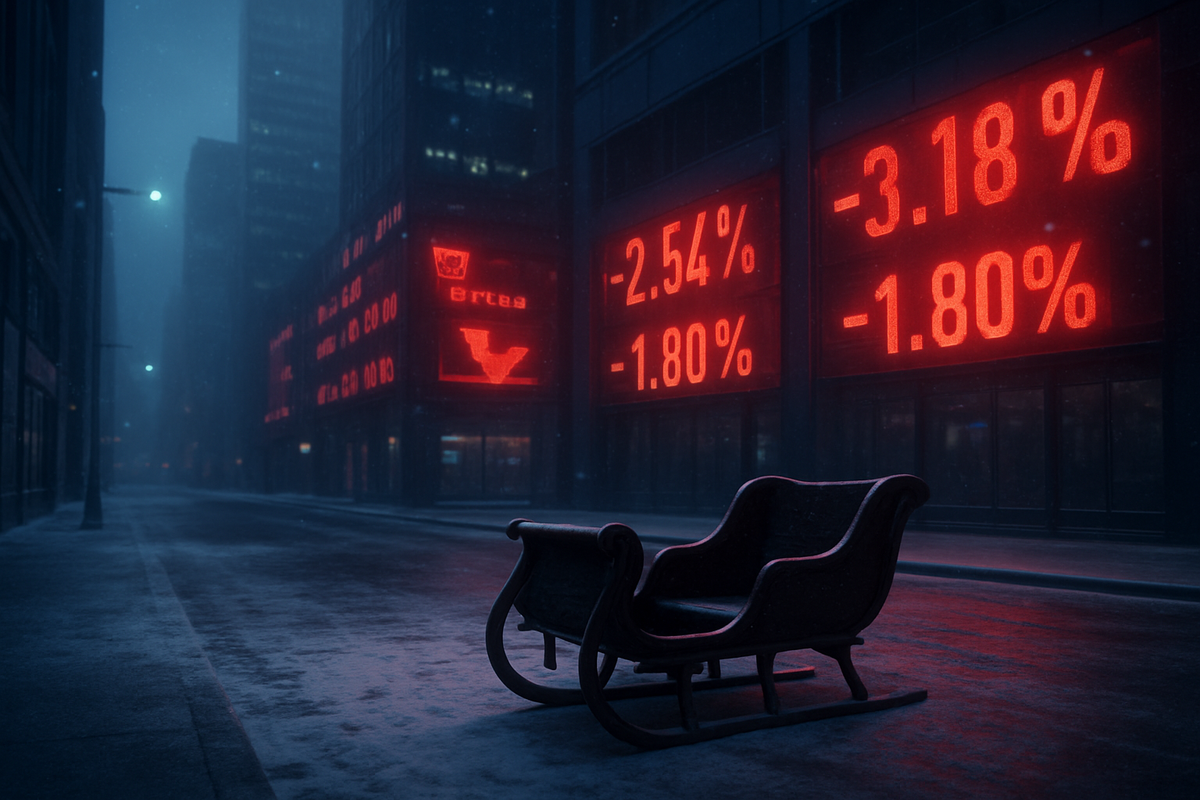
The highly anticipated "Santa Claus Rally" of 2025 has officially failed to materialize, leaving investors with a lump of coal as they ring in the new year. While the broader market enjoyed a year of respectable double-digit gains, the traditional seven-session window—encompassing the last five trading days of December and the first two of January—was characterized by a "Santa Stall." As of the close on January 2, 2026, the S&P 500 (INDEXSP: .INX) remained roughly 0.6% below its December 24 starting point, marking the third consecutive year that this seasonal phenomenon has missed its mark.
The failure of the rally is more than just a seasonal disappointment; it is often viewed by market historians as a "canary in the coal mine." On Wall Street, the old adage "If Santa Claus should fail to call, bears may come to Broad and Wall" is being whispered across trading floors. Historically, when the market fails to post a gain during this specific year-end period, the subsequent first quarter often faces significant headwinds. Data suggests that a failed rally typically precedes a flat or negative January and a lackluster performance for the rest of the year, signaling that the bullish momentum of 2025 may have reached a point of technical exhaustion.
The Anatomy of a 'Santa Stall'
The 2025 holiday trading window began on Wednesday, December 24, with the S&P 500 hitting a record close of 6,932.05. However, the festive mood quickly soured. Over the following week, a synchronized sell-off took hold, driven by institutional de-risking and aggressive tax-loss harvesting. By the time the markets closed on December 31, the Dow Jones Industrial Average (INDEXDJX: .DJI) had retreated nearly 0.8% from its peak, and the Nasdaq Composite (INDEXNASDAQ: .IXIC) faced an even steeper decline as investors locked in profits from the year's high-flying semiconductor and AI stocks.
The timeline leading to this moment was fraught with economic uncertainty. Despite a 25-basis-point interest rate cut by the Federal Reserve on December 17, the accompanying "hawkish" commentary from Chair Jerome Powell suggested that the central bank remained wary of "sticky" inflation, which ended the year at 3.4%. Furthermore, the market was still reeling from the psychological impact of a historic 43-day federal government shutdown that concluded in mid-November, which many analysts believe shaved 1.5% off fourth-quarter GDP growth. This "macro whiplash" left investors hesitant to commit new capital during the low-liquidity holiday sessions.
Key stakeholders, including major hedge funds and institutional asset managers, appeared more interested in protecting their 2025 gains than betting on a year-end surge. Trading volumes during the final week of December plummeted to nearly 50% of the 20-day average, allowing even modest sell orders to trigger outsized price swings. By the time trading resumed on January 2, 2026, a modest 0.65% rebound in the S&P 500 was not enough to pull the index back into positive territory for the rally window, cementing the "Santa Stall" in the record books.
Winners and Losers: A Great Rebalancing
The failure of the rally has highlighted a significant divergence in the performance of the "Magnificent Seven." While NVIDIA (NASDAQ: NVDA) remained a standout performer, finishing 2025 up 39%, it was not immune to the year-end volatility. Conversely, Apple (NASDAQ: AAPL) and Microsoft (NASDAQ: MSFT) struggled as investors questioned their high price-to-earnings multiples in a slowing economy. Apple, in particular, faced headwinds from renewed tariff uncertainties, leading it to trail the broader index with a modest 12% gain for the year. Amazon (NASDAQ: AMZN) and Meta Platforms (NASDAQ: META) also faced late-year selling pressure as the market pivoted away from companies with massive AI-related capital expenditures that have yet to show clear bottom-line returns.
On the winning side, the "Santa Stall" triggered a rotation into defensive "safe havens." Utilities and healthcare sectors saw significant inflows as investors sought stability. NextEra Energy (NYSE: NEE) and Constellation Energy (NASDAQ: CEG) emerged as leaders, benefiting from their roles in powering the massive data centers required for the AI revolution while offering the security of regulated earnings. In the healthcare space, UnitedHealth Group (NYSE: UNH) and Johnson & Johnson (NYSE: JNJ) saw increased demand, as their recession-resistant profiles became more attractive amid the growing "risk-off" sentiment.
Other notable laggards included high-beta names like Tesla (NASDAQ: TSLA), which faced heavy selling in late December due to its sensitivity to discretionary spending and interest rate fluctuations. Meanwhile, companies like Broadcom (NASDAQ: AVGO) were hit by a broader rotation out of high-multiple technology stocks. This shift suggests that while the AI theme is far from dead, the "AI-at-any-cost" era may be giving way to a more disciplined approach where valuation and cash flow take center stage.
Historical Precedents and Wider Significance
The broader significance of a failed Santa Claus Rally cannot be overstated for market technicians. According to the Stock Trader’s Almanac, when the S&P 500 gains during this period, it averages a 1.4% rise in January and a 2.6% gain for the first quarter. However, when the rally fails, the index has historically averaged a loss of approximately 1.0% over the subsequent three months. This historical correlation places 2026 on a precarious footing, suggesting that the "January Effect"—where stocks typically rise in the first month of the year—may also be in jeopardy.
This event fits into a broader industry trend of "valuation consolidation." After three years of aggressive AI-driven expansion, the market is grappling with the reality of higher-for-longer interest rates and a fragmented global trade environment. The 2025 failure is particularly notable because it marks the first time in decades that the rally has failed for three consecutive years. This suggests a fundamental shift in market mechanics, where traditional seasonal patterns are being disrupted by the dominance of algorithmic trading and the concentration of market cap in a handful of mega-cap tech stocks.
Furthermore, the geopolitical backdrop of late 2025, including the "April Tariff Shock" and ongoing trade tensions, has created a "fog of uncertainty" that historical precedents struggle to account for. The failure of the rally may be a signal that the market has already priced in the "best-case scenario" for 2026 and is now beginning to discount the risks of a potential economic slowdown or a secondary spike in inflation.
The Road Ahead: Q1 2026 and Beyond
Looking ahead, the short-term outlook for the first quarter of 2026 appears challenging. Investors should prepare for heightened volatility as the market digests the implications of the failed rally and waits for the next round of corporate earnings. A strategic pivot toward "quality" and "value" is likely to continue, with a focus on companies that possess strong balance sheets and the ability to maintain margins in an inflationary environment. We may see a "wait-and-see" approach from institutional investors until the Federal Reserve provides clearer guidance on its 2026 rate path.
In the long term, the failure of the Santa Claus Rally may force a recalibration of growth expectations. If the first quarter of 2026 indeed proves to be weak, it could lead to a more cautious investment landscape for the remainder of the year. However, this also creates opportunities for savvy investors to pick up high-quality assets at more reasonable valuations. The "Great Rebalancing" could ultimately lead to a healthier, more diversified market, reducing the over-reliance on a few tech giants to drive index returns.
Potential scenarios for the coming months include a "sideways grind" as the market seeks a new floor, or a more pronounced correction if economic data continues to soften. Investors should keep a close eye on the January 5 closing prices, as a failure to reclaim the December 24 levels would officially confirm the rally's failure and likely trigger further defensive positioning across the board.
Conclusion: A Cautious Start to the New Year
The failure of the 2025 Santa Claus Rally serves as a sobering reminder that seasonal trends are not guarantees. The combination of policy uncertainty, geopolitical friction, and technical exhaustion has effectively stalled the market's momentum, leaving Wall Street in a defensive posture as 2026 begins. The key takeaways for investors are clear: the "easy money" of the AI surge may be behind us, and the first quarter of 2026 is likely to be a test of resilience rather than a continuation of the bull run.
As we move forward, the market's performance in the coming weeks will be critical. If the historical "Santa Claus" indicator holds true, the first quarter may be characterized by lower-than-average returns and increased sensitivity to macro news. Investors should watch for the "January Barometer"—the idea that "as goes January, so goes the year"—to see if the early-year weakness persists. While the long-term outlook for American enterprise remains robust, the immediate path is clouded by the shadow of a missing Santa.
This content is intended for informational purposes only and is not financial advice.