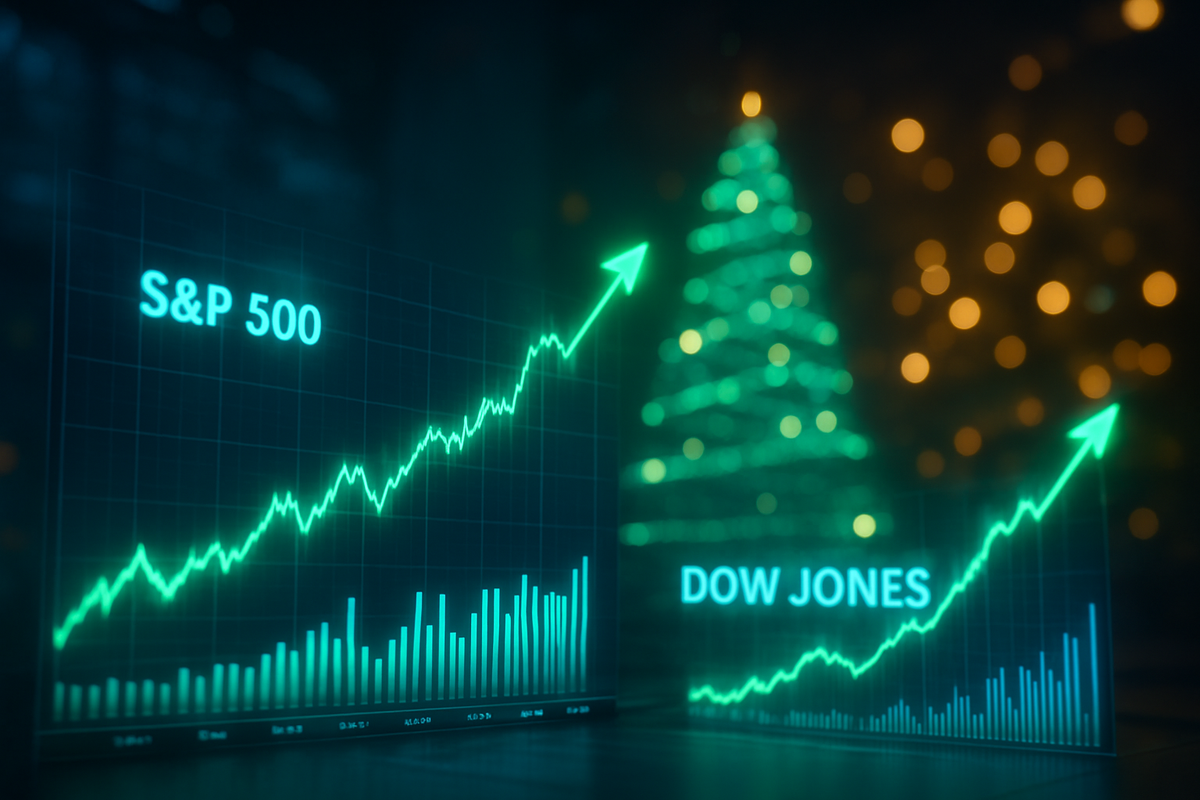
The final trading sessions of 2025 are witnessing a historic "Santa Claus Rally" that has propelled major averages to unprecedented heights. On December 24, the S&P 500 (^GSPC) closed at a record 6,932.05, while the Dow Jones Industrial Average (^DJI) surged past 48,700, marking a definitive end to a year characterized by both legislative gridlock and technological triumph. This year-end surge, traditionally defined as the final five trading days of December and the first two of January, is being fueled by a potent cocktail of resilient corporate earnings and a long-awaited relief rally following the resolution of the autumn's fiscal turmoil.
The momentum heading into the final week of the year is particularly striking given the hurdles 2025 placed in the market's path. Investors are currently shaking off the lingering effects of a record-breaking 43-day government shutdown that paralyzed Washington earlier this fall, choosing instead to focus on a robust 4.3% GDP growth rate and the Federal Reserve’s recent pivot toward easing. With the "Great Data Gap" finally closed by a flurry of late-December economic reports, the market's trajectory suggests that the holiday spirit on the trading floor is backed by more than just seasonal optimism—it is supported by a fundamental belief in a "soft landing" for the American economy.
A Perfect Storm of Relief and Resilience
The 2025 Santa Claus Rally officially kicked off on Wednesday, December 24, with a shortened but explosive session. The rally is the culmination of a volatile fourth quarter that saw markets initially retreat during the 43-day partial government shutdown from October 1 to November 12. During that period, the Federal Reserve was forced to "fly blind" without official labor and inflation data, creating a vacuum of uncertainty. However, the release of the December 18 Consumer Price Index (CPI) report—showing inflation cooling to 2.7%—acted as the primary catalyst for the current year-end surge.
Key to this momentum was the Federal Open Market Committee (FOMC) meeting on December 10, where Chair Jerome Powell delivered what analysts have termed a "Hawkish Cut." The Fed lowered the benchmark federal funds rate by 25 basis points to a range of 3.50%–3.75%. While the committee signaled that further cuts in 2026 would be sparse, the move was enough to reassure investors that the central bank was committed to supporting a labor market where unemployment had crept up to 4.6%. The combination of a proactive Fed and the "coiled spring" effect of deferred government contracts being released post-shutdown has created a high-liquidity environment perfect for a year-end run.
The rally has been further bolstered by the "AI Supercycle," which transitioned in 2025 from a speculative frenzy into a phase of tangible infrastructure deployment. Throughout December, the Nasdaq Composite (NASDAQ: IXIC) led the charge, finishing the pre-Christmas session at 23,613.31. This tech-heavy dominance was underscored by a massive influx of capital into semiconductor and energy stocks, as the market began to price in the immense power requirements of next-generation data centers.
The Winners and Losers of the 2025 Surge
The clear champion of this year’s rally is Nvidia (NASDAQ: NVDA), which achieved a staggering $5 trillion market capitalization in late December. As the company’s "Blackwell Ultra" architecture reached full-scale production, it solidified its position as the bedrock of the global AI economy. Similarly, Tesla (NASDAQ: TSLA) emerged as a holiday star, with its stock price surging toward $500. Investor confidence in the electric vehicle giant was restored following the reinstatement of Elon Musk’s compensation package and breakthroughs in "unsupervised" Full Self-Driving (FSD) testing, making it one of the top performers of the December window.
In the retail sector, a sharp divide has emerged. Amazon (NASDAQ: AMZN) and Walmart (NYSE: WMT) have dominated the 2025 holiday season, which became the first to surpass $1 trillion in total U.S. retail sales. Walmart, in particular, benefited from the "trade-down effect," as even higher-income households sought value amid lingering service-sector inflation. Conversely, premium brands and traditional ad-tech firms have struggled. The Trade Desk (NASDAQ: TTD) saw significant drawdowns this month as fears grew that proprietary AI tools would allow major brands to bypass traditional advertising middlemen.
The financial sector also saw a resurgence, with JPMorgan Chase (NYSE: JPM) and Goldman Sachs (NYSE: GS) benefiting from a late-year spike in merger and acquisition activity. However, the rally was not universal. The real estate sector, represented by firms like Alexandria Real Estate Equities (NYSE: ARE), continued to lag due to the ongoing structural crisis in commercial office space. Meanwhile, Fiserv (NYSE: FI) became one of the S&P 500’s biggest detractors for the year, as slowing merchant-services growth weighed heavily on its valuation.
Historical Precedents and the AI Infrastructure Shift
The 2025 Santa Claus Rally fits into a historical pattern first identified by Yale Hirsch in 1972, which suggests that year-end gains often precede a bullish first quarter. Historically, the S&P 500 has risen about 1.3% during this seven-day window. However, the 2025 iteration is unique due to the "AI Infrastructure" narrative. Unlike previous years where gains were broad-based across consumer discretionary stocks, this year's rally is heavily concentrated in companies that provide the "picks and shovels" for the digital age, such as Micron Technology (NASDAQ: MU) and next-gen energy firms like Oklo (NYSE: OKLO).
The wider significance of this event lies in the market's ability to decouple from political instability. The 43-day shutdown was the longest in U.S. history, yet the market's recovery suggests that private sector innovation—particularly in AI and biotechnology—is now a more powerful driver of valuation than fiscal policy. This shift mirrors the late 1990s dot-com boom but with a crucial difference: in 2025, these tech giants are generating record-breaking cash flows and dividends, providing a fundamental floor that was absent in previous tech bubbles.
The Road to 2026: What Comes Next?
As investors look toward the opening bell of 2026, the primary question is whether this momentum can be sustained. In the short term, the market faces a "reality check" in early January when institutional volume returns and the full economic impact of the government shutdown is finally quantified in the Q4 GDP prints. Analysts expect a period of consolidation, especially as the Federal Reserve has indicated it may only deliver one additional rate cut in the entirety of 2026.
Strategic pivots will be required for investors who have ridden the AI wave. The focus is expected to shift from hardware providers like Nvidia to "AI adopters"—companies in sectors like healthcare and logistics that can successfully integrate these tools to expand margins. Furthermore, the energy sector is poised for a volatile 2026 as the massive power demands of AI data centers clash with aging grid infrastructure, potentially creating opportunities in nuclear and renewable energy stocks.
Wrap-Up: A High-Note Finish to a Turbulent Year
The 2025 Santa Claus Rally has provided a triumphant conclusion to a year that many feared would be defined by economic stagnation. With the S&P 500 and Dow at record highs, the "everything rally" has rewarded those who stayed the course during the autumn's political volatility. The key takeaway for investors is the sheer resilience of the U.S. consumer and the transformative power of the AI supercycle, which has managed to overshadow even the longest government shutdown in history.
Moving forward, the market appears to be on firm footing, but the "hawkish" undertones of the Federal Reserve cannot be ignored. While the Santa Claus Rally often predicts a strong start to the new year, the high valuations currently seen in Big Tech leave little room for error. In the coming months, investors should keep a close eye on labor market stability and the first-quarter earnings guidance from the "Magnificent Seven" to see if the 2025 records were a peak or merely a plateau on the way to even higher ground.
This content is intended for informational purposes only and is not financial advice