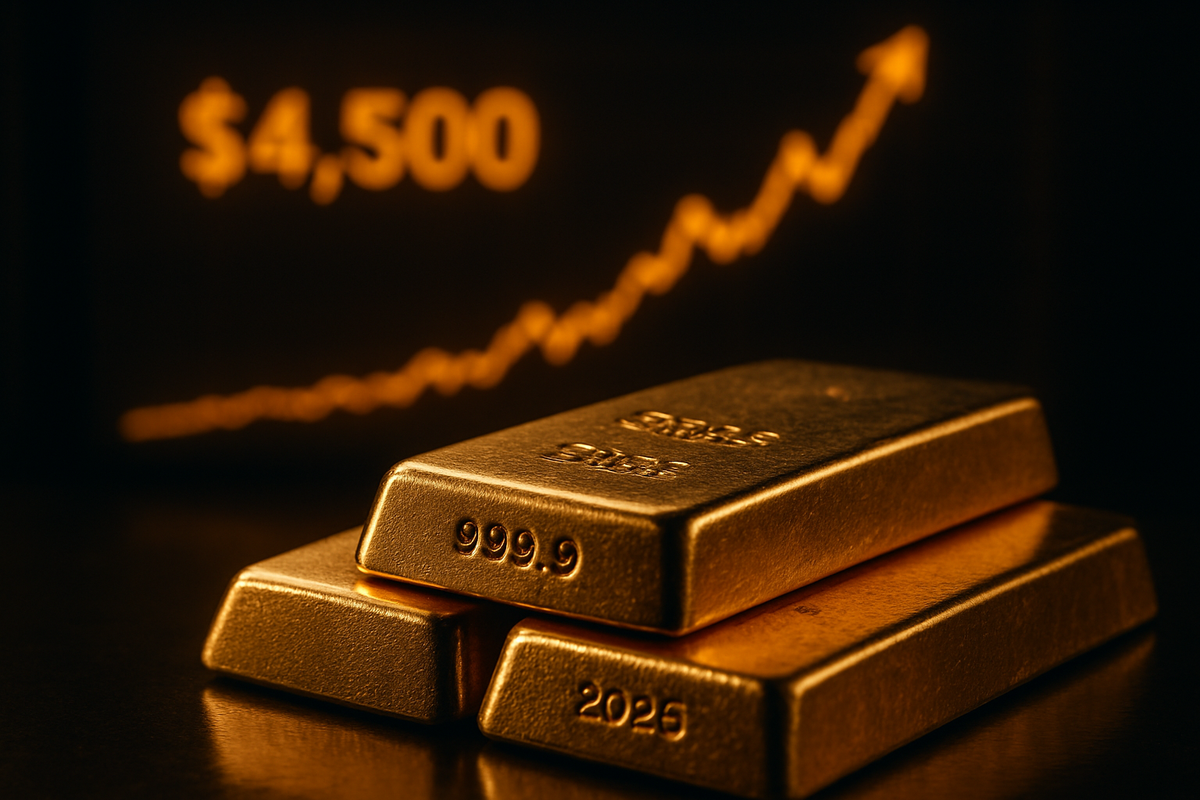
In a historic trading session that will be etched into the annals of financial history, gold prices officially breached the $4,500 per ounce mark today, December 23, 2025. This momentous surge represents a staggering 70% increase since the beginning of the year, cementing gold's status as the definitive asset of 2025. The final push beyond the $4,500 psychological barrier was triggered by a confluence of cooling economic data and a weakening U.S. dollar, sending a clear signal that investors are bracing for a prolonged period of macroeconomic uncertainty.
The immediate implications of this milestone are profound, reshaping global capital flows and forcing a total re-evaluation of risk-adjusted returns. As the "ultimate arbiter of value," gold's ascent to $4,500 reflects a broader loss of confidence in fiat currencies and traditional fixed-income instruments. With the Federal Reserve now widely expected to pivot toward aggressive monetary easing in early 2026, the flight to hard assets has reached a fever pitch, leaving market participants to wonder how much higher the "yellow metal" can climb in this new stagflationary era.
The Road to $4,500: A Perfect Storm of Catalysts
The ascent to $4,500 was not an overnight phenomenon but the culmination of a volatile year defined by geopolitical friction and shifting monetary policy. The rally began in earnest following the January 2025 inauguration, as the new U.S. administration’s aggressive tariff policies and trade tensions—most notably a naval blockade of Venezuela—injected a massive risk premium into the markets. By mid-2025, gold had already surpassed $3,500, driven by record-breaking central bank purchases. Institutions from Poland to China added over 950 tonnes to their reserves this year, a structural shift toward "de-dollarization" that provided a durable floor for prices.
The final catalyst arrived this morning with the release of the revised U.S. third-quarter GDP data. The Bureau of Economic Analysis reported that growth was revised downward to 3.2%, falling short of the previously estimated 3.8%. This cooling growth, coupled with persistent Personal Consumption Expenditures (PCE) inflation hovering near 3.1%, has reignited fears of stagflation. The market’s reaction was instantaneous: the U.S. Dollar Index (DXY) slipped below the critical 98 level, and gold spot prices surged from $4,440 to cross the $4,500 threshold within minutes of the opening bell.
Market veterans have drawn parallels between the current environment and the inflationary shocks of the 1970s. However, the scale of today's move is unprecedented. A 43-day government shutdown in the final quarter of 2025 further eroded domestic stability, leaving gold as the only viable haven for investors seeking to preserve purchasing power. The Federal Reserve's 25-basis-point rate cut on October 29, 2025, served as the "green light" for this final leg of the rally, signaling that the central bank is now more concerned with supporting growth than fighting stubborn price increases.
Winners and Losers in the High-Gold Era
The meteoric rise of gold has created a stark divide between industries that profit from the boom and those that are being squeezed by rising input costs. Gold mining companies have been the primary beneficiaries, with many stocks outperforming the metal itself due to significant operating leverage. Barrick Gold (NYSE: GOLD), recently rebranded as Barrick Mining, has seen its share price skyrocket by 182% this year, buoyed by record margins and its strategic expansion into copper. Similarly, Newmont (NYSE: NEM), the world’s largest producer, reported its best annual performance in over fifty years, as the gap between its all-in sustaining costs and the $4,500 spot price generated historic levels of free cash flow.
Junior miners and diversified exchange-traded funds have also reaped the rewards. The VanEck Gold Miners ETF (NYSE: GDX) and the VanEck Junior Gold Miners ETF (NYSE: GDXJ) have both posted gains exceeding 120% year-to-date. For investors seeking direct exposure to the physical metal, the SPDR Gold Shares (NYSE: GLD) remains the primary vehicle, though its 56% gain lags behind the triple-digit returns seen in the mining sector. On the flip side, the jewelry industry is facing a "sticker shock" crisis. Signet Jewelers (NYSE: SIG), the parent company of Kay and Zales, reported a 7% decline in annual revenue as consumers are increasingly priced out of high-karat gold, forcing the company to pivot toward lower-karat alloys and lab-grown diamonds to maintain sales volume.
The technology sector is also feeling the pinch. While the amount of gold in individual devices is small, the aggregate cost for giants like Apple (NASDAQ: AAPL) and Nvidia (NASDAQ: NVDA) is starting to weigh on hardware margins. High-performance AI servers and premium consumer electronics require gold for its superior conductivity and corrosion resistance. Reports suggest that these tech behemoths are now celebrating research into alternative conductive materials to mitigate the impact of $4,500 gold on their bottom lines, marking a significant shift in industrial material science.
Wider Significance and Historical Precedents
Gold hitting $4,500 is more than just a price milestone; it is a symptom of a fundamental shift in the global financial architecture. Historically, gold has served as a barometer for systemic risk. The current surge mirrors the 1979-1980 rally, where geopolitical instability and high inflation drove prices to then-unthinkable heights. However, the 2025 rally is unique due to the level of institutional and sovereign participation. Central banks are no longer just "holding" gold; they are aggressively accumulating it as a hedge against a weaponized dollar and a debt-saturated global economy.
This event has significant ripple effects on the broader market. The "safe-haven" trade has effectively sucked liquidity out of more speculative sectors, such as small-cap growth stocks and certain emerging markets. Furthermore, the regulatory environment is shifting; there is growing talk in Washington about the need for a "Digital Gold" framework or even a return to some form of commodity-backed currency to stabilize the dollar. While these remain fringe ideas for now, the reality of $4,500 gold makes previously "impossible" economic discussions suddenly mainstream.
What Comes Next: The Path to $5,000?
As we look toward 2026, the question on every investor's mind is whether this rally is sustainable or if a correction is imminent. In the short term, technical analysts expect a period of consolidation. After such a parabolic move, it would be healthy for gold to trade sideways between $4,300 and $4,600 as the market digests the recent GDP data. However, the long-term outlook remains overwhelmingly bullish. Major Wall Street institutions, including Goldman Sachs and J.P. Morgan, have already begun revising their 2026 targets, with some analysts projecting a move toward $6,000 if the Federal Reserve follows through with multiple rate cuts.
The primary challenge for the market will be the "high-price environment" itself. If gold remains above $4,000, we can expect a permanent shift in consumer behavior and industrial manufacturing. Strategic pivots toward recycling and material substitution will become the norm. For investors, the opportunity lies in identifying the "next tier" of miners who can increase production in this high-margin environment. Conversely, the risk remains a sudden "hawkish" turn by the Fed or a resolution to global trade conflicts, either of which could trigger a sharp, albeit likely temporary, pullback in prices.
Summary and Market Outlook
The achievement of $4,500 gold is a watershed moment for the global economy. It validates the concerns of those who warned of the long-term consequences of fiscal profligacy and geopolitical overreach. For the average investor, this milestone serves as a reminder of the importance of diversification and the role of hard assets in a balanced portfolio. The key takeaways from today's GDP-fueled surge are clear: growth is slowing, inflation is sticky, and the demand for safety has never been higher.
Moving forward, the market will be hyper-focused on the Federal Reserve's first meeting of 2026 and the subsequent employment data. If the labor market shows signs of cracking alongside the slowing GDP, the momentum behind gold could accelerate even further. Investors should watch the U.S. Dollar Index closely; as long as the DXY remains under pressure, the path of least resistance for gold is likely upward. While $4,500 seemed like a fantasy just twelve months ago, it is now the new reality of the 2025 financial landscape.
This content is intended for informational purposes only and is not financial advice.