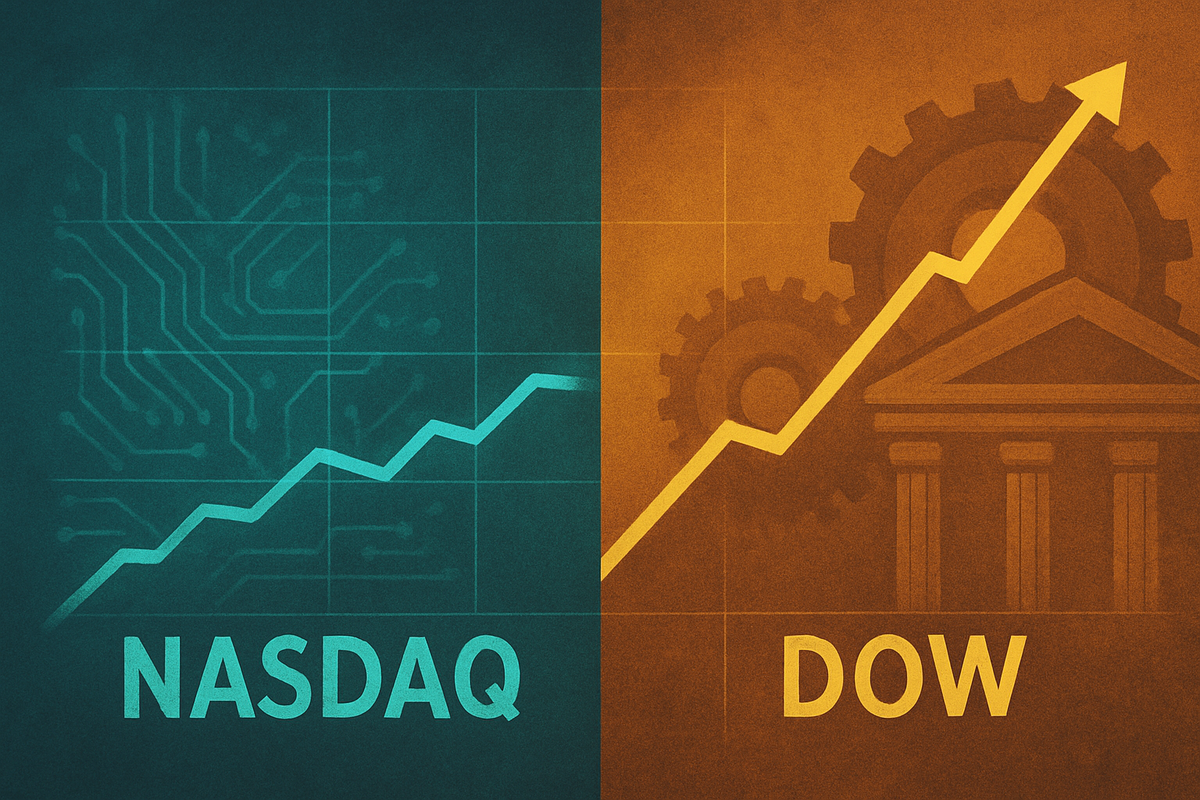
The U.S. stock market is currently navigating a significant recalibration, marked by a pronounced divergence as of December 11, 2025. While the venerable Dow Jones Industrial Average (DJIA) has demonstrated remarkable resilience, soaring to new all-time highs, the tech-heavy Nasdaq Composite (NASDAQ) finds itself in a challenging position, lagging significantly behind. This "Great Divergence" signals a fundamental shift in investor sentiment, moving away from the high-growth technology sector towards more traditional, value-oriented companies.
This market dynamic carries immediate implications, notably an accelerated sector rotation and heightened scrutiny of tech valuations. The underperformance of technology stocks, once the darlings of the market, is prompting investors to re-evaluate their portfolios and demand clearer pathways to profitability from companies that have seen massive investments, particularly in artificial intelligence. The current environment suggests a period of sustained volatility as the market seeks a new equilibrium.
The Tech Sector's Reality Check
On December 11, 2025, the market showcased this divergence in stark relief. The Dow Jones Industrial Average surged by 1.34%, closing at a fresh all-time high of 48,704.01 points. In stark contrast, the Nasdaq Composite experienced a decline of 0.7%, with its futures dropping sharply by 1.5% earlier in the trading day. The S&P 500 (SPX) also saw a slide, albeit a more modest one, decreasing by 0.4%. This performance underscores a clear shift in investment flows, favoring established industries over the often-speculative growth of the tech sector.
The primary catalyst for this recent downturn in technology stocks, especially on this specific date, was the disappointing earnings report from Oracle (NYSE: ORCL). The company missed its crucial cloud revenue targets and, more alarmingly, announced a substantial $15 billion increase in data center spending. This revelation caused Oracle's shares to plummet over 15%, sending ripples of concern through the entire tech sector. Investors were "spooked" by the report, which "revived AI spending fears," prompting questions about the actual profitability and return on investment for the massive capital outlays in artificial intelligence infrastructure.
This event has exacerbated a broader "risk-off" sentiment that has permeated global financial markets. Investors are actively rotating out of high-growth tech stocks, which are often perceived as more sensitive to economic headwinds, and into more defensive or value-oriented sectors. This sentiment has been further fueled by a sharp sell-off in the cryptocurrency market, led by Bitcoin, which has indirectly impacted technology companies with strong ties to the digital asset ecosystem. Concerns over elevated valuations, particularly for the "Magnificent Seven" mega-cap technology companies that have largely driven market gains throughout the year, are also playing a significant role.
Adding to the pressure are rising Treasury yields, with the 10-year Treasury note yield climbing to around 4.10% from 4.01% at the start of December. Higher bond yields make fixed-income investments more attractive, diverting capital away from equities, especially high-valued growth stocks. Furthermore, emerging signs of an economic slowdown, including U.S. factory activity contracting more than expected in November and an uptick in weekly jobless claims, are intensifying investor unease, leading to reduced R&D and investment across the tech industry in 2025.
Winners and Losers in the Market Shift
The "Great Divergence" currently reshaping the U.S. stock market is creating a clear divide between potential winners and losers, particularly as capital flows away from the tech sector. Companies heavily weighted in technology, especially those whose valuations are predicated on aggressive future growth and AI investments, are facing significant headwinds. Conversely, more traditional, value-oriented sectors and companies with robust fundamentals are poised to benefit.
Among the most affected losers are the mega-cap technology and AI-driven growth stocks, often referred to as the "Magnificent Seven." Companies like Nvidia (NASDAQ: NVDA), Apple (NASDAQ: AAPL), Amazon (NASDAQ: AMZN), Microsoft (NASDAQ: MSFT), Meta Platforms (NASDAQ: META), and Alphabet (NASDAQ: GOOGL) are under intense scrutiny regarding whether their earnings growth can sustain their current high valuations. Nvidia, despite its pivotal role in AI, saw its strong earnings momentum falter in November 2025, signaling investor skepticism about the sustainability of its lofty valuation amidst geopolitical concerns impacting the semiconductor boom. The recent disappointing earnings report from Oracle (NYSE: ORCL), which saw its shares plummet over 15% after missing cloud revenue targets and announcing massive data center spending, further highlights the challenges facing software and cloud computing giants within the tech sphere.
The ripple effects extend to the semiconductor manufacturing equipment and traditional chip companies. Firms such as ASML (NASDAQ: ASML), KLA Corp (NASDAQ: KLAC), Applied Materials (NASDAQ: AMAT), and Lam Research (NASDAQ: LRCX) are vulnerable to warnings and geopolitical tensions, exemplified by ASML's anticipated "significant" decline in Chinese market sales for 2026 due to U.S. export controls. Major chip manufacturers like Intel (NASDAQ: INTC) and TSMC (NYSE: TSM) are also directly impacted, with Intel undertaking substantial layoffs in 2024 and 2025, reflecting a broader sales slowdown. Furthermore, companies with high debt levels across all sectors face increased borrowing costs in a higher interest rate environment, eating into profits and reducing investor appeal.
On the winning side, sectors traditionally considered "value" or "cyclical" are experiencing a resurgence. The financial sector, including giants like Bank of America (NYSE: BAC), Comerica (NYSE: CMA), JPMorgan Chase & Co. (NYSE: JPM), and Morgan Stanley (NYSE: MS), thrives in a higher interest rate environment as banks can achieve higher net interest margins. The energy sector, with companies such as Exxon Mobil (NYSE: XOM) and Occidental Petroleum (NYSE: OXY), is also benefiting from increased economic activity and a rotation of capital away from tech. Utilities, driven by rising AI-related power demand and infrastructure buildout, along with healthcare and biotechnology firms focused on areas like obesity and cancer treatment, are showing resilience. Industrials and Materials are benefiting from global economic recovery and infrastructure spending, while consumer staples like PepsiCo (NASDAQ: PEP) and Walmart (NYSE: WMT) offer stability and consistent dividends during volatile periods, making them attractive defensive plays.
Broader Implications and Historical Parallels
The divergence of the Nasdaq from the Dow and S&P 500, with the tech sector lagging, carries a wider significance that extends beyond immediate market fluctuations, touching upon fundamental industry trends, economic ripple effects, and regulatory considerations. This recalibration, observed throughout parts of 2025, underscores a re-evaluation of growth versus value and the sustainability of tech-led expansion.
One of the primary broader industry trends influencing this divergence is the prevailing interest rate environment. Higher-than-expected interest rates throughout 2025 have disproportionately impacted high-valued technology and growth stocks, often considered "long duration" assets whose future cash flows are less valuable when discounted at higher rates. With the Federal Reserve's projected federal funds rate for 2025 at 3.9%, investors have been compelled to reassess tech valuations, which, for the Information Technology sector, neared dot-com bubble levels with a P/E ratio of 27.7x earlier in the year. This has spurred a discernible sector rotation, with capital flowing from rate-sensitive tech stocks towards more defensive sectors like utilities, financials, materials, and consumer staples, reflecting a prioritization of stable cash flows and dividend yields over speculative growth.
The ripple effects of a lagging tech sector are substantial, given its critical role in the U.S. economy. A slowdown in aggressive capital expenditures from major tech players like Oracle (NYSE: ORCL), Microsoft (NASDAQ: MSFT), and Alphabet (NASDAQ: GOOGL) could directly impact cloud providers, AI software developers, and hardware manufacturers, potentially stifling innovation and growth across the tech supply chain. Furthermore, large-scale layoffs, which saw approximately 100,000 global tech job cuts in 2024 and over 54,000 tech-driven job cuts in 2025 (partly due to AI adoption), could significantly dampen overall economic growth, consumer spending, and innovation rates, also posing challenges for the commercial real estate market in major tech hubs.
From a regulatory and policy standpoint, the evolving tech landscape brings increased scrutiny. Antitrust investigations, such as those by the Department of Justice against Google (NASDAQ: GOOGL) and the Federal Trade Commission against Amazon (NASDAQ: AMZN), are intensifying, aiming to curb large-scale tech consolidation and promote fair competition. AI regulation is also a significant area, with discussions potentially shifting towards deregulation in the U.S. to foster competition, while global scrutiny on AI and cybersecurity remains intense. Data privacy, cybersecurity, and new global tax regulations, including minimum tax requirements, are also compelling multinational tech companies to adapt their practices, alongside tightening U.S. export controls on advanced technologies.
Historically, the current market dynamics draw parallels to the dot-com bust of the early 2000s, where "frothy valuations" and concentration risk led to a significant tech sector downturn. This serves as a cautionary tale about speculative investing and the importance of fundamental profitability. The impact of rising interest rates on growth stocks is also a recurring theme, as seen in previous periods of monetary tightening. The observed sector leadership rotation is a common market phenomenon, highlighting that leadership among stocks and sectors shifts over time, underscoring the importance of diversification and the inherent risks of market concentration on a few dominant tech companies.
The Road Ahead for Tech and the Market
The current "Great Divergence" in the market, with the Nasdaq lagging the Dow and S&P 500, sets the stage for a dynamic period ahead for the tech sector, marked by both challenges and significant opportunities. In the short term (next 6-12 months), the sector rotation is expected to continue, with investors maintaining a selective approach. While a complete abandonment of technology is unlikely, the focus will intensify on companies that can clearly articulate and demonstrate the financial benefits and measurable return on investment (ROI) from their substantial AI initiatives. Some strategists anticipate high-single-digit to low-double-digit returns for the tech sector in 2026, assuming no sharp profit recession and sustained demand for AI infrastructure, with the Nasdaq 100 potentially benefiting from structural AI trends and anticipated Federal Reserve rate cuts. However, warnings of a potential "AI bubble burst" and a recession in 2026 suggest a more cautious outlook, where defensive sectors like healthcare might outperform.
Looking further out (beyond 2026), the long-term possibilities for the tech sector remain robust, driven by the transformative power of AI. AI is projected to be a "mega-force" profoundly reshaping the global economy, necessitating unprecedented, capital-intensive buildouts in computing power, data centers, and energy infrastructure. Key trends include continued AI dominance with massive GDP impact by 2030, significant infrastructure investments (estimated at $6.7 trillion by McKinsey by 2030), and the growth of emerging technologies like cloud, edge computing, quantum computing, and AI-driven cyber resilience. After a subdued period, a resurgence of tech IPOs is also anticipated between 2026 and 2030, with a pipeline of over 400 private tech firms, primarily in AI infrastructure, semiconductors, and climate-tech, preparing for public listings.
To navigate this evolving landscape, tech companies will need to implement strategic pivots. A primary adaptation is an intensified focus on profitability and demonstrable ROI from AI investments, moving away from purely narrative-driven growth. This includes a shift towards outcome-based pricing models, rethinking business processes with "AI-first" operating models, and operational discipline through cost restructuring. Diversification beyond "pure tech" into the "picks and shovels" of the AI buildout—such as semiconductors, industrial automation, and power infrastructure—will also be crucial. Market opportunities abound in AI infrastructure demand, broadening AI applications, and digital transformation in traditional industries. However, challenges persist, including ongoing valuation scrutiny, concerns about an "AI bubble," potential economic slowdowns, regulatory uncertainty, and the capital-intensive nature of the AI buildout requiring significant financing. Potential scenarios range from a "soft landing" and AI-driven rebound to an "AI bubble burst" leading to a recessionary bear market, or a period of fragmented growth demanding a nuanced, active investment approach.
A New Era of Market Discretion
The "Great Divergence" currently unfolding in the U.S. stock market, with the Nasdaq lagging behind the Dow and S&P 500, marks a significant turning point, particularly for the tech sector. This recalibration, underscored by events on December 11, 2025, and throughout the year, highlights a critical shift in investor sentiment: a move away from unbridled growth narratives towards a demand for tangible profitability and sustainable business models, especially concerning massive AI investments. The disappointing performance of key tech players and the ensuing "risk-off" environment have emphasized the vulnerability of concentrated market leadership and the inherent risks of frothy valuations.
Moving forward into 2026 and beyond, the market is expected to remain dynamic and potentially volatile, characterized by continued sector rotations. While U.S. equities, in general, may outperform global peers, the path will likely be choppy, with sustained churn between sectors. AI will undoubtedly remain a dominant theme, driving significant capital expenditure and contributing to earnings growth across various industries. However, this will also likely lead to further polarization within equity markets, distinguishing between true AI beneficiaries and those merely riding the narrative. The Federal Reserve's anticipated interest rate cuts are expected to provide some tailwind, but inflation risks could introduce monetary policy instability.
The lasting impact of this divergence could be a more discerning investment landscape. The tech sector is maturing, moving from an "asset-light" software model to an "asset-heavy" industrial utility due to the vast infrastructure needs of AI. This demands a critical evaluation of capital flows for their return on investment rather than simply chasing growth. Investors in the coming months should closely watch tech valuations and profitability, particularly for AI-heavy companies. Monitoring for continued sector rotation, the sustainability of AI capital expenditure, and any shifts in the Federal Reserve's monetary policy will be crucial. Furthermore, observing market breadth—whether gains are broadening beyond a few mega-cap stocks—and maintaining a diversified portfolio will be key strategies to navigate this evolving market.
This content is intended for informational purposes only and is not financial advice