As of February 16, 2026, the global technology landscape is defined by a single acronym: TSM. Taiwan Semiconductor Manufacturing Company (NYSE: TSM), the world’s largest dedicated independent semiconductor foundry, has moved beyond being a mere supplier to becoming the fundamental substrate of the "AI Giga-cycle." With the company currently hovering near a $1.9 trillion market capitalization and eyeing the historic $2 trillion and $3 trillion milestones, TSMC finds itself at a unique crossroads of unprecedented financial growth and intensifying geopolitical complexity. Following a year of stellar performance marked by 26% revenue growth, the company is no longer just a bellwether for the chip industry—it is the central engine of the global digital economy.
Historical Background
Founded in 1987 by Dr. Morris Chang, TSMC pioneered the "pure-play" foundry model. Before TSMC, semiconductor companies designed and manufactured their own chips (Integrated Device Manufacturers, or IDMs). Chang’s radical insight was that many designers would prefer to outsource the capital-intensive manufacturing process to a trusted partner that did not compete with them in design.
Based in Hsinchu Science Park, Taiwan, the company initially focused on mature nodes but rapidly climbed the "learning curve." By the early 2000s, TSMC was matching the world’s best in process technology. The mobile revolution, led by the iPhone, catapulted TSMC to global dominance as it became the exclusive manufacturer for Apple’s A-series chips. Over four decades, TSMC has evolved from a government-backed experiment into a global monopoly on the most advanced "leading-edge" logic chips, accounting for over 90% of the world's production of sub-5nm processors.
Business Model
TSMC’s business model remains remarkably consistent: it does not design, brand, or sell its own semiconductor products. Instead, it offers fabrication services to "fabless" clients like Nvidia (NASDAQ: NVDA), Apple (NASDAQ: AAPL), AMD (NASDAQ: AMD), and Qualcomm (NASDAQ: QCOM).
The revenue model is primarily driven by wafer shipments and price-per-wafer, which increases significantly with each new node (e.g., 3nm wafers are significantly more expensive than 5nm). Beyond pure fabrication, TSMC has expanded into advanced packaging—technologies like CoWoS (Chip-on-Wafer-on-Substrate)—which are essential for stacking HBM (High Bandwidth Memory) with GPUs for AI applications. This "Foundry 2.0" model ensures that as chips become harder to shrink, TSMC captures value through complex assembly and multi-chip integration.
Stock Performance Overview
Over the past decade, TSM has been a "generational" wealth creator.
- 10-Year Horizon: Investors have seen returns exceeding 800% as the company transitioned from a 28nm leader to the sole provider of 3nm technology.
- 5-Year Horizon: The stock benefited from the post-pandemic digitalization surge and the 2023-2025 AI boom, roughly tripling in value since 2021.
- 1-Year Horizon: In the last 12 months, TSM has outperformed the S&P 500 significantly, fueled by the realization that AI demand is "structural" rather than "cyclical."
In early 2026, the stock has shown resilience despite higher interest rates, trading at a premium P/E multiple compared to its historical average, reflecting its status as a "defensive growth" play in the tech sector.
Financial Performance
TSMC’s financial results for the 2025 fiscal year were nothing short of extraordinary. The company reported a 26% year-over-year revenue growth, closing the year with approximately $115 billion in total revenue. This growth was underpinned by the aggressive ramp-up of the 3nm (N3P) node and early revenue from the 2nm (N2) pilot lines.
The company maintains an industry-leading gross margin of approximately 54-56%, even as it invests heavily in overseas expansion. For 2026, management has signaled a record-breaking Capital Expenditure (CapEx) budget of $52–$56 billion, a signal to the market that they expect demand for AI silicon to persist through the end of the decade. Net debt remains negligible, with a cash-rich balance sheet that allows for both massive R&D and consistent dividend growth.
Leadership and Management
Under the leadership of Chairman and CEO Dr. C.C. Wei, TSMC has maintained a culture of "operational excellence." Following the retirement of Mark Liu in 2024, Wei consolidated power, emphasizing a strategy of "global footprint, Taiwan core."
The management team is widely regarded by analysts as the most disciplined in the semiconductor industry. Their ability to manage "yield"—the percentage of usable chips on a wafer—is their primary competitive advantage. Governance remains a strong suit, with a board that balances Taiwanese industrial expertise with international corporate experience, ensuring the company navigates its role as a "geopolitical focal point" with diplomatic precision.
Products, Services, and Innovations
TSMC’s product is essentially "the future."
- 2nm (N2) Node: Having entered volume production in late 2025, the 2nm node is the first to use Gate-All-Around (GAA) nanosheet transistors, providing a 15% speed boost or 30% power reduction over 3nm.
- A16 (1.6nm) Node: Slated for mass production in the second half of 2026, the A16 node introduces the "Super Power Rail," a backside power delivery network that is expected to be a game-changer for high-performance AI GPUs.
- Advanced Packaging: TSMC’s CoWoS and SoIC (System on Integrated Chips) technologies have become the bottleneck for AI chip supply, and the company is doubling its packaging capacity in 2026 to meet Nvidia’s voracious appetite.
Competitive Landscape
While TSMC holds a dominant market share (over 60% of the total foundry market), it faces renewed competition:
- Intel (NASDAQ: INTC): Under its "Intel Foundry" rebrand, Intel is racing to regain "process leadership" with its 18A and 14A nodes. While Intel has secured some U.S. government support, it still lags TSMC in yield and customer trust.
- Samsung Foundry: The South Korean giant remains the "second source" for many. Samsung has improved its 2nm GAA yields to approximately 60% in late 2025, securing a major contract with AMD for its 2nm-based chips.
Despite these rivals, TSMC’s "ecosystem" of design tools and library partners (the Open Innovation Platform) creates a massive "moat" that makes it difficult for customers to switch.
Industry and Market Trends
The semiconductor industry is currently driven by three secular trends:
- The AI Giga-cycle: The shift from general-purpose computing to accelerated computing requires massive quantities of high-end logic and memory.
- Sovereign AI: Nations are increasingly seeking to build their own AI data centers, diversifying the customer base beyond US "Hyperscalers."
- Silicon Diversification: Companies like Amazon, Google, and Meta are designing their own "in-house" chips (ASICs), all of which are manufactured by TSMC.
Risks and Challenges
TSMC's primary risks are not technological, but structural:
- Geopolitical Sensitivity: With the majority of its production in Taiwan, the risk of a cross-strait conflict remains the "black swan" for global markets.
- Concentration Risk: A significant portion of revenue comes from a handful of customers (Apple and Nvidia). Any slowdown in these specific ecosystems would weigh heavily on TSMC.
- Resource Constraints: In Taiwan, TSMC consumes nearly 8-10% of the island's electricity. Managing water and power in a climate-stressed world is an ongoing operational challenge.
- Execution at 2nm: While yields are currently strong, the transition to GAA architecture is a major shift that carries inherent technical risks.
Opportunities and Catalysts
The "Path to $3 Trillion" is paved with specific catalysts:
- The 2nm Ramp: As 2nm moves from pilot to high-volume production in 2026, ASPs (Average Selling Prices) will rise, boosting margins.
- Edge AI: The integration of AI capabilities into smartphones and PCs (AI PCs) will require a massive refresh cycle of chips, benefiting TSMC’s older and newer nodes alike.
- Automotive Evolution: As cars become "data centers on wheels," the demand for 5nm and 3nm chips in the automotive sector is projected to grow by 40% annually.
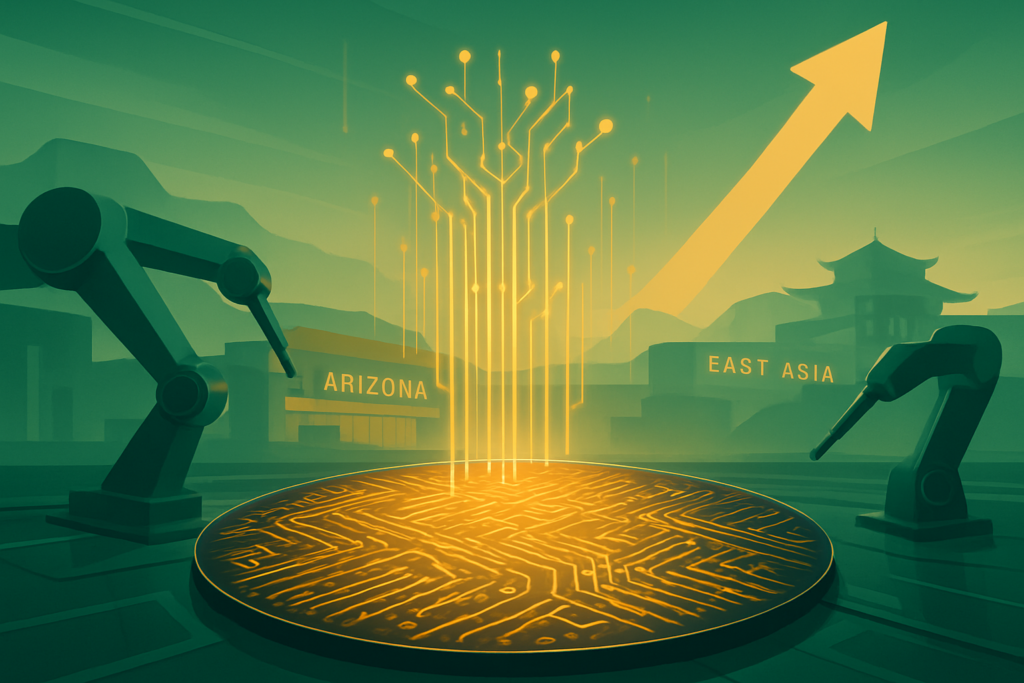
- Valuation Rerating: If TSMC successfully proves that its Arizona and Japan fabs can produce high yields, the "geopolitical discount" on the stock may evaporate, leading to a higher P/E multiple.
Investor Sentiment and Analyst Coverage
Wall Street remains overwhelmingly bullish on TSMC. Most major investment banks maintain "Buy" or "Strong Buy" ratings, citing the company as the "safest way to play AI." Institutional ownership remains high, with heavyweights like BlackRock and Vanguard maintaining significant positions.
The retail sentiment, often tracked via social platforms, has shifted from fearing a "Taiwan invasion" to "FOMO" (Fear Of Missing Out) regarding the AI growth. Hedge funds have also increased their "long" positions in late 2025, viewing TSM as a cheaper alternative to Nvidia on a PEG (Price/Earnings-to-Growth) basis.
Regulatory, Policy, and Geopolitical Factors
The geopolitical landscape is a double-edged sword. On one hand, the U.S. CHIPS and Science Act has provided billions in grants for TSMC’s Arizona expansion (Fabs 21 and 22). On the other hand, increasingly stringent U.S. export controls on China have forced TSMC to strictly monitor its client list, potentially limiting its "legacy node" business in the Chinese market.
Furthermore, the "Silicon Shield"—the idea that TSMC's importance to the global economy prevents conflict in the Taiwan Strait—is being tested as the company diversifies its manufacturing to Japan (Kumamoto) and Germany (Dresden). This "globalization" reduces risk but increases the cost of production, a factor investors must weigh carefully.
Conclusion
TSMC enters 2026 as the undisputed king of the silicon world. Its 26% revenue growth and the imminent rollout of 2nm and A16 technologies demonstrate a company that is not just participating in the AI revolution, but dictating its pace. While geopolitical risks and the astronomical costs of overseas expansion remain permanent fixtures of the TSMC narrative, the company’s "quasi-monopoly" on the world’s most advanced technology makes it an indispensable asset.
For investors, the journey toward a $3 trillion market cap will depend on two factors: the continued "insatiable" demand for AI compute and TSMC's ability to maintain its "Taiwan-level" efficiency in Arizona and beyond. As we look toward the remainder of 2026, TSMC stands as the bridge between the digital present and an AI-driven future.
This content is intended for informational purposes only and is not financial advice.