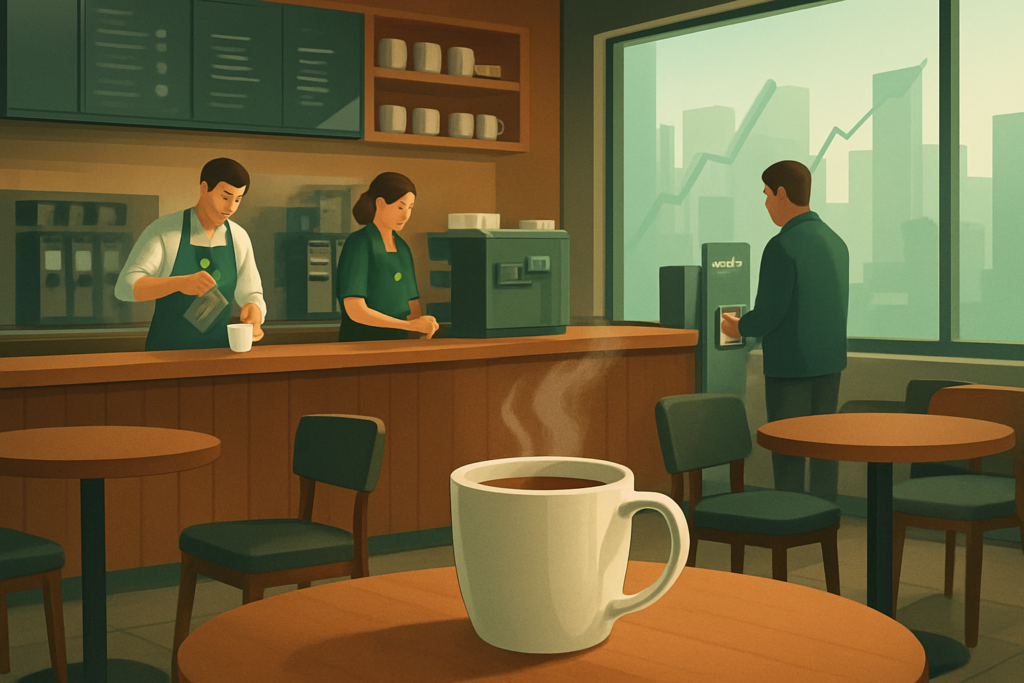
The following research feature analyzes Starbucks Corporation (NASDAQ: SBUX) as of January 28, 2026, following the release of its first-quarter fiscal 2026 results.
Introduction
On this Tuesday, January 28, 2026, Starbucks Corporation (NASDAQ: SBUX) finds itself at a pivotal crossroads. After several years of navigating leadership transitions, cooling consumer sentiment, and a hyper-competitive landscape in China, the Seattle-based coffee giant has finally provided investors with a reason for optimism. The latest earnings report, released today, highlights a significant turnaround: a 4% growth in U.S. same-store sales and a record-breaking global holiday season.
The "Back to Starbucks" strategy, spearheaded by CEO Brian Niccol, appears to be gaining traction. As the company works to reclaim its status as the world’s "Third Place," the markets are reacting with cautious enthusiasm. With the stock rallying nearly 16% year-to-date, this deep dive explores whether the current momentum is a sustainable long-term trend or a seasonal spike driven by holiday nostalgia.
Historical Background
Starbucks began in 1971 as a single shop in Seattle’s Pike Place Market, founded by Jerry Baldwin, Zev Siegl, and Gordon Bowker. Originally, the company did not sell brewed coffee; it was a retailer of high-quality whole beans. The modern Starbucks we know today was born in 1983, when Howard Schultz visited Milan and envisioned bringing the Italian espresso bar experience to the United States.
Schultz eventually acquired the company in 1987 and embarked on an unprecedented global expansion. Starbucks went public in 1992 (NASDAQ: SBUX) at $17 per share. Over the decades, the company transformed from a coffee shop into a cultural phenomenon. However, its history is also marked by cycles of "soul-searching." Howard Schultz returned as CEO twice (in 2008 and 2022) to course-correct after periods of brand dilution. The current era, led by Brian Niccol, represents the company's first major attempt to move beyond the "Schultz era" by blending operational discipline with the brand's heritage.
Business Model
Starbucks operates a multi-channel business model centered on "the coffee experience." Its revenue is derived from three primary segments:
- North America: The largest and most profitable segment, comprising company-operated and licensed stores in the U.S. and Canada.
- International: Focuses on growth markets, particularly China, Japan, and the UK. In early 2026, this segment underwent a massive structural change with the China business transitioning to a joint venture.
- Channel Development: Includes roasted whole bean and ground coffees, Seattle’s Best Coffee, and ready-to-drink beverages sold outside of company-operated stores through partnerships like the North American Coffee Partnership with PepsiCo (NASDAQ: PEP).
The company’s competitive edge lies in its "Starbucks Rewards" ecosystem, which now boasts over 35 million active members in the U.S. alone, providing a massive data-driven engine for personalized marketing and demand forecasting.
Stock Performance Overview
As of January 28, 2026, Starbucks’ stock performance reflects a narrative of recovery:
- 1-Year Performance: After a dismal 2024 and a flat 2025, the stock has returned roughly 2.3% over the last twelve months, with the bulk of those gains occurring in the first month of 2026.
- 5-Year Performance: The stock has underperformed the S&P 500, with a modest 9% total return. This reflects the "lost years" of 2022–2024 where store traffic stagnated.
- 10-Year Performance: Long-term investors have seen a total return of approximately 108%, averaging roughly 7.5% annually.
While the stock remains well below its 2021 all-time high of $113.56, its current price of ~$97.00 indicates that the "valuation floor" established during the 2024 lows has held firm.
Financial Performance
The Q1 FY2026 earnings report delivered the "beat" that Wall Street was looking for.
- Revenue: Consolidated revenue hit a record $9.92 billion, up 6% year-over-year.
- U.S. Same-Store Sales: A critical 4% increase, driven by a 3% rise in transaction volume—the first positive traffic growth in eight quarters.
- Global Holiday Demand: Management highlighted a "record revenue holiday launch week," fueled by the viral $29.95 "Bearista" glass cold cup and a simplified, high-margin holiday menu.
- Margins: However, profitability remains a concern. U.S. operating margins contracted to 11.9% (down from 16.7% a year ago). This was attributed to heavy investments in labor, new "Siren System" equipment, and higher coffee commodity costs exacerbated by new tariffs.
- EPS: Non-GAAP Earnings Per Share came in at $0.56, slightly below analyst expectations due to these margin pressures, but the market largely looked past this in favor of the strong top-line traffic growth.
Leadership and Management
The "Brian Niccol Era" is officially in full swing. Niccol, the former CEO of Chipotle Mexican Grill (NYSE: CMG), was brought in late in 2024 with a mandate to "fix the basics."
His leadership team has been restructured to prioritize operations over pure digital expansion. Key moves include the appointment of a new CTO to modernize "stone-age" supply chain systems and the introduction of "Coffeehouse Coaches"—a new layer of management focused solely on barista training and store culture. Niccol’s reputation for operational excellence is the primary reason the stock trades at a premium P/E multiple despite current margin compression.
Products, Services, and Innovations
Innovation at Starbucks in 2026 is less about "new flavors" and more about "operational throughput."
- The Siren System: This new equipment suite allows baristas to make complex cold drinks (which now account for 75% of sales) in less than 30 seconds.
- Cold Foam Dominance: Cold foam has become a billion-dollar platform, with the company introducing new "seasonal foam" flights that have driven record high-margin "add-on" sales.
- Wellness Category: Recognizing a shift in consumer trends, Starbucks recently launched a line of "Functional Espresso" drinks featuring adaptogens and plant-based protein, aimed at the Gen Z demographic.
Competitive Landscape
In 2026, Starbucks is fighting a two-front war.
- Domestic Challengers: Dutch Bros (NYSE: BROS) continues to steal share in the drive-thru and "beverage-as-a-treat" category. Dunkin' (private) remains the value-tier incumbent. Starbucks has responded by simplifying its menu to compete on speed while maintaining its premium "Third Place" environment to justify its $6.00 lattes.
- The China Battlefield: Starbucks has officially fallen to the #2 spot in China behind Luckin Coffee (OTC: LKNCY). While Luckin wins on price and sheer store count (26,000+), Starbucks is positioning itself as the "Premium/Luxury" choice, recently entering a 60/40 joint venture with Boyu Capital to de-risk its China operations.
Industry and Market Trends
Three macro trends are shaping the coffee industry today:
- The "Cold" Revolution: Hot coffee is increasingly a "legacy" product. The 2026 market is dominated by iced energy drinks, cold brews, and shaken espressos.
- Digital Friction: Consumers are increasingly frustrated with wait times. The industry is shifting toward "order-ahead only" stores in high-traffic urban areas.
- Sustainability: With climate change threatening Arabica bean yields, Starbucks has invested heavily in its "Innovation Farms" to develop heat-resistant hybrids, a move that provides long-term supply chain security.
Risks and Challenges
Despite the positive Q1 report, several "red flags" remain:
- Labor Unrest: The "Red Cup Rebellion" strikes by Starbucks Workers United have persisted into early 2026. A national framework contract is still not finalized, and legal costs related to Unfair Labor Practice charges continue to mount.
- Valuation: Trading at a trailing P/E of ~59x, the stock is "priced for perfection." Any slowdown in the 2026 turnaround could lead to a sharp correction.
- Supply Chain: Legacy technology in distribution centers still causes frequent "out-of-stock" issues for lids, syrups, and milks, which frustrates customers and caps growth.
Opportunities and Catalysts
- AI-Personalization: The company is rolling out "Deep Brew AI" to provide real-time, weather-and-location-based offers to Rewards members, which is expected to drive higher afternoon traffic.
- China Joint Venture (JV): By shifting to an asset-light model in China with Boyu Capital, Starbucks can repatriate cash more easily and focus on its high-margin licensing fees rather than the volatility of the Chinese real estate market.
- Investor Day 2026: Scheduled for tomorrow, January 29, this event is expected to provide the first clear long-term guidance under Brian Niccol, which could serve as a further catalyst for the stock.
Investor Sentiment and Analyst Coverage
Wall Street sentiment has shifted from "Hold" to "Overweight" in the last 30 days. Analysts at major firms like Goldman Sachs and JPMorgan have raised price targets to the $105–$110 range, citing the return of transaction growth as a "clear signal that the brand is healthy." Retail chatter on social platforms remains focused on the "Bearista" cup craze and the perceived improvement in store atmosphere.
Regulatory, Policy, and Geopolitical Factors
Geopolitics play a massive role in the 2026 Starbucks narrative.
- Tariffs: Recent trade policy shifts have introduced new tariffs on coffee imports from Brazil and Vietnam, putting pressure on gross margins.
- China De-risking: The move to a JV with Boyu Capital is widely seen as a proactive attempt to shield the brand from escalating U.S.-China tensions.
- Labor Policy: The National Labor Relations Board (NLRB) remains active in its oversight of Starbucks, and any federal policy shifts regarding unionization will directly impact the company's operating costs.
Conclusion
Starbucks Corporation enters 2026 with its strongest wind in years. The 4% U.S. same-store sales growth and record holiday demand prove that the brand’s core appeal remains intact despite a difficult few years. CEO Brian Niccol has successfully brought operational sanity back to the stores, and the "Back to Starbucks" strategy is yielding tangible results in foot traffic.
However, investors must weigh this growth against high valuation multiples and persistent margin contraction. While the "top-line" is booming, the "bottom-line" is being squeezed by labor tensions and global trade factors. For the long-term investor, Starbucks remains a cornerstone consumer discretionary play, but the next 12 months will be a test of whether Niccol can turn this "holiday spike" into a permanent "third-place" recovery.
This content is intended for informational purposes only and is not financial advice.