Date: January 28, 2026
Introduction
As we enter the first quarter of 2026, Northrop Grumman Corporation (NYSE: NOC) stands as a cornerstone of the Western defense architecture. Amidst a geopolitical landscape defined by the "New Cold War" and the rapid modernization of the U.S. Nuclear Triad, Northrop Grumman has transitioned from a traditional defense contractor to a high-rate industrial powerhouse. With its stock hovering near all-time highs and a record-breaking backlog of $95.7 billion, the company is currently in focus as the primary architect of the B-21 Raider stealth bomber and the Sentinel intercontinental ballistic missile (ICBM) program. This deep dive explores how NOC is navigating the complexities of multi-billion dollar cost restructurings while simultaneously accelerating production to meet an era of unprecedented global demand.
Historical Background
The lineage of Northrop Grumman is a tapestry of American aviation history. Founded by Jack Northrop in 1939, the company became synonymous with flying wing designs and pioneering stealth technology. The modern entity was forged through the 1994 merger of Northrop and Grumman Corporation, the latter of which was famed for the Apollo Lunar Module and the F-14 Tomcat.
Over the last decade, the company has undergone a massive transformation. The 2018 acquisition of Orbital ATK for $9.2 billion was a pivotal moment, catapulting Northrop into a leadership position in space systems and rocket propulsion. This strategic move allowed the company to capture the "high ground" in modern warfare, moving beyond aircraft into satellite constellations and missile defense, setting the stage for its current dominance in the space and nuclear sectors.
Business Model
Northrop Grumman operates a diversified but highly integrated business model centered on four primary segments:
- Aeronautics Systems: The crown jewel, housing the B-21 Raider and the Global Hawk/Triton uncrewed systems.
- Defense Systems: Focused on battle management, integrated air and missile defense, and high-rate ammunition production.
- Mission Systems: The "brains" of the operation, providing advanced sensors, cyber capabilities, and electronic warfare suites.
- Space Systems: Leading the charge in satellite constellations, launch vehicles, and the propulsion systems for the U.S. nuclear deterrent.
The company’s revenue is heavily weighted toward the U.S. Department of Defense (DoD), which provides a stable, multi-year visibility into earnings. However, it is increasingly expanding its international footprint as NATO and Indo-Pacific allies seek advanced stealth and sensor capabilities.
Stock Performance Overview
As of January 28, 2026, NOC has demonstrated exceptional resilience and growth. The stock is currently trading at approximately $678.74, representing a 1-year return of 34.6%. When looking at longer horizons, the performance is even more striking:
- 5-Year Return: ~130.5%, significantly outperforming the S&P 500's aerospace sub-index.
- 10-Year Return: 327.8%, a testament to the compounding power of the company's dividend growth and its strategic pivot toward high-priority national security programs.
The stock’s recent surge is attributed to the successful transition of the B-21 Raider into Low-Rate Initial Production (LRIP) and a broader realization among investors that Northrop’s "moat" in stealth and space is widening.
Financial Performance
Northrop’s Fiscal Year 2025 results, released yesterday, highlight a company in an aggressive growth phase.
- Revenue: $42.0 billion for FY2025, up from $39.3 billion in 2023.
- Earnings Per Share (EPS): Adjusted EPS of $26.34, beating analyst consensus.
- Free Cash Flow (FCF): $3.3 billion, marking a 26% year-over-year increase.
- Backlog: A record $95.7 billion, providing nearly 2.3 years of revenue visibility.
Management has guided for $43.5 – $44.0 billion in sales for 2026, indicating that the ramp-up in production for the B-21 and Space Development Agency (SDA) satellites is beginning to translate into top-line growth.
Leadership and Management
Under the leadership of Chair, CEO, and President Kathy Warden, Northrop Grumman has adopted a "Speed at Scale" philosophy. Warden, who took the helm in 2019, has been instrumental in navigating the company through the high-risk development phases of the B-21 Raider.
Her strategy focuses on "digital-first" engineering, which utilizes digital twins to reduce manufacturing errors and accelerate the deployment of new systems. The board’s reputation for disciplined capital allocation is strong, evidenced by their commitment to returning value to shareholders through dividends and buybacks while simultaneously funding the massive capital expenditures required for the B-21 and Sentinel programs.
Products, Services, and Innovations
Northrop’s portfolio is defined by "high-end" capabilities that few competitors can match:
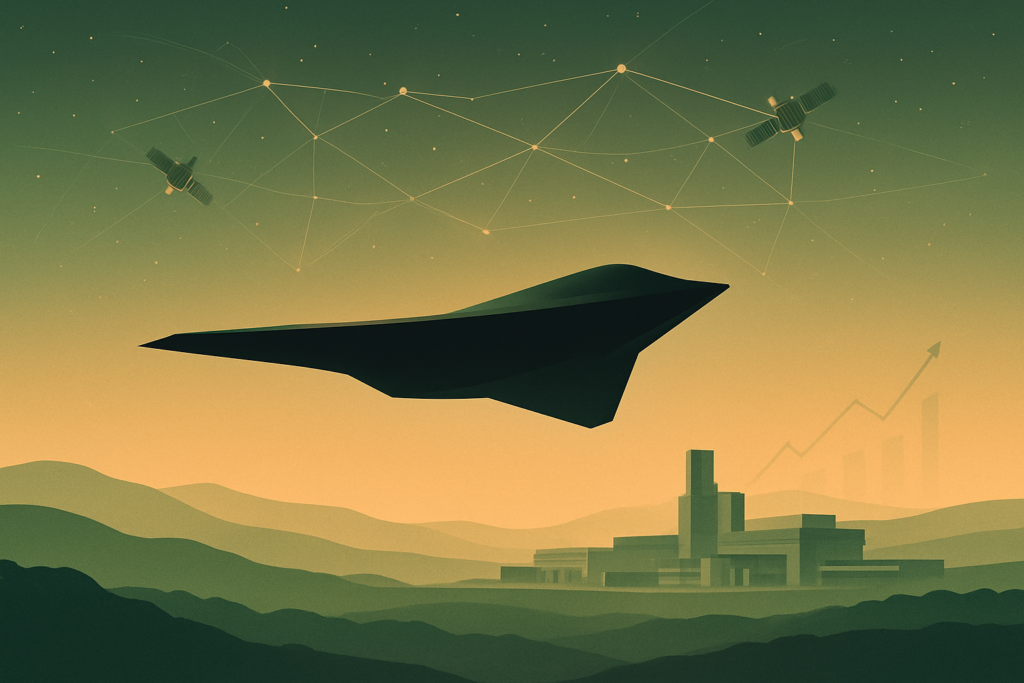
- B-21 Raider: The world’s first sixth-generation aircraft. It is currently in LRIP, with Northrop negotiating to accelerate production via a $4.5 billion congressional boost.
- Sentinel (GBSD): The replacement for the aging Minuteman III ICBM. Despite cost overruns, it remains a "must-have" for the Pentagon.
- Space Development Agency (SDA) Satellites: Northrop is building a mesh network of over 150 satellites for missile tracking and data transport.
- YFQ-48A "Talon": An uncrewed "loyal wingman" aircraft designed to fly alongside crewed fighters, showcasing the company’s push into autonomous systems.
Competitive Landscape
Northrop Grumman operates in an oligopolistic market alongside Lockheed Martin (NYSE: LMT), RTX Corporation (NYSE: RTX), and General Dynamics (NYSE: GD).
- Vs. Lockheed Martin: While Lockheed dominates the tactical fighter market with the F-35, Northrop holds the edge in long-range stealth bombers and nuclear propulsion.
- Vs. General Dynamics: GD is the king of the sea (submarines), but Northrop’s mission systems often provide the electronic "nervous system" for GD’s hulls.
- Competitive Edge: Northrop’s unique advantage lies in its "full-stack" nuclear capability—designing the missile (Sentinel), the bomber (B-21), and the secure communications that link them.
Industry and Market Trends
The defense sector is undergoing a paradigm shift from "low-rate, high-complexity" to "high-rate, resilient" manufacturing.
- Distributed Space Architectures: Moving away from a few large, expensive satellites to "constellations" of hundreds of smaller ones—a trend Northrop is leading via the SDA.
- Autonomous Systems: The shift toward uncrewed aerial vehicles (UAVs) to offset the high cost of crewed pilots.
- Hypersonic Defense: Developing the interceptors and sensors needed to track missiles traveling at Mach 5+.
Risks and Challenges
Despite the strong performance, Northrop is not without significant risks:
- Sentinel Cost Overruns: The program suffered a "critical" Nunn-McCurdy breach in 2024, with costs jumping to $141 billion. While the Pentagon has recertified the program, the resulting restructuring remains a drag on the Space Systems segment's margins.
- Fixed-Price Contracts: The B-21 Raider was initially bid as a fixed-price contract. High inflation and supply chain disruptions in previous years forced Northrop to take multi-billion dollar pre-tax charges. While the company is now in LRIP, any further production delays could impact profitability.
- High Capital Expenditure: To meet production goals, Northrop is investing $2–$3 billion in new facilities over the next few years, which could limit FCF growth in the short term.
Opportunities and Catalysts
- B-21 Acceleration Deal: An expected agreement by March 31, 2026, to use $4.5 billion in funding to speed up bomber production would be a major catalyst for the stock.
- Space Re-acceleration: 2026 is viewed as a "transition year" for Space Systems, with a forecasted re-acceleration in 2027 as high-volume satellite production matures.
- Indo-Pacific Demand: Australia and other allies have expressed interest in Northrop’s advanced uncrewed and mission systems, potentially opening new high-margin international revenue streams.
Investor Sentiment and Analyst Coverage
Wall Street remains largely bullish on NOC. Institutional investors, including Vanguard and BlackRock, maintain significant positions, viewing the company as a "defensive growth" play. Analyst sentiment is currently "Buy" to "Strong Buy," with price targets averaging $710. The primary "bear case" cited by analysts involves the potential for future cost overruns in the Sentinel program, but this is largely offset by the strategic necessity of the platform.
Regulatory, Policy, and Geopolitical Factors
Northrop’s fate is inextricably linked to U.S. federal policy. The 2026 defense budget has prioritized "Nuclear Modernization" and "Space Dominance," both of which play directly into Northrop’s strengths. Furthermore, geopolitical tensions in the South China Sea and Eastern Europe have created a "floor" for defense spending that is unlikely to drop, regardless of the political party in power. Congressional support for the B-21 remains nearly unanimous, providing a rare bipartisan shield for the program's funding.
Conclusion
Northrop Grumman is a company that has successfully positioned itself at the nexus of the most critical national security priorities of the 21st century. While the Sentinel program presents an ongoing execution challenge, the successful rollout and production of the B-21 Raider and the rapid expansion into low-earth orbit satellite constellations provide a formidable growth engine. For investors, Northrop Grumman offers a unique combination of a massive, stable backlog and exposure to high-growth technological frontiers in stealth and space. As the company moves to "accelerate at scale" through 2026, it remains a vital, if high-stakes, component of any long-term industrial or defense-oriented portfolio.
This content is intended for informational purposes only and is not financial advice. Today's Date: January 28, 2026.