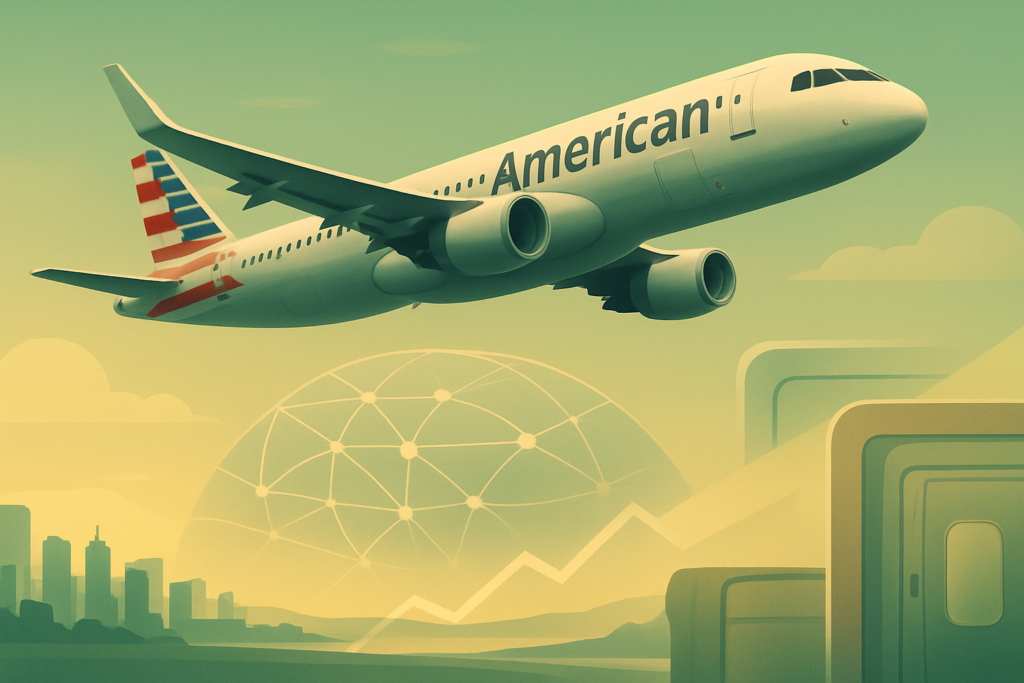
The airline industry has always been a game of razor-thin margins and massive capital requirements, but for American Airlines Group Inc. (NASDAQ: AAL), the last two years have been a defining chapter in its nearly century-long history. Today, as American enters 2026, the carrier is at a pivotal crossroads. After a tumultuous 2024 defined by a failed commercial strategy and a subsequent leadership shakeup, the airline has spent 2025 "righting the ship." With the recent inaugural flight of its long-awaited Airbus A321XLR and a balance sheet that is finally shedding its post-pandemic weight, American is attempting to prove it can compete not just on scale, but on profitability and premium experience.
Historical Background
The story of American Airlines is, in many ways, the story of American commercial aviation. While its roots trace back to a federation of 82 small airlines in the late 1920s, the modern carrier was forged under the leadership of Cyrus Rowlett (C.R.) Smith. Smith, who took the helm in 1934, transitioned the company from a mail-focused carrier to a passenger powerhouse, pioneering the Douglas DC-3—the first aircraft to make passenger travel profitable without government subsidies.
The decades that followed saw American innovate with the industry’s first automated reservations system (SABRE) and the first airline lounge (the Admirals Club). However, the most significant modern transformation occurred on December 9, 2013, when American Airlines merged with US Airways. This "merger of equals" created the world’s largest airline at the time and brought in a management team led by Doug Parker, which spent the next several years integrating complex systems and refreshing a massive, aging fleet.
Business Model
American Airlines operates a classic hub-and-spoke business model, centering its operations around massive domestic fortresses. Its primary hubs—Dallas/Fort Worth (DFW), Charlotte (CLT), and Miami (MIA)—provide dominant regional connectivity, while its presence in Chicago (ORD), Philadelphia (PHL), and Phoenix (PHX) rounds out a network that touches nearly every corner of North America.
The company’s revenue streams are increasingly diversified:
- Passenger Revenue: The core of the business, split between domestic (the bulk of its volume) and international routes.
- Loyalty Programs: The AAdvantage program is a crown jewel, generating high-margin revenue through credit card partnerships (notably with Citi and Barclays) and selling miles to third parties.
- Ancillary Services: Fees for baggage, seat selection, and on-board amenities have become essential margin boosters.
- Cargo: While a smaller percentage of total revenue, American maintains a robust global freight operation, particularly on trans-Atlantic and Latin American routes.
Stock Performance Overview
Investors in AAL have had a volatile decade. In 2018, the stock reached a post-merger peak in the high $50s, driven by record profits and industry optimism. However, the 2020 pandemic sent the stock into a tailspin, hitting a low of approximately $9.04 in May 2020 as travel halted and the company’s massive debt load became a primary concern.
Over the last five years, the stock has struggled to return to its pre-pandemic highs, often lagging behind peers Delta Air Lines (NYSE: DAL) and United Airlines (NASDAQ: UAL). As of early 2026, the stock has shown signs of a "recovery rally," rebounding from a 2023 low of $10.92 to trade in the $16-$19 range. This recent performance reflects cautious optimism that the airline has finally addressed its commercial missteps from 2024, when a shift away from traditional travel agencies caused a temporary loss in market share.
Financial Performance
American’s 2025 financial results tell a story of disciplined recovery. In 2024, the carrier reported record revenue of $54.2 billion, but profits were squeezed by rising labor costs and a failed direct-booking strategy.
In the first nine months of 2025, American reported an operating profit of approximately $1.015 billion. While this remains significantly lower than Delta’s $4.36 billion or United’s $3.33 billion over the same period, the trend is positive. The airline has successfully recaptured nearly 75% of the indirect corporate revenue it lost during its 2024 strategy shift.
Crucially, American has been aggressive in its deleveraging. By late 2024, the company reached its goal of reducing total debt by $15 billion from its 2021 peak—achieving this milestone a year ahead of schedule. As of January 2026, total debt stands at roughly $36.8 billion, with management aiming to drop below $35 billion by the end of 2027.
Leadership and Management
The current era of American Airlines is led by CEO Robert Isom, who took over from Doug Parker in 2022. Isom’s tenure has been characterized by a "back to basics" approach: focusing on operational reliability and debt reduction.
The most significant recent leadership move was the appointment of Nathaniel Piper as Chief Commercial Officer in late 2025. Piper, the former CEO of the oneworld alliance, was brought in to repair the fractured relationships with travel management companies and corporate travel departments—a direct response to the controversial "direct-only" strategy championed by his predecessor, Vasu Raja. This shift signals a return to a more balanced, multi-channel distribution strategy.
Products, Services, and Innovations
American is currently in the midst of a "premium-heavy" fleet refresh designed to narrow the margin gap with its competitors.
- The A321XLR: On December 18, 2025, American became the first U.S. carrier to fly the Airbus A321XLR, a long-range narrowbody aircraft. This jet allows American to fly "thin" trans-Atlantic routes (like Philadelphia to smaller European cities) with much lower operating costs than a widebody jet.
- Flagship Suites: The airline has introduced its new Flagship Suite product, featuring privacy doors and lie-flat beds, on its new Boeing 787-9 "Premium" aircraft.
- Fleet Modernization: American continues to boast one of the youngest fleets among the "Big Three" U.S. carriers, which provides a competitive edge in fuel efficiency and lower maintenance costs.
Competitive Landscape
The U.S. airline industry is a triopoly at the top, and American finds itself in a fierce battle:
- Delta Air Lines: The industry leader in premium revenue and customer loyalty. Delta’s operational "moat" and high-margin credit card income remain the benchmark American is chasing.
- United Airlines: United has aggressively expanded its international footprint and premium seating, often outperforming American on long-haul profitability.
- Low-Cost Carriers (LCCs): While American competes with Southwest (NYSE: LUV) and Spirit (NYSE: SAVE) on price, its strategy has shifted toward using its "Basic Economy" product to protect its hubs while luring high-value travelers into its premium cabins.
Industry and Market Trends
The airline sector in 2026 is grappling with several macro shifts:
- The Premium Pivot: Travelers are increasingly willing to pay for more than just a seat. Premium economy and business class demand have remained resilient even as economy fares have seen some pricing pressure.
- Sustainability: The industry is under pressure to adopt Sustainable Aviation Fuel (SAF). American has set ambitious goals but faces a supply-constrained market for green fuels.
- Supply Chain Constraints: Delays in aircraft deliveries from Boeing (NYSE: BA) have hampered growth plans for all major carriers, forcing American to keep some older aircraft in service longer than originally planned.
Risks and Challenges
Despite the recovery, several headwinds remain:
- Debt Load: While declining, American’s debt remains the highest in the industry, making it more sensitive to interest rate fluctuations.
- Labor Costs: In late 2024, American’s flight attendants ratified a deal worth $4.2 billion, including an immediate 20% pay raise. These increased fixed costs require the airline to maintain high load factors and pricing power.
- Economic Sensitivity: As a cyclical business, any broader economic slowdown in 2026 could quickly dampen the "revenge travel" tailwinds that have supported the industry since 2022.
Opportunities and Catalysts
- A321XLR Expansion: In March 2026, the A321XLR will begin international service (JFK to Edinburgh). If successful, this could unlock a new level of profitability on secondary international routes.
- Corporate Recovery: As Nathaniel Piper’s new commercial strategy takes hold, a full return of corporate travel to pre-2024 levels could provide a significant boost to the bottom line.
- Credit Rating Upgrades: If American continues its debt reduction pace, a potential upgrade to a BB credit rating could lower its cost of capital and attract more institutional investors.
Investor Sentiment and Analyst Coverage
Wall Street remains "cautiously optimistic" on AAL. Most analysts hold a "Hold" or "Moderate Buy" rating. The consensus view is that while American has the best domestic network and a young fleet, it must prove it can generate the same level of free cash flow as Delta and United before it sees a significant valuation re-rating. Institutional investors have noted the improved operational reliability—American led the industry in completion factor for several months in 2025—as a key sign of management's focus.
Regulatory, Policy, and Geopolitical Factors
The Department of Transportation (DOT) has become increasingly active in 2024 and 2025, focusing on passenger rights and fee transparency. American must navigate these new regulations while also managing the geopolitical risks of its international network. Tensions in the Middle East and Eastern Europe continue to impact fuel prices and flight routing, while trade relations with China dictate the pace of the slow-to-recover trans-Pacific market.
Conclusion
American Airlines enters 2026 as a leaner, more focused version of its former self. By moving past the commercial experiments of 2024 and doubling down on its "premium" fleet strategy, the carrier is finally beginning to close the gap with its peers. For investors, the story is one of execution: Can American maintain its operational excellence while continuing to slash its debt?
The inaugural international flights of the A321XLR this spring will be a litmus test for the company’s new direction. While risks regarding labor costs and the macroeconomy persist, American’s younger fleet and dominant domestic hubs provide a solid foundation. Investors should watch for the Q1 2026 earnings report to see if the revenue-management changes under Nathaniel Piper are bearing fruit.
This content is intended for informational purposes only and is not financial advice