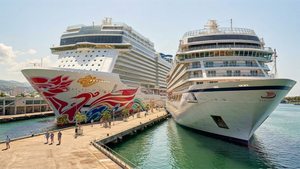
In Wednesday’s market action, Royal Caribbean (RCL) and its two major competitors, Carnival (CCL) and Norwegian Cruise Lines (NCLH), were all down on the day, with RCL down the most, off 4.68%.
Over the past five trading days, the three stocks' share prices have lost an average of 10.4%, with Royal Caribbean losing the least. It’s my favorite of the three long-term, so that’s good news.
The bad news is that cruise operators live and die with oil prices. Virtually nothing affects their profitability more than high oil prices. The Iran war has put the stocks on the defensive. While I have no idea how long it will last, I do know that the longer it goes on, the worse it will be for shareholders.
In yesterday’s unusual options activity, Royal Caribbean had two options in the top 20, with the seventh- and 17-highest Vol/OI (volume-to-open-interest ratios).
If you bought RCL stock five years ago, or more importantly, at the March 2020 lows, and are still long and strong, the cruise operators’ two unusually active options are precisely what you need.
Here’s why.
The Unusual Options Activity in Question
 The two call and put options had significant volumeyesterday on a relative basis. The total volume of 52,772 was 4.1 times its 30-day average; the 12,312 in volume from the two accounted for nearly one-quarter of the day’s total and almost as much as its 30-day average. Importantly, the stock’s daily options volume was the second-highest in the past 12 months.
Here we’ve got a short-term call with a 44 DTE (days to expiration) and a long-term put with a 106 DTE. Based on the above, the call was 18.38% OTM (out-of-the-money), while the put was slightly ITM (in-the-money) at 0.97%.



Looking at yesterday's trade data, there was an 8,000-contract trade at 11:49 in the morning, accounting for all but seven of the April 17 $340 strike calls. As for the June 18 $290 put, there was a 4,300-contract trade at precisely the same time, accounting for all but five of the puts for that strike price.
The trading suggests a Dynamic Collar: you own the stock, sell the $340 call for income, and buy the $290 put for downside protection. The call has a near-term DTE, while the put’s expiration is longer term. Think of it as combining a Married Put with a Covered Call.
Let’s Assume You Bought RCL at the March 2020 10-Year Low
Royal Caribbean’s 10-year low was on March 1, 2020, at $19.25. Let’s assume you timed the markets like nobody’s business and bought at the absolute bottom. Let’s also assume that you were still holding on Feb. 10 when it hit $356.39, its 2026 high. You thought about selling some or all of your stock to take profits, but decided to let your winner run.
Hindsight is 20/20, but you’ve given back about $70 a share in gains in the three weeks since. Sensing that the Iran war could go on for months, if not years, you’re desperate to protect your healthy gains. That’s where the dynamic collar comes in.
The two images below are based on early Thursday trading as I write this.
 The net debit or cost of the $290 married put is $318.30 [$287 share price + $31.30 ask price].

The premium for selling the $340 call is $2.65, an annualized return of 7.9% [$2.65 [bid price premium / $287 share price - $2.65 bid price premium * 365 / 43 DTE].
In the case of the married put, the most you can lose is $2,830 ($31.30 ask price - ($290 strike - $287 share price) * 100] or 9.9% of the share price. Add in the $2.65 premium from the covered call, and the most you can lose falls to $2,565 [$28.30 - $2.65] or 8.9%.
That’s the price of protection.
Why Institutions Use This Strategy
The one downside of the covered call is that you cap your upside potential at the strike price. So, in this example, if the shares are above $340 in April, they will likely be assigned to the buyer of the call.
That’s not a big deal if you bought the shares in March 2020 for $19.25. However, if you bought at $287, your maximum gain would be $2,435 [$340 share price - $287 purchase price - $31.30 put ask price + 2.65 call bid price], or 8.5% [72.2% annualized].
While a 72% annualized return isn’t the worst result by any means, you did the dynamic collar because you’re bullish about RCL stock over the long term, not just the next six weeks.
Institutions like the one that sold 8,000 $340 short calls and bought 4,300 long puts use dynamic collars to keep the party going.
For example, let’s say RCL stock rallies to $320 over the next 2-3 weeks, with 2-3 weeks to expiration. They might roll the call to a higher strike with an expiration in late May or into June. If the stock falls well below $287, it might roll the put to a lower strike with an expiration in July or August. If the share price doesn’t really move, you might roll both the call and the put.
This collar strategy is dynamic, allowing you to roll (pun intended) with the market action, knowing that Royal Caribbean is an excellent stock to hold for the long term. It’s especially useful if you’ve owned the shares for a long time and don’t want to realize your gains just yet.
On the date of publication, Will Ashworth did not have (either directly or indirectly) positions in any of the securities mentioned in this article. All information and data in this article is solely for informational purposes. For more information please view the Barchart Disclosure Policy here.
More news from Barchart